


We may not have the course you’re looking for. If you enquire or give us a call on 01344203999 and speak to our training experts, we may still be able to help with your training requirements.
Essential Facilitation Skills With Examples and Practical Tips
ByThe Knowledge AcademyLast updated on: 19 November 2026
Explore essential facilitation skills, including active listening, communication, impartiality and conflict resolution. Learn how these abilities help you navigate discussions, manage group dynamics, and encourage participation, with practical examples and tips to improve your facilitation skills.
The Gist
1. Facilitation skills help professionals communicate clearly and guide meaningful discussions.2. Active listening, impartiality and group dynamics management encourage balanced participation.3. Emotional intelligence and conflict resolution skills help address disagreements constructively.4. Time management, adaptability and group decision-making skills support clear outcomes.5. Practice, feedback and reflection help professionals strengthen their facilitation skills.
A meeting starts with ten participants, but only two people contribute ideas. The discussion moves from one topic to another, disagreements arise, and the group finishes without a clear decision. What could have made the meeting more productive? The answer often lies in effective facilitation skills.
Facilitation skills help professionals guide discussions, encourage participation and keep groups focused on shared objectives. Whether you are leading a workshop, managing a team meeting or supporting a collaborative project, these skills can make a significant difference. In this blog, we'll explore the essential facilitation skills and practical ways to improve them.
Top Facilitation Skills
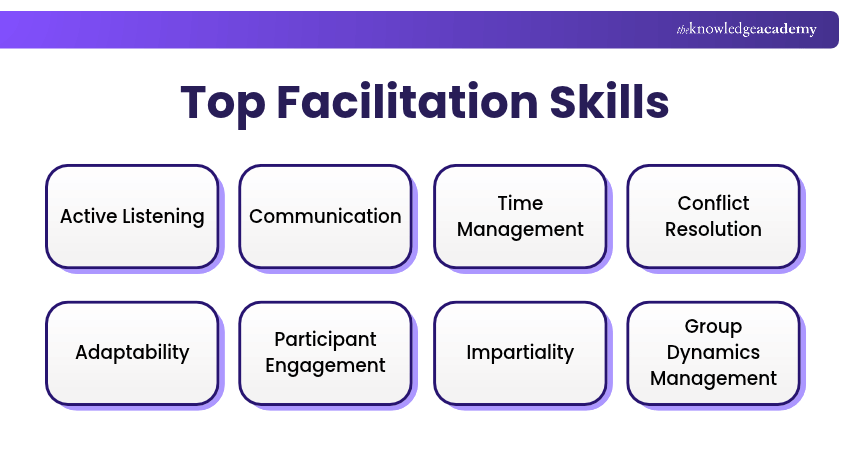
Successful facilitators use a combination of interpersonal, organisational and analytical skills to manage discussions and support group collaboration. Let's explore these skills in detail:
1) Active Listening
Active listening involves paying close attention to participants, understanding their viewpoints and responding thoughtfully. It helps facilitators recognise concerns, clarify information and ensure that individuals feel heard. Facilitators can demonstrate active listening by paraphrasing responses, summarising important points and asking follow-up questions.
For example, when two team members present different approaches to a project, a facilitator can summarise both perspectives before inviting further discussion. This helps establish a shared understanding without favouring either viewpoint.
2) Communication
Clear communication helps facilitators explain session objectives, provide instructions and guide discussions effectively. They should use concise language, explain unfamiliar terms and adapt their communication style to the group.
Clear transitions between activities also help participants follow the session. For example, before starting a brainstorming exercise, a facilitator can explain its purpose, time limit and participation rules so everyone understands how to contribute.
3) Time Management
Time management helps facilitators keep meetings and workshops within their scheduled duration while ensuring that important topics receive adequate attention. It involves planning agendas, allocating realistic time limits and recognising when discussions move away from the main objective.
They can summarise key points, redirect attention or adjust the schedule when necessary. For example, if a discussion exceeds its allocated time, the facilitator may identify unresolved questions, agree on follow-up actions and move to the next agenda item.
Pro Tip
When a useful idea falls outside the current agenda, record it in a visible parking lot rather than interrupting the discussion. Review these items towards the end of the session and assign follow-up actions where necessary.
4) Conflict Resolution
Conflict resolution involves addressing disagreements constructively while maintaining a respectful discussion environment. Facilitators should listen to the perspectives involved, identify underlying concerns and encourage participants to discuss possible solutions.
They must remain calm and avoid taking sides. For example, when two departments disagree about resource allocation, a facilitator can help them clarify their priorities, identify shared objectives and explore alternatives that address the main concerns.
5) Adaptability
Adaptability allows facilitators to adjust their approach when circumstances, participant needs or group dynamics change. Even well-planned sessions may require modifications when activities do not produce the expected results.
An adaptable facilitator can change the format, pace or discussion technique while keeping the session's objectives in mind. For example, if participants struggle with a large-group discussion, the facilitator may divide them into smaller groups to encourage more focused conversations.
6) Participant Engagement
Participant engagement involves keeping individuals interested and meaningfully involved throughout a session. Facilitators must recognise when attention decreases and adjust activities to encourage participation. Techniques such as interactive exercises, short reflection periods, polls and small-group discussions can help participants contribute.
However, facilitators should select activities based on the session's purpose. For example, during a lengthy workshop, a facilitator may introduce a short, paired discussion to give participants an opportunity to reflect on the ideas presented.
Learn to turn individual strengths into collective success with the Team Development Training – Join now!
7) Impartiality
Impartiality involves treating participants and their perspectives fairly without favouring individuals or predetermined outcomes. Facilitators should recognise personal biases, manage discussions fairly and be transparent about any involvement in the outcome.
However, impartiality does not mean allowing disruptive behaviour or unequal participation. For example, if one participant repeatedly interrupts others, the facilitator can establish speaking turns to ensure everyone has an appropriate opportunity to contribute.
Bonus Tip
When participants struggle to contribute, try the 1-2-4-All technique. Begin with individual reflection, move into pairs and then groups of four, before inviting the whole group to share ideas. This encourages wider participation and helps develop ideas collaboratively.
8) Group Dynamics Management
Group dynamics management involves understanding how participants interact, influence one another and contribute to collective discussions. Facilitators should recognise participation patterns, manage dominant voices and create opportunities for quieter members to contribute.
For example, if several participants hesitate to speak during an open discussion, the facilitator might introduce individual reflection followed by small-group sharing. This can create additional opportunities for participation without putting individuals under unnecessary pressure.
9) Facilitating Group Decision-making
Facilitating group decision-making involves helping participants evaluate alternatives, understand different priorities and reach decisions or recommendations through an agreed process. Facilitators may use techniques such as prioritisation matrices, voting, structured discussions or consensus-building activities.
Their responsibility is to clarify the decision-making process rather than determine the outcome themselves. For example, when a team must select a new project management tool, the facilitator can help members establish evaluation criteria, compare options and document the final decision.
10) Self-awareness
Self-awareness helps facilitators recognise how their assumptions, communication style and emotional reactions may influence group discussions. A self-aware facilitator reflects on personal strengths, weaknesses and potential biases.
This makes it easier to recognise when their behaviour may unintentionally discourage participation or influence the discussion. For example, a facilitator who naturally prefers quick decisions may need to allow additional discussion time when participants require more information before reaching an agreement.
Learn how to guide discussions and achieve meaningful outcomes with the Facilitation Skills Foundation and Practitioner Training – Sign up now!
11) Questioning Techniques
Questioning skills help facilitators encourage discussion, clarify ideas and explore problems without directing participants towards predetermined answers. Different question types can be used depending on the situation:
a) Open-ended Questions: Encourage detailed responses, such as "What challenges are affecting the project?"
b) Clarifying Questions: Help establish meaning, such as "Could you explain what you mean by limited resources?"
c) Probing Questions: Explore underlying reasons, such as "What factors contributed to this outcome?"
d) Reflective Questions: Encourage evaluation, such as "What would you approach differently next time?"
Expert Insight
Combining brainstorming and evaluation too early can discourage participants from sharing unconventional ideas. Facilitators should first collect suggestions without immediate criticism, then guide the group through a separate evaluation stage using agreed criteria. This creates space for exploration while keeping decision-making structured.
12) Cultural Awareness and Inclusivity
Cultural awareness and inclusivity involve recognising that participants may have different communication styles, experiences and expectations. Facilitators should use respectful language, avoid assumptions and consider accessibility needs when planning activities.
They must also recognise accessibility and communication needs when planning activities. For example, in a workshop involving participants from different backgrounds, the facilitator may combine spoken discussion with written contributions to accommodate different participation preferences.
13) Technology Proficiency
Technology proficiency helps facilitators use digital tools to support meetings, workshops and collaborative activities, particularly in virtual or hybrid sessions. Facilitators should understand relevant features such as screen sharing, breakout rooms, digital whiteboards, polls and collaborative documents.
They should also prepare for common technical difficulties. For example, during a remote workshop, a facilitator might use a shared digital board to collect ideas and organise them into themes before guiding the group through a prioritisation activity.
14) Emotional Intelligence
Emotional intelligence involves recognising, understanding and managing one's own emotions while responding thoughtfully to the emotions expressed by others. Facilitators use empathy, self-regulation and social awareness to maintain respectful discussions, particularly when participants feel frustrated, uncertain or concerned.
For example, if a participant becomes visibly frustrated during a discussion, the facilitator can acknowledge the concern, clarify the issue and guide the conversation towards a constructive response.
Learn how to navigate complex discussions and guide teams towards meaningful outcomes with the Facilitation Skills Practitioner Training – Join today!
How to Improve Your Facilitation Skills?
Developing facilitation skills requires practice, reflection and a willingness to adapt. The following steps can help strengthen your facilitation abilities:
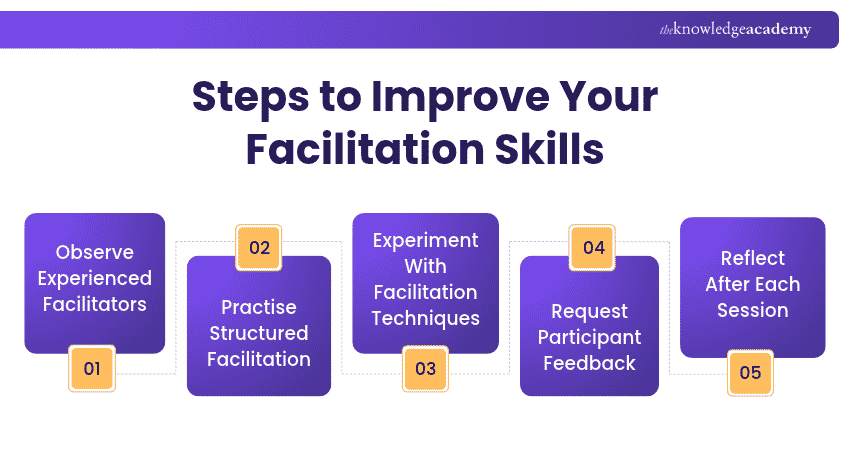
1) Observe Experienced Facilitators
Pay attention to how experienced facilitators introduce activities, manage group interactions and handle difficult discussions. Notice the language they use, how they encourage participation and how they bring sessions to a conclusion. These observations can help you identify techniques worth practising in your own meetings or workshops.
2) Practise Structured Facilitation
Begin with smaller meetings or team discussions that have clear objectives and defined outcomes. Prepare an agenda, explain the purpose of each activity and monitor how the group progresses. This helps develop your confidence in managing the different stages of a facilitated session.
3) Experiment With Facilitation Techniques
Different activities suit different groups and objectives. Practise techniques such as brainstorming, round-robin discussions, small-group activities and structured prioritisation. Evaluate whether each technique helps participants contribute and supports the intended outcome.
4) Request Participant Feedback
Ask participants whether the session objectives were clear, the activities were useful, and they had suitable opportunities to contribute. Use specific feedback questions rather than relying entirely on general satisfaction ratings. This can help identify improvements in session structure, communication and participation.
5) Reflect After Each Session
Review what worked well, which challenges occurred and how effectively the group achieved its objectives. Consider whether the agenda was realistic, the chosen methods were suitable, and the agreed actions were documented. The International Association of Facilitators (IAF) competency framework also recognises continuous reflection and professional development.
Before You Facilitate: A Quick Session Checklist
Use this checklist before your next meeting or workshop to prepare the session more effectively:□ Define the main objective and expected outcome.□ Identify participants and their relevant needs.□ Prepare a realistic agenda and time allocations.□ Choose activities suitable for the group and objective.□ Decide how contributions, decisions and actions will be recorded.□ Plan how to gather feedback and communicate follow-up actions.

The Knowledge Academy develops accessible learning content across Project Management, IT, Cybersecurity, Data Science, Business Analysis, HR, Accounting and Finance, Leadership and Health and Safety. Its resources combine subject research with clear explanations to help professionals build practical knowledge across a wide range of disciplines.
View Detail

 If you wish to make any changes to your course, please


