




We may not have the course you’re looking for. If you enquire or give us a call on +33 805638382 and speak to our training experts, we may still be able to help with your training requirements.
Home
 Resources
Human Resources
Difference Between Personnel Management and Human Resource Management
Resources
Human Resources
Difference Between Personnel Management and Human Resource Management
Resources
Human Resources
Difference Between Personnel Management and Human Resource Management
Difference Between Personnel Management and Human Resource Management
ByThe Knowledge AcademyLast updated on: 23 September 2026
Explore the distinct realms of personnel management and human resource management and unravel their differences and commonalities. By the end, you'll have a clear perspective on these essential aspects of workforce management.
Personnel management and Human Resource Management (HRM) are two approaches to managing employees within an organisation. Although they share several responsibilities, they differ in scope, emphasis and strategic involvement.
Personnel management focuses on administrative tasks, while HRM aligns with an organisation's goals. Want to know how? Explore the difference between personnel management and human resource management with this blog. Also, learn about their characteristics, roles, and responsibilities. Let's dive in!
What is Personnel Management?
Personnel management is an established approach to managing employees within an organisation, focusing on various administrative tasks and ensuring the welfare and satisfaction of employees. It encompasses a range of activities aimed at the following:
a) Recruiting
b) Selecting
c) Training
d) Evaluating
e) Maintaining employee relations
Recruitment is a key aspect of personnel management. Personnel Managers are responsible for the following:
a) Identifying job vacancies
b) Developing job descriptions
c) Advertising openings
d) Screening applications
e) Conducting interviews
f) Coordinating hiring decisions
They aim to attract and select individuals with the necessary skills and qualifications to contribute to the organisation's success.

What is Human Resource Management?
Human Resource Management (HRM) is a comprehensive approach to managing employees within an organisation. It encompasses the following:
a) Strategic planning
b) Recruitment
c) Employee development
d) Engagement
e) Compensation management
f) Employee relations
HRM combines operational people management with longer-term workforce planning and alignment with organisational objectives.
Strategic planning is a key component of HRM, where HR Managers work closely with top-level management to develop HR strategies that support the organisation's overall strategic goals. This involves analysing the workforce needs, identifying skills gaps, and planning for recruitment, talent development, and succession.
HRM also covers employee engagement, compensation, and employee relations. This includes supporting a positive work environment, managing pay and benefits, addressing workplace concerns, and maintaining effective communication between employees and management.
Difference Between Personnel Management and Human Resource Management
Personnel management and human resource management are two distinct approaches to managing employees within an organisation. While they share similarities in their focus on employee welfare, there are significant differences between the two. Some of these differences are elaborated as follows:
1) Objectives
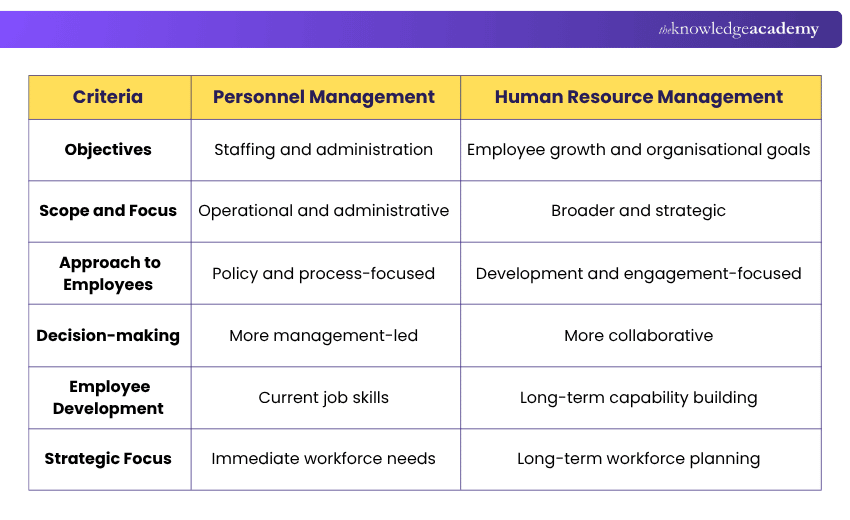
Personnel Management traditionally focuses on ensuring that an organisation has the employees it requires and that essential workforce activities, such as recruitment, compensation, employee records, training and employee relations, are effectively administered.
HRM includes many of these responsibilities but generally takes a broader perspective. It considers how recruitment, employee development, performance, engagement and workforce planning can support both organisational objectives and effective people management over the longer term.
2) Scope and Focus
Personnel management primarily deals with administrative tasks related to employees. It involves activities such as recruitment, selection, training, performance evaluation, and employee relations. However, the main focus is on ensuring compliance with employment laws, handling payroll and benefits, and maintaining employee satisfaction. Personnel management traditionally places greater emphasis on immediate operational and administrative needs.
In contrast, HRM takes a broader and more strategic approach. It encompasses not only administrative functions but also aligning HR practices with the overall goals of the organisation. HRM emphasises long-term planning, talent development, strategic workforce management and fostering a positive work culture. HR professionals may participate in strategic decision-making and contribute to organisational culture, workforce planning and long-term people strategy.
3) Approach to Employees
Personnel management traditionally focuses on managing employees through established policies, procedures, and day-to-day workforce practices. The role of Personnel Managers is often transactional, focusing on daily operations, including administrative tasks, enforcing policies and procedures, and addressing employee relations issues.
On the other hand, HRM places greater emphasis on employees as contributors to organisational performance and on their development, engagement, and growth. HR Managers aim to create an environment where employees feel motivated and supported in their roles. They focus on strategic talent management, aligning employee goals with organisational objectives, and supporting a positive work culture.
Elevate your HR career to new heights with our Certified HR Manager Course – Register today!
4) Decision-making Authority
Personnel management typically follows a more management-led decision-making approach. Key decisions regarding employee matters, such as policies, benefits and compensation, are often made by senior management. Personnel Managers are responsible for implementing and communicating these decisions to employees.
In HRM, decision-making may be shared among HR Managers, senior management and line managers depending on the organisation’s structure. HR Managers may contribute to recruitment, training, talent development, and employee engagement decisions while also advising senior leadership on HR strategy and practices.
Key Insight
The distinction between personnel management and HRM is not always absolute. Modern organisations may combine administrative personnel responsibilities with strategic HR activities within the same function or team.
5) Employee Development
Personnel management focuses on training employees to perform their current job responsibilities adequately. Training programmes are typically job-specific and skill-oriented, addressing immediate needs. The emphasis is on providing employees with the necessary skills to carry out their assigned tasks effectively.
In HRM, employee development is often viewed as a long-term investment. HR Managers may emphasise continuous learning, career development, mentoring, and opportunities to build skills beyond employees’ current roles. This broader approach can help prepare employees for future responsibilities and organisational needs.
6) Strategic Focus
Personnel management traditionally places greater emphasis on day-to-day operations and immediate workforce requirements, with less focus on long-term workforce strategy. Personnel Managers may primarily handle compliance, employee relations issues, and operational workforce needs.
HRM, however, takes a more proactive and strategic approach. HR Managers may participate in strategic planning, align HR practices with organisational goals, and anticipate future workforce needs. They can also analyse skills requirements and develop people strategies that support the organisation’s long-term direction.
Strengthen your strategic HR capabilities and align people practices with organisational goals through our HR Strategy Training – Register now!
Quick Check: Which Approach Does It Resemble?
1) Managing payroll, employee records and immediate administrative issues→ Personnel management
2) Planning future workforce capability and aligning people strategy with long-term business goals→ Human resource management
3) Recruitment, training and employee relations→ Both approaches
Similarities Between Personnel Management and Human Resource Management
The major similarities between personnel management and human resource management are as follows:
a) Both support effective workforce management and organisational performance.
b) They are both responsible for recruiting people with appropriate skills and knowledge to fulfil the criteria.
c) Personnel Management and HRM are not necessarily separate departments operating together. They focus on how to help the company achieve its goals, complete its mission, and efficiently carry out operations.
d) Despite having different approaches to fulfil these objectives, human resource management and personnel management focus on relieving the pain points of the organisation, helping it to develop efficient and effective business operations.
Strengthen your leadership capabilities and manage people with greater confidence through our HR Leadership Courses – Sign up today!
Keep This in Mind
1) Personnel management and HRM share several people management responsibilities.2) Personnel management traditionally focuses more on administrative and operational needs.3) HRM generally takes a broader approach that includes development and workforce planning.4) Both approaches can support recruitment, training and employee relations.5) Organisations may combine elements of both depending on their structure and workforce needs.

The Knowledge Academy develops accessible learning content across Project Management, IT, Cybersecurity, Data Science, Business Analysis, HR, Accounting and Finance, Leadership and Health and Safety. Its resources combine subject research with clear explanations to help professionals build practical knowledge across a wide range of disciplines.
View Detail

 If you wish to make any changes to your course, please


