


We may not have the course you’re looking for. If you enquire or give us a call on 01344203999 and speak to our training experts, we may still be able to help with your training requirements.
CAPM® vs PMP® Certification: Key Differences Explained
ByVidhya NairLast updated on: 17 October 2026
CAPM® and PMP® are project management certifications designed for different experience levels. This blog compares their eligibility, exam formats and career benefits to help you choose the certification that aligns with your goals.
Picture this: you're enjoying your coffee when a colleague casually mentions, "I finally got my PMP certification!" You congratulate them, of course, but a thought immediately crosses your mind: "Should I get PMP certified too? Or would CAPM be a better option?" And just like that, your peaceful coffee break turns into a full-blown career planning session!
But there's a reason this decision deserves some thought. Although CAPM® and PMP® are offered by the same organisation, they're designed for professionals at different career stages. Their eligibility requirements, exam structures, and professional benefits aren't identical. Understanding these differences can help you choose a certification that matches your experience rather than simply following someone else's career path.
What is PMP® Certification?
The Project Management Professional (PMP)® certification is a globally recognised credential for experienced project management professionals. Obtaining the PMP® certification shows that you meet PMI's experience requirements and have demonstrated your project management knowledge through the examination.

Differences Between CAPM® and PMP®
Pursuing PMP® certification involves more eligibility requirements than CAPM® certification. Both certifications differ in experience, education and exam structure, as shown in the tables below.
a) CAPM and PMP Eligibility Requirements
CAPM® and PMP® have different eligibility requirements based on education, professional experience and training. The table below compares these requirements.
|
Criteria |
CAPM |
PMP |
|
Project Management Experience |
No prior project management experience required. |
2 years (GAC-accredited degree), 3 years (bachelor’s), 4 years (eligible associate’s) or 5 years (secondary diploma), with non-overlapping experience gained within the last 10 years. |
|
Educational Qualification |
Secondary degree (high school diploma or equivalent), minimum age of 18 years. |
Secondary diploma, eligible associate's qualification, bachelor's degree or higher. |
|
Formal Training Required |
At least 23 hours of project management education. |
35 hours of qualifying project management training or an active CAPM® certification. |
|
Renewal Cycle |
Every 3 years |
Every 3 years |
|
Renewal Criteria |
Earn 15 PDUs every three years, including at least 9 Education PDUs, and pay the renewal fee. |
Earn 60 PDUs every three years, including at least 35 Education PDUs, and pay the renewal fee. |
b) Exam Format
Understanding the exam format can help you plan your preparation more effectively. The following table compares the question types, duration and assessment formats of CAPM® and PMP®.
|
Criteria |
CAPM |
PMP |
|
Total Number of Questions |
150 |
180 |
|
Exam Pattern |
Multiple-choice, drag-and-drop and interactive questions. |
Multiple-choice, multiple-response, scenario-based and interactive questions, including enhanced matching and drag-and-drop formats. |
|
Total Time |
180 minutes |
240 minutes |
|
Pass Percentage |
No fixed passing percentage publicly disclosed by PMI. |
No fixed passing percentage publicly disclosed by PMI. |
|
Exam Mode |
Online or Pearson VUE test centre. |
Online or Pearson VUE test centre. |
c) Estimated Exam Preparation Time
Begin by reviewing the exam content and creating a study schedule based on your availability. A structured approach can help you cover the required topics and track your progress. The following table compares the preparation requirements for both exams.
|
Criteria |
CAPM® |
PMP® |
|
Preparation Duration |
Varies according to familiarity with project management concepts and individual study schedules. |
Varies according to professional experience, existing knowledge, and study schedules. |
|
Exam Content |
Based on the CAPM Examination Content Outline, covering project management fundamentals, predictive approaches, Agile and Business Analysis. |
Based on the 2026 PMP Exam Content Outline: People (33%), Process (41%) and Business Environment (26%), emphasising business value, stakeholders, AI and sustainability. |
|
Study Requirements |
No fixed total study hours prescribed by PMI; at least 23 hours of project management education are required for CAPM® eligibility. |
No fixed total study hours prescribed by PMI; generally, 35 hours of qualifying project management training are required for eligibility. |
Benefits of CAPM® and PMP® Certifications
CAPM® and PMP® certifications can strengthen professional credibility and support career development. However, their benefits differ based on your knowledge and experience.
CAPM® Certification Benefits
1) Foundational Knowledge: Demonstrates an understanding of essential project management principles and concepts.
2) Professional Credibility: Provides a recognised credential that can demonstrate commitment to developing project management expertise.
3) Career Opportunities: May support entry-level project management opportunities.
4) Career Development: Builds a foundation for further learning and pursuing advanced certifications.
PMP® Certification Benefits
1) Professional Expertise: Validates knowledge and experience in leading and managing projects.
2) Industry Recognition: Demonstrates project management competencies through a globally recognised certification.
3) Career Opportunities: May support progression into experienced project management and leadership roles.
4) Practical Application: Demonstrates the ability to apply project management knowledge across predictive, agile and hybrid approaches.
Trainer Tip
Before answering a project-related exam question, identify whether the scenario follows a predictive, agile or hybrid approach. The most appropriate response can depend on how the project is organised, how changes are managed, and how the team delivers work.
Tips to Choose Between CAPM® and PMP®
Choosing between CAPM® and PMP® depends on your experience, career goals and budget. Consider these factors before deciding:
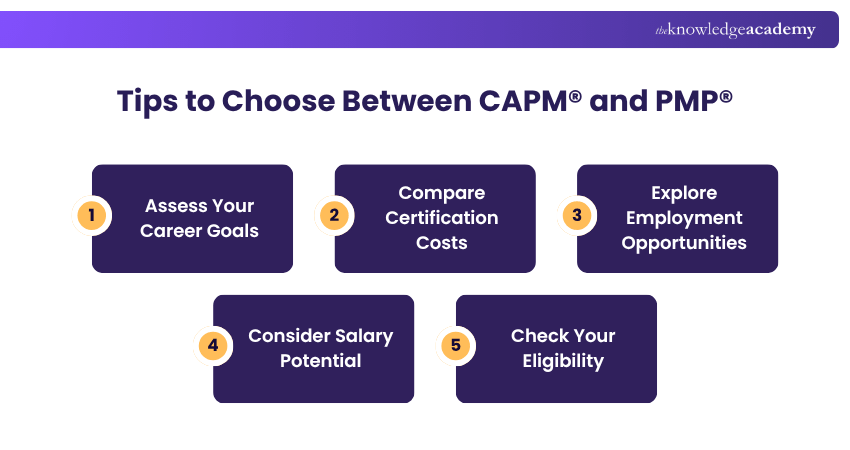
1) Assess Your Career Goals
CAPM® suits beginners and those entering project management, while PMP® is designed for experienced professionals seeking to demonstrate project leadership skills.
2) Compare Certification Costs
CAPM® generally has lower examination fees than PMP®. Consider training, study materials, PMI membership and potential retake expenses before choosing.
3) Explore Employment Opportunities
PMP® may support progression into senior project management roles, while CAPM® can help professionals pursue entry-level roles such as Project Coordinator or Project Analyst.
4) Consider Salary Potential
According to PMI's 2025 Salary Survey, PMP®-certified respondents reported 17% higher median salaries than non-certified respondents across 21 countries. Actual earnings depend on experience, industry and location.
5) Check Your Eligibility
CAPM® requires no previous project management experience, while PMP® requires two to five years of qualifying experience, depending on educational qualifications.
Sign up for the PMP Certification Course to amplify your project management career.

Vidhya Nair is a Senior Copywriter with 7+ years of experience across copywriting, content writing and communication. Her extensive research and editorial experience supports her ability to present topics across Business Skills and Human Resources with clarity and purpose.
View Detail

 If you wish to make any changes to your course, please


