


We may not have the course you’re looking for. If you enquire or give us a call on +47 80010068 and speak to our training experts, we may still be able to help with your training requirements.
What are Campaign Objectives: Explained in Detail
ByAishwarya UnniLast updated on: 09 October 2026
Curious about what are campaign objectives? These are the clear, specific targets set to guide marketing efforts toward desired outcomes. Campaign objectives help organisations measure success, optimise resources, and focus on achieving strategic goals. This blog explores types of objectives and how to set them effectively.
In This Blog
Here’s what you’ll discover:
1. What campaign objectives are and why they matter2. Different types of campaign objectives and the outcomes they support3. Real-world examples of campaign objectives in action4. Practical tips for setting effective campaign objectives5. How to choose the right objective based on your campaign goals
Think about your last project. Did you have a specific goal? Whether baking a perfect cake or training for a marathon, having a clear objective likely made your journey more focused and rewarding. The same principle applies to marketing. Campaign objectives are imperative in any marketing strategy as they align with the central marketing mission of the organisation.
Setting the right campaign objectives can help businesses determine what they want a campaign to achieve, how resources should be allocated, and how success will be measured. In this blog, you will learn about what campaign objectives are, their importance, types, examples, and more. Let’s get started!
What are Campaign Objectives?
Campaign objectives are specific targets a business aims to achieve through its marketing efforts. These goals provide clear direction, align team efforts, and serve as benchmarks for measuring success. By setting precise objectives, businesses can focus their strategies, ensure cohesive teamwork, and allocate resources effectively.
Without well-defined objectives, marketing campaigns risk becoming disorganised and ineffective; this leads to wasted resources and missed opportunities. Clear campaign objectives are essential for guiding marketing activities and achieving desired outcomes efficiently.

Why are Campaign Objectives Important?
Setting campaign objectives is crucial for several reasons. First, they provide a clear target for the marketing team to aim at, which helps in aligning strategies and tactics. Second, they enable the measurement of campaign performance by setting specific, measurable goals. Lastly, campaign objectives support efficient resource allocation and help optimise time, money, and effort for activities with the best outcomes.
Types of Campaign Objectives
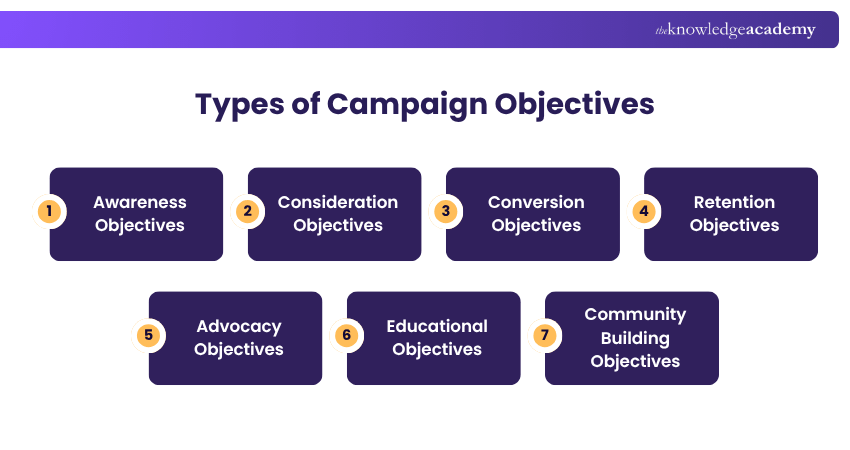
Campaign objectives can be categorised into several types based on the desired outcome. Here are seven common types used across different marketing activities:
1) Awareness Objectives
The aim of awareness initiatives is to increase brand visibility and extend the reach of your brand. Typically, these strategies are employed at the start of a product launch or when introducing a new brand to the market. The goal is to ensure that your advertisement reaches a relevant audience and helps improve brand recognition.
2) Consideration Objectives
Consideration objectives aim to encourage potential customers to show greater interest in a brand, product, or service. Depending on the campaign and channel, this may involve encouraging website visits, content engagement, video views, or other interactions that help audiences evaluate what the business offers.
3) Conversion Objectives
Conversion campaigns aim to boost the number of individuals who complete a specific action, like buying a product or subscribing to a newsletter. Usually, these marketing initiatives aim to acquire potential customers or drive revenue. The goal is to prompt individuals to engage in the intended behaviour.
4) Retention Objectives
Retention objectives focus on keeping existing customers engaged and encouraging repeat business. These objectives are crucial for building long-term customer relationships and loyalty. Metrics for retention objectives include customer retention rate, repeat purchase rate, and customer lifetime value.
5) Advocacy Objectives
Advocacy objectives aim to turn satisfied customers into brand advocates who will suggest your product or service to others. These objectives leverage the power of word-of-mouth marketing and customer referrals. Metrics and indicators for advocacy objectives include referral rates, customer reviews, and Net Promoter Score (NPS), which measures customers' likelihood of recommending a brand.
6) Educational Objectives
Educational objectives are about providing valuable information to your audience to improve their knowledge, address their questions, and potentially position your brand as a thought leader in your industry. These objectives are often used in content marketing campaigns. Metrics for educational objectives include content downloads, webinar attendance, and time spent on educational content.
7) Community Building Objectives
Community building objectives focus on developing an engaged group of people around a brand, shared interest, or offering. These campaigns aim to encourage ongoing participation and interaction. Depending on the channel, relevant measures can include active community members, recurring participation, comments, discussions, user-generated content, and community engagement rates.
Register for the Direct Marketing Training and take your campaigns to the next level!
Examples of Campaign Objectives
Let’s dive into some examples to illustrate each type of campaign objective:
1) Awareness Objectives Example
A new beverage company might set an awareness objective to achieve 1 million impressions on their social media ads within the first month of launching their new product line.
2) Consideration Objectives Example
A software company may aim to generate 500 visits to its product trial page from interested potential customers within one month through a free webinar that highlights the software's key features and benefits.
3) Conversion Objectives Example
An e-commerce store could set a conversion objective to increase its monthly sales by 20% over the next three months through a targeted email marketing campaign that offers a special discount to first-time buyers.
4) Retention Objectives Example
A subscription service might set a retention objective to reduce its monthly churn rate from 10% to 9% within six months through a loyalty programme that rewards customers for continued subscriptions.
5) Advocacy Objectives Example
A fitness firm could strive to boost its referral rate by 15% within six months by creating a refer-a-friend programme that provides discounts to both the referrer and the referred customer.
6) Educational Objectives Example
A financial planning firm might set an educational objective to have 1,000 attendees for their series of free financial literacy webinars aimed at young professionals.
Trainer’s Insight
The most appropriate campaign objective can change as the audience moves through its relationship with a brand. A new audience may first need awareness or consideration, while existing customers may require retention or advocacy campaigns. Instead of using the same objective repeatedly, consider what you want the audience to do at that stage.
7) Community Building Objectives Example
A fitness brand might set a community-building objective to increase active participation in its online fitness community by 25% within three months through weekly challenges, live discussions, and interactive content.
Kickstart your social media career with the Social Media Marketing Course - Sign up today!
Tips for Setting Campaign Objectives
When setting campaign objectives, consider the following tips to ensure they are effective:
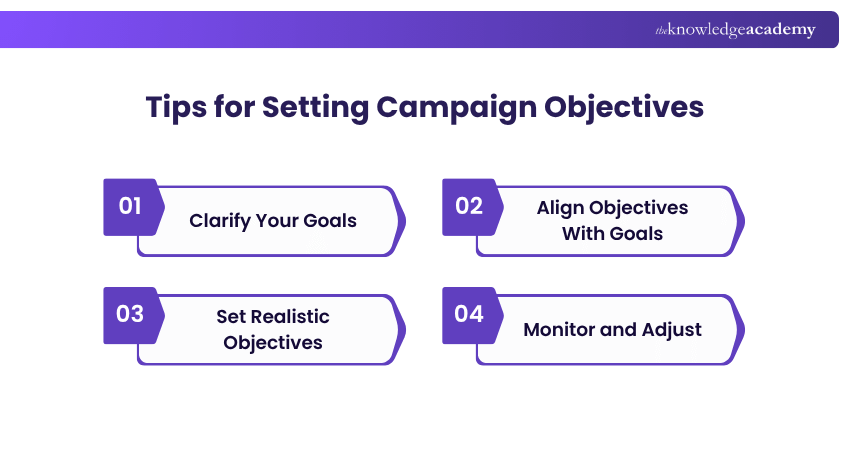
1) Begin by expressing precisely what you intend to achieve with your campaign. Understanding your goals will help you set objectives that are aligned with your desired outcomes.
2) Not all objectives will equally contribute to your goals. Choose objectives that are most likely to drive the results you want.
3) Ensure your objectives are achievable. Overly ambitious objectives can lead to disappointment, while too modest ones might not push you towards your goals.
4) After launching your campaign, regularly track your progress. If your campaign isn’t meeting its objectives, be prepared to adjust your strategy accordingly.
Bonus Tip
Do not choose a campaign objective simply because its results are easy to measure. Start with the outcome the business wants to achieve, then select an objective and relevant metrics that support that outcome.
How do you Choose the Right Campaign Objective for Your Business?
Choosing the right campaign objective for your business depends on several factors:
1) Consider Your Target Audience: Identify whether you want to reach new audiences, engage potential customers or retain existing ones.
2) Evaluate the Customer Journey: Choose awareness, consideration, conversion, retention or advocacy objectives based on the audience's stage.
3) Consider Your Budget and Resources: Select objectives that are realistic given the available budget, channels and campaign duration.
4) Identify the Desired Customer Action: Decide whether you want people to discover your brand, visit your website, make a purchase or participate in a community.
5) Choose Relevant Performance Metrics: Select measurable indicators that reflect the desired result, such as reach, conversions, repeat purchases or referrals.
Quick Check: Is Your Campaign Objective Ready?
Before launching the campaign, ask:
□ Is the objective clearly defined?□ Does it support the broader marketing or business goal?□ Can its progress be measured?□ Is the target realistic given the available budget and resources?□ Does it have a clear timeframe?□ Have you identified the metrics that will indicate success?
Elevate your marketing game with the Business Marketing Strategies Training - Register today!

Aishwarya Unni is a Copywriter with 2+ years of experience in reporting, web content, blogs, email marketing, and case studies. Her journalism background, combined with her research and writing experience across Business Skills and Human Resources, helps her create clear, engaging content for different audiences.
View Detail

 If you wish to make any changes to your course, please


