


 Top Rated Course

We may not have the course you’re looking for. If you enquire or give us a call on +49 8000101090 and speak to our training experts, we may still be able to help with your training requirements.
What is a Key Performance Indicator (KPI) ? Types and Examples
William Brown 16 July 2026Key Performance Indicators (KPIs) are measurable values that track and evaluate the success of an individual, team, or organisation in achieving goals. These are the scorecards that provide insights into your performance and competitive growth. KPIs are ideal for sales, marketing, customer service sectors, and a lot more.

Training Outcomes Within Your Budget!
We ensure quality, budget-alignment, and timely delivery by our expert instructors.
Table of Contents

Are you searching for a tool that makes your performance-tracking job easier and more effective? What if there is an answer to your search? Every business, no matter how big or small, needs a way to check if you are doing well or on the right path.
To make your research and decision-making a smoother journey, there is a powerful tool referred to as Key Performance Indicators (KPIs) to track your travel. Let's get into this blog of What are KPIs to get it implemented immediately!
Table of Contents
1) What are Key Performance Indicators (KPIs)?
2) Why are Key Performance Indicators (KPIs) Important?
3) Different Types of KPIs
4) How to Set Up Effective KPIs?
5) How to Improve Your KPI Results?
6) Pros and Cons of KPIs
7) Examples of KPIs
8) Conclusion
What are Key Performance Indicators (KPIs)?
Key Performance Indicators (KPIs) are simple measurements that show how well a person, team, or company is doing in obtaining certain goals. Whether it is improving customer satisfaction, increasing sales revenue, or reducing operational costs, KPIs offer a clear lens through which performance can be monitored and analysed.
KPIs give you a clear way to measure success. They help you focus on what matters most, that is, contributing to the growth of your business, engaging customers happily, or improving your service. Every business has different goals, so the right KPIs will depend on your specific needs.

Why are Key Performance Indicators (KPIs) Important?
KPIs are important because they help you identify what is working and what needs to be changed or rectified. Instead of guessing or assuming, you can look at real data to make better decisions. When employed properly, KPIs can direct your team to improve performance, thereby making your business stronger.
1) Fast Fact
Businesses that take advantage of the KPIs for their effective decision-making are over three times more likely to succeed in areas like profit, customer loyalty, and team productivity. This portrays how influential KPIs can be in shaping your outcomes.
2) Company
At the top level, KPIs help companies examine how well they are doing with clarity. They give an overview of performance and help leaders plan better. Consider a company-wide KPI, which could be yearly profit growth or market share increase based on analysis.
3) Department
Each department in a company has its specified role and goals. So, they, too, require their own KPIs to know what they’re aiming for. For instance, the sales team might look at how many new customers they bring in, while the Human Resources team might focus on staff turnover.
4) Project or Sub-department
KPIs are applicable to small teams and specific projects, too. This keeps everyone focused and helps track progress. A software development project might use bugs fixed per week as a KPI, while a marketing campaign might track the number of registrations.
Enrich your business analytics techniques for decision-making accuracy by signing up for our Introduction to Business Analytics Training today!
Different Types of KPIs
KPIs do not work with the formula of one size fits all. So, it has different types, specifically designed to fit various natured businesses. They can be broadly categorised based on the area of the business they are meant to monitor. Some help you understand your money, some measure your customers’ happiness, and others focus on your staff. Here are the most common types of KPIs:
1) Sales and Finances
These KPIs help you see how much money you are earning with your business and how well you are managing it. Some real-life situations are total sales, profit after expenses, how much it costs to get a new customer, the average order size, and how much money is coming in and going out each month. These numbers show whether your business is growing and making enough profit.
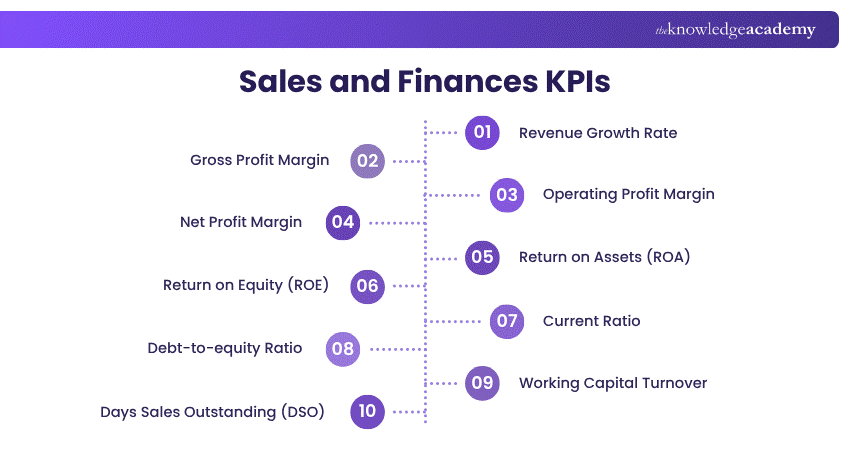
If something is deviating or not working as per the plan, these KPIs help you to identify the problem early and make changes to improve your finances. Some of the common examples of KPIs in sales and finances are:
1) Revenue growth
2) Profit margin (how much money you keep after expenses)
3) Average deal size
4) Monthly cash flow
5) Cost per acquisition
2) Marketing Effectiveness
Marketing KPIs show the effectiveness of your advertising and campaigns as if they are working. They include things like how many people visit your website, how many likes or shares you get on social media, how many people click on your ads, how much you pay for each lead, and how much money your marketing brings in. These KPIs help you understand what’s attracting people to your business and what’s not to enrich your strategies.
If you're spending money but not getting results, these numbers will show you where to adjust your marketing plans. A few KPI analysis areas include:
1) Conversion rates (how many people take action)
2) Website visitors
3) Social media engagement
4) Return on marketing investment (ROMI)
5) Cost per lead
3) Customer Relations
The main objective of customer KPIs is to check how happy and loyal your customers are. The key focus areas include customer satisfaction scores, whether customers would recommend your business or not, how many people will plan on choosing you again, how fast your team responds to their queries, and how many complaints have been solved. These KPIs are the trademark of whether your service is good and if people will still enjoy doing business with you.

The better your customer service, the more likely people will stay with you and tell others about your business. The customer KPIs involve:
1) Net Promoter Score (NPS)
2) Customer Satisfaction Score (CSAT)
3) Customer retention rate (how many comebacks)
4) Average response time
5) Complaint resolution rate
4) Human Resources and Employment
Human resources and employment KPIs show how your employees are doing and how efficient your workplace is. The metrics will check how often employees leave their jobs, how long it takes to hire someone new, how many days people might miss their work, how happy and friendly your employees are, and how many training sessions they might need. Tracking these numbers helps you keep your team strong and motivated.
If there are any problems like the sudden increase of employees quitting their roles, these KPIs help you understand the reason and rectification needed. Its KPI factors are:
1) Diversity and inclusion metrics
2) Employee satisfaction survey results
3) Required number of training sessions
4) Employee turnover rate
5) Time to hire
5) Employee Success
Employee success KPIs look at the jobs done by the employees, like if they are done properly and efficiently. These might include how many tasks they finish in the allotted time, how many goals were reached, the kind of feedback they might get, how many sales are boosted by each individual, and new idea suggestions. These numbers help managers see who is performing well and who might need help.

They also aim to reward good work and keep everyone focused. When employees know their work matters, they feel more valued and stay motivated. Such KPIs’ determinants are:
1) Customer feedback ratings
2) Employee innovation suggestions
3) Lists of goals set and achieved
4) Task completion rate
5) Sales closed by each salesperson
How to Set Up Effective KPIs?
Just checking the numbers won’t do any good. Your KPI needs to clearly show if you're moving anywhere closer to your goals. Here’s a simple four-step guide to setting up KPIs that really work.

1) Define Your Business Objective
Start by thinking about what you want to achieve. Analyse if you want more sales, happier customers, or a quicker service. It will help you to be clear about your goals.
Instead of saying “Get more customers,” you can set your goals like “Get 100 new customers in three months.” A clear and definite goal will make it easier to track progress.
2) Identify Important Business Metrics
Once you have identified your goal, explore which KPI metric will help you track it. Make sure the number you choose is easy to measure and tells you something useful about your progress.
For example, if your goal is to get more customers or like 100 customers, track “new customer actions per week.”
3) Set Up a Tracking System
After setting a defined KPI, find a way to keep track of it. You can use dashboards like spreadsheets, CRM systems, software, or tools like Google Analytics.
You can assign someone to be in charge of updating the numbers. This way, your data stays up to date, and you can always track how things are going.
4) Track and Share Real-time Progress
Share the performance details with your team using a chart, dashboard, or quick report. When they see how they’re doing, it helps them stay focused and work better together.
In addition, sharing progress helps everyone feel involved and motivated, and keeps the team aligned and moving in the right direction.
How to Improve Your KPI Results?
Implementing KPIs for your project or organisation is not the final step to track your performance. Improving the KPI results is where the actual process lies since it helps to get better results. Here are some ways to help improve your KPIs over time.
1) Consider the Logic Behind the KPIs
Every time you look at the numbers, make sure the quality of your goal is equal in significance to the quantity. For instance, just counting calls will not conclude that the service is good. A better measure could be how happy the customers feel after support. Ensure each KPI truly matches your goal and tells you something useful, not just a number that looks high but means little.
2) Create Clear Strategies
In case the KPI scores are not as expected, create new strategies to boost the scores. If your KPIs are not improving and are static also, this plan will fix it. For example, if sales are low, training the employees, introducing a new methodology, or a change to your website might work. A clear plan gives you steps for what to do and where to focus.
Explore the key analysis techniques to drive business success by joining our Business Analyst Fundamentals Training soon!
3) Adopt a Positive Daily Habit
Small bricks make a building! Likewise, doing small, helpful things every day can really make a difference. The sales team might try sending follow-up emails, or the support team could check messages more often. These good habits will add up over time and help your KPIs improve without needing big changes all at once.
4) Regularly Review Your KPI Results
Keep track of your progress. For this, avoid waiting too long to check the progress since you can improve in the middle of your project, too. Therefore, check your KPIs every week or month. This way, you can catch problems early and fix them quickly. Regular reviews help you stay on track, make better choices, and stop small issues before they turn bigger.
5) Celebrate Your Achievements
Achievements are meant to be recognised. When your team meets a goal, never forget to celebrate it. Some thank you notes, small rewards, or a mention of their work in a meeting would make a great difference. It helps people feel good about their efforts and keeps them motivated.
Pros and Cons of KPIs
As with the advantages of a Key Performance Indicator, it has its own drawbacks, like any other tool. Here are the pros and cons of a KPI.
Pros of KPI
1) Helps in providing clear direction and focus
2) Promotes data-driven and facts-oriented decision making
3) Encourages performance tracking and benchmarking
4) Maintains everyone on the same goal page with business strategy
Cons of KPI
1) It might lead to some misleading if it is not properly designed
2) Focus may drift apart from quality and focus only on quantity
3) Requires frequent checking and updating
4) Chances to become outdated if not regularly checked
Examples of KPIs
Let's check KPI examples from different parts of a business. Each one helps you see how things are going and shows where you can improve or keep doing well.
1) Financial KPI Examples
When it comes to business, finance is its backbone, and KPIs will help you to understand your financial stability. The Return on Investment (ROI) technique is one of the KPIs. KPI also focuses on the net profit margin, gross profit margin, and operating cash flow of your business.
2) Customer KPI Examples
In general, customer KPIs are designed to learn how your customers feel about your business. It tells how much your products or services are enjoyed and preferred by them. The KPI determinants include NPS score, First Call Resolution (FCR), and Lifetime Customer Value (LCV).
3) Process KPI Examples
Each process and project will have its individual contribution to the business. This process KPI includes factors like efficiency track, cycle time, inventory turnover, and number of people involved. This helps to determine the efficiency of the work done with human resources.
4) Marketing KPI Examples
Every business runs on marketing and promotional practices. They are inevitable to bring your product or service to the spotlight. Such marketing KPIs include Click-through Rate (CTR), cost per lead, email open rate, and organic traffic rate.
5) Project Management KPI Examples
Most of the Project Managers use a KPI format of balanced scorecard, which focuses on project process, finance, customers, and growth aspects. Along with this, budget adherence, project completion duration, earned value, risk mitigation, and overall project satisfaction.
Conclusion
Key Performance Indicators are one of the simplest and most useful tools in business. They help you focus on what matters, motivate your team, and improve your results. Whether you’re running a startup, managing a team, or planning your next big project, KPIs can make your work clearer and more successful.
Acquire the skills to analyse business needs and achieve objectives with our BCS Foundation Certificate in Business Analysis Course – Join today!
Frequently Asked Questions
What is a KPI in the workplace?

In simple terms, a KPI in the workplace is a number or score that shows how well someone is doing their job. It helps to track progress and support better performance.
How do you explain KPI in an interview?
In an interview, you can explain KPI as "A KPI, or Key Performance Indicator, is a measurable value that shows how well someone, or a team is achieving key business objectives. It helps track progress and improve performance in areas like sales or customer service."

William Brown


Senior Business Analyst and Strategic Advisor
William Brown is a senior business analyst with over 15 years of experience driving process improvement and strategic transformation in complex business environments. He specialises in analysing operations, gathering requirements and delivering insights that support effective decision making. William’s practical approach helps bridge the gap between business goals and technical solutions.
View Detail

 If you wish to make any changes to your course, please


