




We may not have the course you’re looking for. If you enquire or give us a call on 01344203999 and speak to our training experts, we may still be able to help with your training requirements.
Assertive Behaviour: A Comprehensive Guide
ByAkhil KLast updated on: 05 October 2026
Dive into the concept of assertive behaviour and gain insights into its various aspects. Discover what assertive behaviour entails and explore the many benefits it offers in personal and professional contexts. Delve into the risks and challenges that can come with assertiveness and how to navigate them.
The Gist
1. Assertiveness helps you express needs without becoming passive or aggressive2. Healthy boundaries make it easier to communicate your limits clearly3. Active listening keeps assertive conversations balanced and constructive4. Saying “no” respectfully helps maintain boundaries without unnecessary conflict5. Assertiveness works best when your tone and approach suit the situation
In today's interconnected and fast-paced world, effective communication has become more vital than ever before. Among the various communication styles, assertive behaviour stands out as a powerful tool for building healthy relationships.
Assertive behaviour involves communicating confidently and respectfully while recognising the rights and boundaries of others. It can foster mutual respect and support personal growth. Moreover, an assertive person can facilitate smooth communication and solve problems efficiently. Want to know how?
Check out this blog to learn what assertive behaviour is. Also, explore the benefits and challenges of assertiveness, along with practical ways to communicate more assertively in everyday situations.
What is Assertive Behaviour?
Assertive behaviour is characterised by the confident expression of one's thoughts, feelings, and needs while respecting the rights and boundaries of others. It involves advocating for oneself directly, honestly, and respectfully without being passive or aggressive. Assertive individuals are able to voice their opinions and stand up for their rights without disregarding or demeaning others. Core characteristics of assertive behaviour include the following:
a) Clear and concise communication
b) The ability to express emotions constructively
c) The capacity to set and maintain personal boundaries
Assertiveness differs from passive and aggressive behaviours in several key ways. Passive individuals tend to avoid conflict and may suppress their needs and opinions. This often leads to unexpressed frustration and resentment. Aggressive individuals, on the other hand, dominate conversations and impose their views on others, often at the expense of their relationships.
The importance of being assertive lies in its ability to promote open and honest communication, leading to healthier and more authentic interactions. By assertively expressing oneself, individuals can avoid misunderstandings, reduce conflicts, and build stronger connections. Assertiveness also fosters mutual respect and trust. This creates a positive environment for constructive discussions and problem-solving.

What are the Benefits of Being Assertive?
Showcasing an assertive behaviour allows an individual to communicate their needs clearly and confidently while maintaining fairness and respect for others. Developing assertiveness can support confidence, communication and, in some contexts, psychological well-being.
Additionally, assertiveness can offer several benefits in the workplace and other areas of life. Some potential benefits include:
a) Can Support Effective Management: Assertive communication can help managers communicate expectations clearly, address concerns respectfully and maintain appropriate boundaries. These behaviours can support constructive working relationships and effective leadership.
b) Ability to Negotiate Constructive Solutions: Assertive individuals can communicate their needs clearly while considering other perspectives, which can help identify common ground and mutually acceptable solutions.
c) Can Support Problem-solving: Assertive individuals can express concerns clearly, consider different perspectives and participate constructively in finding solutions to problems.
d) Helps Manage Difficult Interactions: Assertive communication can help individuals manage difficult interpersonal situations by expressing their concerns, needs and boundaries clearly and respectfully.
e) Support Job Satisfaction: Assertiveness can help individuals communicate their needs, make decisions and maintain healthy workplace boundaries. It can also build confidence in saying ‘no’ when necessary and managing workloads effectively. These skills can contribute to more positive workplace experiences and greater job satisfaction.
Trainer’s Pro Tip
Before responding in a difficult conversation, use three simple steps: Pause, Plan and Respond.a. Pause before reacting emotionallyb. Plan the main point you need to communicatec. Respond clearly without becoming passive or aggressive.
This can help you stay firm while keeping the conversation respectful.
Exploring the Risks Associated with Assertive Communication
The way assertiveness is perceived can vary across organisational and cultural contexts. The communication style which is considered appropriately assertive in one setting may be interpreted differently in another. Gender expectations can also influence how assertive behaviour is perceived, meaning similar behaviours may sometimes be interpreted differently depending on who displays them.
However, this does not suggest that people must abandon their individuality and conform to workplace expectations simply to earn approval from colleagues and supervisors. Instead, individuals can practise assertive communication gradually, observe how others respond and adapt their approach while remaining clear and respectful.
Communication intended to be assertive can become counterproductive if it becomes forceful or begins disregarding other people's perspectives and boundaries. At that point, it moves towards aggressive rather than assertive communication.
Such behavioural changes can result in them alienating their co-workers and straining their professional relationships. They can prevent this by experimenting with tiny steps, as they discover what works for them in the workplace. Even small steps towards more assertive communication can be beneficial when applied appropriately.
Quick Self-check
Ask yourself:
1. Do I avoid expressing disagreement?2. Do I find it difficult to say “no”?3. Can I express my needs without blaming others?4. Do I listen when someone disagrees with me?5. Can I maintain boundaries without becoming confrontational?
Your answers can highlight areas where your assertiveness may need improvement.
Attain confidence in public speaking and everyday interactions with our Effective Communication Skills Training – Join today!
Key Assertiveness Skills and How to Apply Them
Assertive behaviour can be expressed in different ways depending on the situation. These behaviours help individuals communicate confidently, establish boundaries and express their needs while respecting others.
Assertiveness involves several communication skills and behaviours that can be applied across different situations. Key aspects of assertive behaviour include the following:
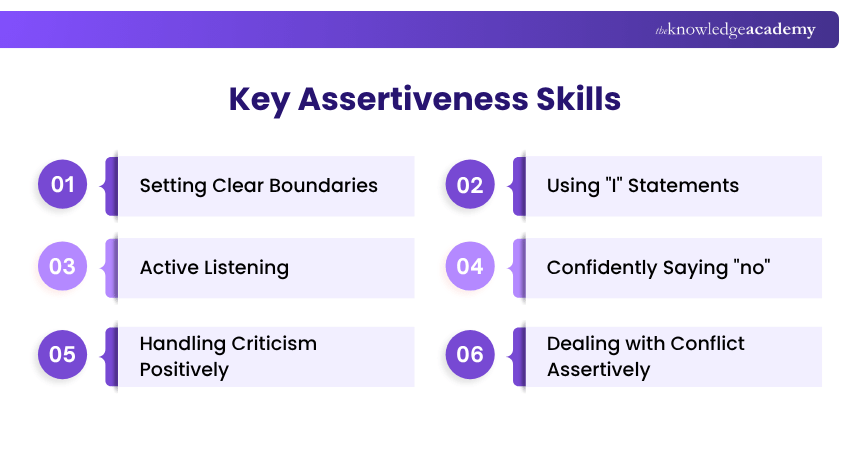
1) Setting Clear Boundaries
Setting clear boundaries is essential for being assertive in everyday life. It's important to understand that refusing to comply with a request is within your rights, and it is acceptable to do so. Recognising your limits and communicating them confidently to others empowers you to safeguard your well-being and values. This helps foster mutual respect in relationships.
Clearly articulating your needs promotes open communication, and consistently upholding these boundaries reinforces your assertiveness. Setting clear boundaries allows you to create a balanced and respectful environment that promotes positive interactions and honours each person's autonomy and well-being.
2) Using "I" Statements
One of the assertive behaviours includes using “I” statements. "I" statements are powerful tools for assertive communication. This involves expressing your thoughts and feelings from a personal perspective without blaming or accusing others. Using "I" statements encourages open and non-confrontational dialogue. This reduces defensiveness in others.
For example, instead of saying, "You never listen to me," say, "I feel unheard when I'm not given a chance to express myself." This approach encourages understanding and paves the way for productive discussions.
3) Active Listening
Active listening is an integral aspect of assertive behaviour. It involves attentive comprehension of both spoken words and underlying emotions. By giving undivided attention and displaying genuine empathy, assertive individuals foster trust and mutual respect. This enhances connections and validates others' perspectives in interpersonal interactions.
Employing techniques like maintaining eye contact, avoiding interruptions, and using verbal cues refines active listening skills.
4) Confidently Saying "no"
Confidently saying "no" is crucial for upholding personal boundaries and self-worth. Assertively declining requests that contradict your values or priorities empowers you. To express a respectful "no," use clear and concise language and avoid over-apologising. Also, when feasible, propose alternative solutions.
By confidently asserting your limits, you prioritise your well-being and communicate with authenticity and self-assurance. This cultivates healthier relationships and fosters mutual understanding while safeguarding your personal needs and values.
5) Handling Criticism Positively
Handling criticism positively is a testament to emotional intelligence. When receiving feedback, remain open and consider whether the criticism contains useful points before responding calmly and constructively.
Approaching criticism with assertive behaviour allows you to demonstrate maturity and humility. This attitude fosters a positive learning environment, encourages constructive feedback exchanges, and empowers individuals to evolve in various aspects of life.
6) Dealing with Conflict Assertively
Dealing with conflict is one of the assertive behaviours that involves addressing disagreements in a composed and empathetic manner. Assertive conflict resolution seeks to find common ground and positive outcomes. By actively listening to the other's perspective and respectfully expressing one's needs and concerns, individuals can navigate conflicts constructively.
Remaining calm and composed during conflicts allows for clearer communication and prevents unnecessary escalation. Constructive conflict management can support open communication, problem-solving and better understanding of different viewpoints.
Where Can Assertive Behaviour be Applied?
Assertive behaviour can be applied across different areas of life where clear, respectful communication is important. Whether at work or in personal relationships, it helps individuals express their needs, opinions and boundaries while also considering the perspectives of others.
Assertiveness at Work
Assertiveness can support professional communication, teamwork and leadership by helping individuals express ideas, concerns and needs clearly and respectfully.
In workplace interactions and negotiations, assertiveness encourages a positive and productive work environment. Embracing assertiveness empowers employees to advocate for their contributions and engage in constructive discussions. This also helps build harmonious working relationships, which can contribute to more constructive working relationships and effective collaboration.
Real-world Example
Your manager assigns another urgent task when your workload is already full.Passive: “Sure, I’ll manage somehow.”Aggressive: “No. I already have too much work.”Assertive: “I can take this on, but I have two urgent priorities. Which should take precedence?”
The assertive response raises the concern clearly while encouraging a constructive solution.
Assertiveness in Personal Relationships
Assertiveness can play an important role in nurturing healthier and more respectful connections in personal relationships. By expressing needs and boundaries assertively, individuals foster mutual understanding and create a safe space for open communication. Valuing each other's feelings and opinions is crucial for cultivating deeper and more meaningful relationships.
Embracing assertiveness in personal relationships can support more fulfilling and harmonious connections by encouraging honest communication, healthy boundaries and mutual respect.
Gain the confidence to present ideas persuasively in any workplace scenario with our Communication Skills Courses – Register today!

Akhil K is a Copywriter and Video Editor with experience in content creation, visual storytelling, advertising and brand communication. His background in journalism, research and audience-focused communication strengthens his ability to create clear and engaging Business Skills content.
View Detail

 If you wish to make any changes to your course, please


