




We may not have the course you’re looking for. If you enquire or give us a call on 01344203999 and speak to our training experts, we may still be able to help with your training requirements.
Approaches of Organisational Behaviour: A Complete Guide
ByThe Knowledge AcademyLast updated on: 19 September 2026
Welcome to the fascinating world of organisational behaviour! In this comprehensive blog, we’ll explore the various approaches used to understand and manage behaviour within organisations. Let’s unravel the secrets behind effective organisational dynamics, from human resources to interdisciplinary perspectives.
What's Coming Up
1. Key Principles: Understand the ideas that distinguish different organisational behaviour approaches.2. Situational Factors: Explore why different workplace situations may require different responses3. People and Performance: Explore the connection between employees, resources and organisational outcomes.4. Context and Connections: Understand why circumstances and interconnected systems matter.5. Broader Understanding: Learn how multiple perspectives can help explain complex workplace behaviour.
Organisational Behaviour (OB) is like deciphering a synchronised dance, a blend of steps, rhythms, and patterns. Imagine you’re a part of this choreography. Each approach offers a different perspective, helping you look at workplace situations from a new angle. So, let’s step onto the dance floor and explore what sets each perspective apart.
From supporting employee development to responding to changing circumstances and understanding interconnected systems, these approaches highlight different aspects of organisational life. They can also complement one another depending on the organisational context. Are you ready to tango with turbulence in organisational behaviour? Let’s get to it then.

Organisational Behaviour Approaches
Let’s take a look at the different approaches of organisational behaviour in detail:
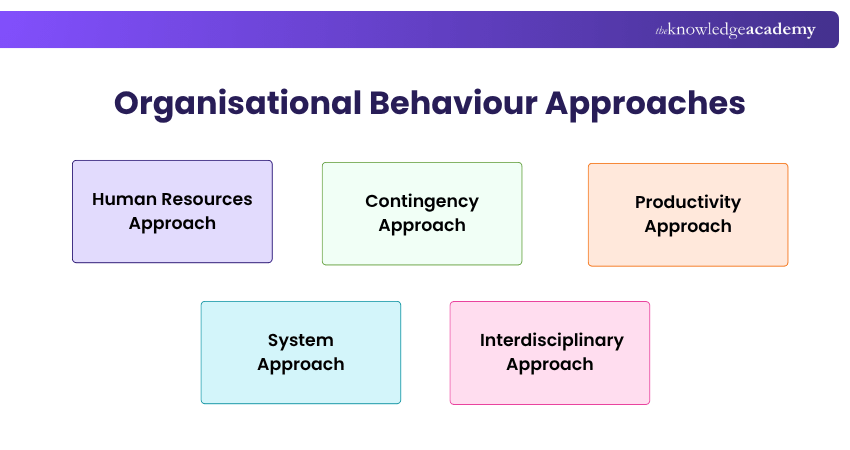
1) Human Resources Approach
The Human Resources Approach views people as a central organisational resource and focuses on supporting their growth, development, competence and performance. It does so in the following ways:
a) People-centric: This approach views employees as valuable assets. Their well-being, motivation, and development can contribute to organisational success.
b) Employee Satisfaction: Employee satisfaction can contribute to engagement, motivation and positive organisational outcomes.
c) Training and Development: Investing in employee development can strengthen skills, competence and performance.
Trainer Insight
Employee development works best when individual growth is connected with team and organisational objectives.
2) Contingency Approach
This approach recognises that there is no single best way to manage every organisational situation. Instead, appropriate actions depend on the circumstances and relevant internal and external factors. It focuses on the following:
a) Context Matters: There’s no one-size-fits-all solution. The best approach depends on the situation.
b) Adaptability: Organisations must adapt to relevant internal and external factors, like chameleons changing colours.
c) Flexible Leadership: Leaders may adapt their approach according to situational demands and employee needs.
3) Productivity Approach
This approach focuses on improving organisational results by considering the relationship between outputs and the resources used to achieve them. It does so by focusing on:
a) Efficiency: Use resources effectively, streamline processes and reduce unnecessary waste while working towards organisational goals.
b) Resource Management: Coordinate time, people and other organisational resources to support productive outcomes.
c) Performance Metrics: Monitor relevant outcomes to identify opportunities for performance improvement.
4) Systems Approach
This approach views an organisation as an interconnected system in which different parts influence one another and contribute to the functioning of the whole. It focuses on:
a) Holistic View: Organisations are interconnected systems. A change in one part can influence other parts of the organisation.
b) Feedback Loops: Feedback helps organisations monitor inputs, processes and outputs and make adjustments where necessary.
c) Open-system Perspective: Recognise that organisations interact with their external environment by receiving inputs, transforming them through organisational processes and producing outputs.
Example
Introducing new technology may improve one process but also affect employee responsibilities, training requirements and workflows in other teams. A systems perspective considers these interconnected effects before evaluating the change.
5) Interdisciplinary Approach
The Interdisciplinary Approach draws concepts and insights from multiple disciplines to develop a broader understanding of behaviour within organisations. Here is how:
a) Blend of Disciplines: Draw on insights from psychology, sociology, economics and other relevant disciplines.
b) Complexity: Organisations are intricate ecosystems. Understand the interplay of variables.
c) Broader Understanding: Combining insights from different disciplines provides a more comprehensive understanding of individual, group and organisational behaviour.
Manager’s Reflection: Before You Choose an Approach
Before applying an organisational behaviour approach, consider these questions:
☐ People: Is the challenge related to employee motivation, development or performance?☐ Context: What internal or external factors are shaping the situation?☐ Resources: Are outputs and available resources being used effectively?☐ Connections: Could a change in one area affect other teams, processes or outcomes?☐ Perspectives: Would insights from multiple disciplines provide a better understanding?
Learn critical data-driven skills like process modelling with the Business Analysis Courses – Join now!

The Knowledge Academy develops accessible learning content across Project Management, IT, Cybersecurity, Data Science, Business Analysis, HR, Accounting and Finance, Leadership and Health and Safety. Its resources combine subject research with clear explanations to help professionals build practical knowledge across a wide range of disciplines.
View Detail

 If you wish to make any changes to your course, please


