




We may not have the course you’re looking for. If you enquire or give us a call on 01344203999 and speak to our training experts, we may still be able to help with your training requirements.
APM Competence Framework and Its Editions: A Brief Overview
ByDavid EvansLast updated on: 05 October 2026
Explore the APM Competence Framework and its editions, including how it defines the knowledge and practical application required across the project profession. Understand how the framework has evolved over time and how the latest updates reflect changing expectations across the project profession.
Every successful project leaves behind more than a finished outcome. It reveals the skills, judgement and behaviours of the people who delivered it. The APM Competence Framework helps define those capabilities and shows how they have evolved across its different editions.
Understanding this evolution gives professionals a clearer view of what effective project practice looks like today and how expectations are continuing to change. So, let’s get into the framework and see how it has developed over the years.
APM Competence Framework - An Overview
The APM Competence Framework outlines the essential competences for effective projects, programmes, portfolios, and the Project Management Office (PMO) work. The framework comprises 29 competences, each detailing specific outcomes that project professionals must achieve. These competences include criteria for both knowledge and practical application.
Additionally, the framework features a Ratings Scale used to assess knowledge and practical application against each competence, ranging from Level 0, “Unaware”, to Level 5, “Expert”. These ratings help gauge an individual's proficiency and capability within each competence area.

APM Competence Framework 2nd Edition
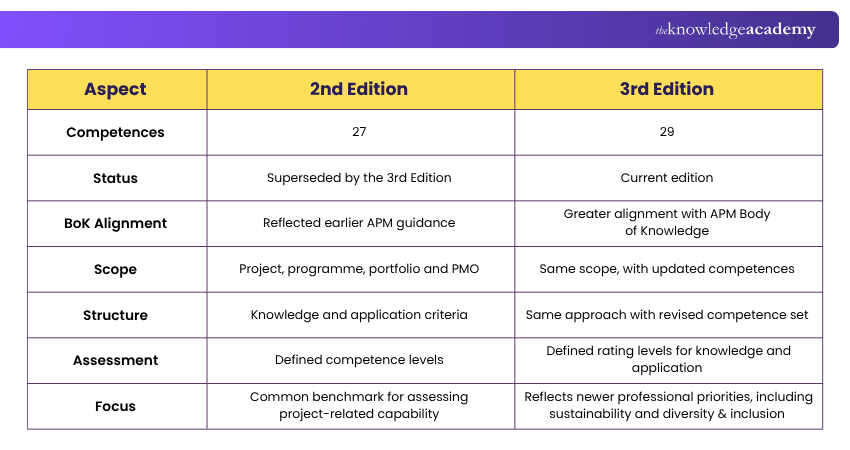
The APM Competence Framework 2nd Edition was released in 2015 and provided a common benchmark for assessing capability across project, programme and portfolio management and Project Management Office (PMO) roles. It contained 27 competences, each supported by knowledge and application criteria.
1) 27 Competences: The 2nd Edition consisted of 27 competences covering areas such as leadership, governance arrangements, risk, opportunity and issue management, stakeholder and communications management, financial management, benefits management and change control.
2) Knowledge and Application Criteria: Each competence outlined both what professionals needed to know and how that knowledge could be applied in practice.
3) Benchmarking Tool: The framework provided a common benchmark that individuals and organisations could use to assess professional capability across project-related roles.
4) Professional Development: Individuals used this framework to identify strengths and areas for growth, crafting tailored professional development pathways.
5) Rating Scale: The edition included defined competence ratings that allowed professionals to assess their level of performance and identify areas requiring further development.
Together, these elements provided the foundation for the framework's later development into the 3rd Edition.
APM Competence Framework 3rd Edition
The APM Competence Framework 3rd Edition, launched in 2022, remains the current framework and contains 29 competences covering the knowledge and practical application required across project, programme and portfolio management and PMO activities.
1) Expanded Competence Framework: The 3rd Edition increased the number of competences from 27 to 29, broadening the areas against which project professionals can assess their knowledge and practical application.
2) Sustainability: Sustainability was introduced as a dedicated competence for the first time, reflecting its growing importance in project delivery and organisational decision-making.
3) Diversity and Inclusion: Diversity and inclusion was also introduced as a dedicated competence, recognising the importance of inclusive working environments and diverse project teams.
4) Four Competence Areas: The current 29 competences are organised across four areas: Setting up for success, preparing for change, people and behaviours, and planning and managing deployment.
5) Stakeholder Management and Communication: The framework covers stakeholder identification, engagement and communication as part of the official Stakeholder engagement and communication management competence.
6) Competence Assessment: The framework provides defined rating levels that allow professionals to assess their knowledge and practical application across each competence.
7) Self-assessment Support: Professionals can use APM's online competence assessment tool to benchmark themselves against the 29 competences and identify areas for development.
Trainer’s Insight
When reviewing the 29 competences, do not assess each one in isolation. Consider how related areas, such as stakeholder engagement, leadership, risk management and change control, work together during real project delivery.
How Does the APM Competence Framework Align with the APM Body of Knowledge 8th Edition?
The publication of the APM Body of Knowledge 8th Edition (BoK8) does not represent a new edition of the APM Competence Framework. The Competence Framework remains in its 3rd Edition, while BoK8 has been structured to align more clearly with it.
The Body of Knowledge explains what project professionals need to know and why it is important, while the Competence Framework defines the knowledge and application needed to demonstrate competence. BoK 8 contains 33 sections, with 29 reflected as competences in the APM Competence Framework.
Pro Tip
Use the Competence Framework to identify what you need to demonstrate, then refer to the APM Body of Knowledge to strengthen the knowledge behind those competences.
How to Use the APM Competence Framework Effectively?
The APM Competence Framework can help project professionals assess their current capabilities, identify development needs and plan their continued professional growth. Here are some practical ways to use it:
1) Self-assessment: Evaluate your current competences against the framework, identifying strengths and gaps.
2) Set Clear Goals: You can establish short-term and long-term professional development objectives based on the assessment.
3) Training and Development: Seek training opportunities, workshops, or courses aligning with your growth areas.
4) Regular Reviews: Periodically revisit the framework to measure progress and recalibrate goals.
5) Engage With Peers: Discussing the framework with colleagues can provide fresh insights and collaborative learning opportunities.
6) Stay Updated: Use the latest APM Competence Framework alongside current APM resources such as the Body of Knowledge 8th edition to keep your knowledge and professional development aligned with current project management practice.
Things to Remember
1. The 3rd Edition remains the current APM Competence Framework and contains 29 competences.2. The 2nd Edition contained 27 competences and was replaced by the 3rd Edition in 2022.3. Sustainability and diversity and inclusion were introduced as dedicated competences in the 3rd Edition.
Enhance your ability to plan, manage, and deliver successful projects with APM PMQ Training – Join now!

David Evans creates accessible resources that help professionals understand different approaches to planning and delivering projects. His content addresses changing requirements, collaborative working and the practical demands of contemporary project environments.
View Detail

 If you wish to make any changes to your course, please


