


We may not have the course you’re looking for. If you enquire or give us a call on + 1-866 272 8822 and speak to our training experts, we may still be able to help with your training requirements.
Top Benefits of Web Analytics
ByThe Knowledge AcademyLast updated on: 02 November 2026
Web analytics help businesses understand website performance, customer behaviour, and marketing effectiveness. From tracking website traffic to improving conversions and customer retention, explore the key benefits of web analytics and discover how data-driven insights support smarter business decisions.
The Rundown
Web analytics helps businesses understand website performance and make informed decisions through:
1. Traffic Monitoring: Track website visitors, traffic sources and performance trends.2. Audience Insights: Understand visitor behaviour, preferences and engagement patterns.3. Marketing Performance: Evaluate campaigns and identify opportunities for improvement.4. Conversion Optimisation: Analyse visitor actions and identify ways to improve conversions.5. Business Decisions: Use website data to monitor goals and support better strategies.
Imagine running a busy store where hundreds of customers walk in, browse the shelves, and leave without saying a word. You would naturally want to know what caught their attention and why some walked away.
The same curiosity applies to websites. The benefits of web analytics help businesses understand visitor behaviour, identify missed opportunities, and discover what drives meaningful engagement. With the right insights, even small website improvements can create opportunities for business growth.
What are the Benefits of Web Analytics?
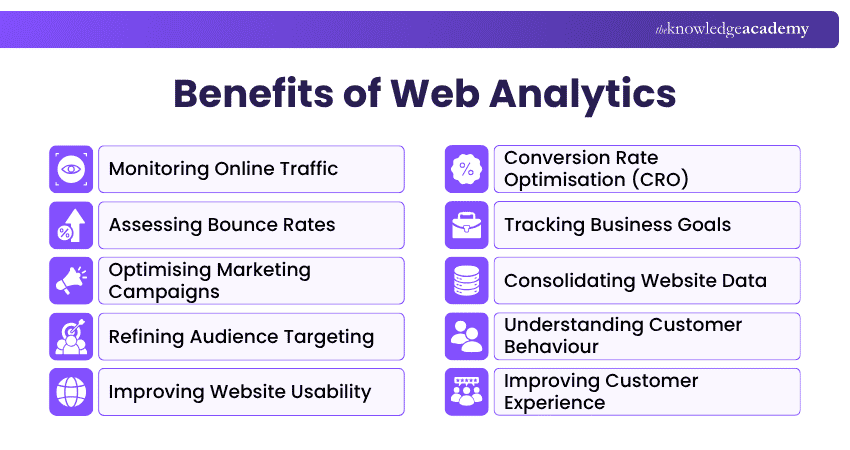
Web analytics can provide you with many benefits that can help you grow your online business. Let’s explore the key benefits of web analytics:
1) Monitoring Online Traffic
Web analytics allows online businesses to monitor the quantity and quality of their website traffic. They can see how many visitors their site attracts, where they come from, how long they stay engaged, and what pages they visit. They can also see how their traffic changes over time, such as daily, weekly, monthly, or seasonally.
This helps them understand the trends and patterns of their website’s performance and popularity. They can also use separate competitor research tools or industry benchmarks to compare their performance with broader market trends.

2) Assessing Bounce Rates
Bounce rate measures the percentage of website sessions that do not meet the criteria for meaningful engagement. In Google Analytics 4, a session is considered engaged if it lasts longer than 10 seconds, includes a key event, or has at least two page or screen views.
Web analytics helps businesses monitor bounce rates and investigate possible engagement issues. By comparing bounce rates across pages and traffic sources, businesses can identify opportunities to improve content relevance, navigation and overall website experience.
3) Optimising Marketing Campaigns
Web analytics helps online businesses plan, execute, and evaluate their marketing campaigns, such as email, social media, SEO, and Pay-Per-Click (PPC) advertising PPC advertising. They can use web analytics to set their campaign goals, such as traffic, leads, and sales, and track their progress and performance.
They can also use web analytics to assess campaign returns when reliable cost and revenue data are available. Web analytics also helps online businesses optimise their campaigns by testing different variables, such as headlines, images, copy, and landing pages, using suitable testing tools alongside analytics data.
4) Refining Audience Targeting
Web analytics helps businesses understand which visitor groups are most interested in their products, services and content. By examining traffic sources, device types, locations and engagement patterns, organisations can identify audience segments and understand how different groups interact with their websites.
They can then use these insights to develop more relevant content, refine their marketing messages and improve their audience targeting strategies. This can help them attract suitable visitors, improve conversion opportunities and build stronger customer relationships.
5) Improving Website Usability
Web analytics helps online businesses improve the design, functionality, and usability of their website. They can use web analytics to identify the strengths and weaknesses of their site, such as navigation, layout, content, and visitor journeys.
They can then use web analytics to investigate underperforming pages and evaluate improvements to their website's design, navigation and content. When combined with website performance testing and accessibility tools, these insights can also help identify technical and usability issues.
6) Conversion Rate Optimisation (CRO)
Conversion Rate Optimisation (CRO) is the process of increasing the percentage of website visitors or sessions, depending on the metric used, that complete a desired action, such as making a purchase, submitting an enquiry or subscribing to a newsletter.
Businesses can use web analytics alongside A/B testing tools to compare website variations and evaluate their impact on conversion rates.
Practical Example: Improving Online Store Conversions
An online clothing store notices that many visitors browse its products but few complete purchases. Using web analytics, the business examines traffic sources, device types and checkout behaviour to identify where visitors drop off. It then tests changes to the checkout process and monitors conversion rates to evaluate their effectiveness.
7. Tracking Business Goals
By leveraging web analytics, businesses can create and track specific, measurable objectives such as page views, downloads, registrations, and purchases that align with their overall business strategy.
They can then use web analytics to measure and evaluate their performance and progress towards their goals and see how well they are meeting their expectations and standards. They can also use web analytics to identify performance gaps and investigate challenges that may affect their results.
8) Consolidating Website Data
Web analytics can help you consolidate and integrate your website data with other sources of data, such as CRM, ERP, email and social media platforms, where supported integrations or additional data connections are available. This can help you create a more complete view of your online business and its performance.
You can also use web analytics to generate and automate reports and dashboards that display and visualise your data in various ways, such as tables, charts and graphs. This can help you simplify and streamline your data analysis and presentation, making it easier and faster to access and share relevant insights with your team and stakeholders.
From traffic to trends, discover what your data reveals by joining the Google Analytics Training now!
9) Understanding Customer Behaviour
Web analytics can help you monitor and understand visitor behaviour, such as how people find, use and interact with your website and its content and offers. You can use web analytics to track and analyse metrics such as page views, engagement time, scroll depth, clicks and downloads, depending on the tracking configuration.
You can also use web analytics to map and visualise observed customer journeys, helping you understand how visitors move through different pages and actions before completing a purchase or other desired activity.
Trainer's Insight
Web analytics provides valuable insights into visitor behaviour, but it does not capture every interaction. Cookie consent, browser restrictions and tracking configurations can affect the data collected. Always consider these limitations before drawing conclusions about customer journeys or website performance.
10) Improving Customer Experience
Web analytics can help online businesses offer a better customer experience. They can use web analytics alongside customer feedback tools to collect and analyse information from surveys, reviews and other feedback sources. This helps them understand customer pain points, expectations and suggestions.
They can also use web analytics to evaluate changes to different aspects of their customer experience, such as usability, accessibility, design, functionality and content, with additional testing tools where needed. This can help businesses identify opportunities to improve website interactions and assess whether those changes support customer satisfaction.
Discover which campaigns work and where to improve with the Marketing Analytics Training – Join now!

The Knowledge Academy develops accessible learning content across Project Management, IT, Cybersecurity, Data Science, Business Analysis, HR, Accounting and Finance, Leadership and Health and Safety. Its resources combine subject research with clear explanations to help professionals build practical knowledge across a wide range of disciplines.
View Detail

 If you wish to make any changes to your course, please


