


 Top Rated Course

We may not have the course you’re looking for. If you enquire or give us a call on +61 272026926 and speak to our training experts, we may still be able to help with your training requirements.
How to Manage People: Skills, Tips and Techniques
James Smith 06 May 2026How to manage people involves clear communication, trust-building, setting expectations, giving feedback, and supporting individual growth to build a productive team. It ensures employees stay motivated, develop skills, and achieve both individual and organisational goals, fostering a culture of collaboration, engagement, and continuous growth.

Training Outcomes Within Your Budget!
We ensure quality, budget-alignment, and timely delivery by our expert instructors.
Table of Contents
Managing a team is more than just assigning tasks, it’s about inspiring, guiding, and supporting people to achieve their best. But what does effective People Management really involve, and why is it crucial for every organisation?
In this blog, we’ll explore what is People Management, its key principles, essential skills, and strategies on how to manage people to drive organisational growth. You’ll also learn practical tips to lead with trust, communication, and coaching.
Table of Contents
1) What is People Management?
2) 15 Best Strategies for Managing People at Work
3) What are Some Key People Management Skills?
4) People Management Styles
5) What are the 4 Types of People to Manage?
6) How to Deal with an Employee who has a Bad Attitude?
7) Conclusion
What is People Management?
People Management includes the range of procedures and the principles by which the leader motivates and develops the employees of an organisation. People Management consists of crucial duties in setting clear goals, providing feedback, resolving conflicts as much as possible, and allowing for open communication.
The major goal of these activities is to make the employees fully equipped and involved in all organisational matters to achieve success. Efficient People Management promotes an environment that provides better conditions for people to flourish and build mutual objectives.
15 Best Strategies for Managing People at Work
Now since you have learned about People Management, Let your team shine with our 15 proven effective People Management strategies for workplace success.
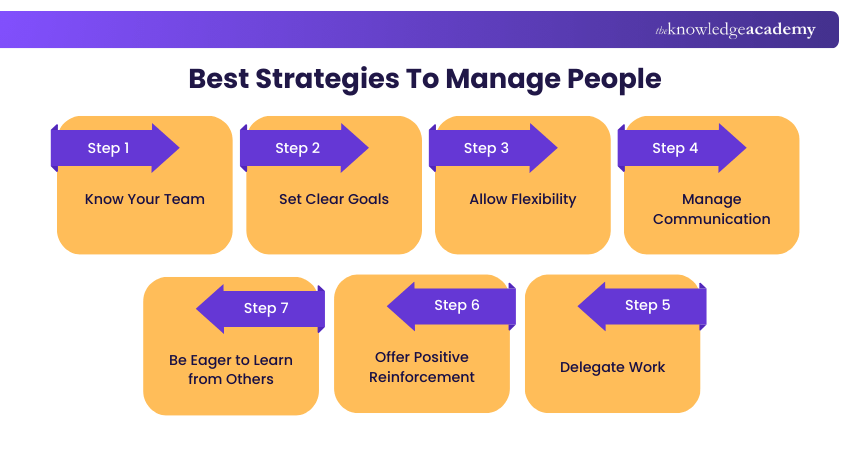
1) Know Your Team
Understanding each team member's strengths, weaknesses, and preferences enables personalised management strategies. Leaders may create a work atmosphere where motivated and valued people feel appreciated by attending to their particular requirements. This approach fosters increased productivity and collaboration, ultimately maximising overall team performance.
2) Set Clear Goals
Establishing objectives helped the team discover the path that they should use to know their roles and duties in the organisation. The knowledge about the goals imposed enables them to concentrate their efforts on other targeted objectives and consequently give them direction and meaning in their work. This alignment ultimately contributes to organisational success.
3) Prioritise Your Own Workload
Effective time management involves allocating time to high-value tasks that contribute significantly to team goals. Prioritisation ensures that essential tasks are addressed promptly, optimising productivity and resource allocation. By managing time efficiently, leaders can maintain the capacity to provide necessary support and guidance to their team, enhancing overall effectiveness.
4) Avoid Taking Team Performance Personally
Team performance doesn't define your Leadership value; it's about guiding and supporting the team's growth. Instead of considering setbacks as personal mistakes, it is crucial to look into setbacks as opportunities to improve on self-growth. Accepting these possibilities not only increases effective Leadership but also cultivates a culture of learning and progress
5) Provide Consistent Leadership
Consistency in Leadership cultivates trust by demonstrating reliability and predictability in actions and decisions. It provides stability, ensuring clarity and coherence in expectations and direction for the team. Ultimately, this fosters a positive work environment where team members feel secure and empowered to perform at their best.
6) Allow Flexibility
Empowering team members to align their work methods with their preferences and circumstances boosts productivity and job satisfaction. By allowing autonomy in approach, individuals can leverage their strengths and optimise performance. This fosters a sense of ownership and fulfilment, driving overall team effectiveness.
7) Be Open About Goal-setting
The involvement of your team in setting the goals provides a sense of belonging and makes them believe that they are part of the organisation. It guarantees that team members are aware of the objectives, make an effort to reach them and contribute to the achievement of an organisation's general purposes, as it will induce work and passion among them to get results.
Elevate remote team productivity with our Managing Remote Teams Course!
8) Establish Clear Workflows
Improvement of processes means incorporating and implementing some elementary ideas, removing operations that are not needed and simplifying complex ones. The precise definition of roles ensures that everybody is doing the job they are expected to, thus reducing confusion and overlaps.
This contributes to the effectiveness in that collaborative efforts among team members become more integrated, and the completion of the job is faster, thus leading to the achievement of better results.
9) Manage Communication
Collaboration within a team is promoted by open and honest communication, which creates an environment of mutual trust and understanding. It minimises misunderstandings by ensuring that information is clear and accessible to all members. Additionally, it strengthens relationships by encouraging honest dialogue and shared accountability among team members.
10) Delegate Work
The practice of delegation leads to team members being responsible for their responsibilities and having a feeling of pride and freedom. It also has a capability to empower individuals as they embrace new experiences and assume new tasks. Moreover, by delegating the activities to the rest of the competent team, managers will have more time to put their efforts on the essential strategic options.
11) Provide Constructive Criticism with Empathy
Continuous evaluation of teammates constitutes friendly and understanding feedback, which allows them to understand their limits and fixed their errors, while assuring their spirits and performance. Through the building of a culture that reinforces the feeling of safety and empowerment of people without the fear of rejection, the method aims at deepening the group cohesion and productivity.
12) Actively Address Conflicts
Early resolution of conflicts keeps them from becoming more severe, which supports confidence and teamwork. By facilitating constructive resolution, teams can resolve issues efficiently, fostering a positive work environment. This proactive approach shows a dedication to finding solutions to problems and maintaining positive team dynamics.
13) Offer Positive Reinforcement
The acknowledging and rewarding of individual achievements and team achievements is their contribution and effort appreciated. This serves as a mark that a positive work culture is enforced. An appreciated attitude raises morale by making employees feel that they are important and that their work is recognised. Consequently, such an attitude keeps the group highly motivated and makes them participate in all of the company's achievements even more enthusiastically.
14) Fulfil Your Own Expectations
Setting a consistent example for your team means exhibiting the attitudes, work ethic, and behaviours you expect from them. By demonstrating integrity, dedication, and professionalism in your own actions, you set a standard for others to emulate. This fosters a culture of accountability and inspires team members to align with the organisation's expectations.
15) Be Eager to Learn From Others
Maintaining improvement in People Management Skills requires staying open to feedback and learning. Accepting feedback from colleagues promotes teamwork and helps in identifying areas that want improvement. To further improve management skills, consulting mentors and other leaders for advice could offer useful views. Recognising the types of Difficult People at Work and learning how to manage people can be an integral part of this process.
Build core management skills and lead your team effectively from day one with our Management Training for New Managers- Join today!
What are Some Key People Management Skills?
Effective People Management is pegged on interpersonal, leadership, and strategic skills. Through these skills, the manager is able to support the employees, build a strong relationship and motivate them to work as a team on a regular basis. The key skills on how to manage people are:
1) Empathy: Empathy would enable the managers to listen to employees and their views, and make them feel appreciated. It also facilitates fair decision-making and a more inclusive and supportive work environment.
2) Leadership: Good leadership ability assists managers in establishing trust, energising work teams, and resolving conflicts. Leaders help others achieve success by clarifying direction and empowering others because such leaders can direct their team members towards common goals and long-term success.
3) Organisation and Analytical Thinking: To be effective in performance management, people managers should be able to unite soft skills and data-oriented decision-making. HR systems and analytics can be used to identify certain trends and advance planning, as well as aid informed workforce strategies.
4) Communication and Active Listening: Effective communication helps managers to generate expectations, deliver feedback and retain trust among teams. This is strengthened by active listening, where employees are made to realise that their opinion is not ignored and is put into action.
5) Creativity: Creativity enables managers to change their manner towards individual requirements and emerging difficulties in the workplace. Creative minds stimulate problem-solving, as well as motivate the teams to work in a new manner.
6) Collaboration: Teamwork enables managers to make teams consistent with the organisational goals and use individual strengths. The participation of the employees in the decision-making process creates confidence, openness and greater team involvement.
Learn how to set goals, measure performance, and drive consistent improvement across teams with our Performance Management Training- Sign in now!
People Management Styles
Explore various People Management styles to understand how different approaches can impact team dynamics and organisational success. Here are the key styles on how to manage people:
1) Coaching People Management
In management coaching approach individual growth is supported and it is provided through guidance, backing and empowerment. In addition to offering personalised guidance and mentorship, leaders should focus on helping employees learn how to improve and grow on their own. This is what builds a culture of continuous improvement and an effective People Management.
2) Supportive People Management
The wellbeing and the professional development of the employees constitute the priorities for the caring supervisor. They play a vital role by actively helping, guiding, and providing the resources which are necessary in the attainment of both individual and socio-cultural goals. They create a productive culture in which team members are encouraged to rise above the challenges and grow their skills and competencies to become more effective in their jobs.
3) Directive People Management
Directive managers take a hands-on approach to Leadership by providing precise instructions and clearly defining expectations for their team members. Accountability is highlighted in this manner because team members are held responsible for achieving established objectives and are aware of their responsibilities. This turns out to bring great outcomes when it comes to how to manage people.
4) Delegative People Management
Delegative Managers asign tasks to their team members trusting that the team will make the right decision and are aware of the fact that this autonomy can lead to a sense of ownership from each team member. This approach ultimately drives greater motivation and productivity within the team.
What are the 4 Types of People to Manage?
Now you have an idea about People Management but there are certain types of people that as a professional you need to be aware of for effective People Management. The 4 types of people to manage are:
1) High Performers: The high performers are self-motivated, responsible and always achieve good results. They need to be appreciated, have a chance to grow and to be challenged.
2) Underperformers: Underperforming employees would have difficulties in competence, comprehension, or drive, which influences their performance. Some of its key management skills include trouble-hunting, coaching, and establishing clear and attainable expectations.
3) Potential Performers: Potential performers are promising and might be inexperienced or not so confident. They can be coached, given feedback and development opportunities and become high-performing and useful team members.
4) Problem Employees: Such people can either oppose change or have low morale, or cause disharmony in groups. They have to be managed with patience, articulateness, and systematic assistance in order to refocus behaviour on the goals of the team.
Strengthen ethical leadership and embed responsible business practices into your organisation with our Corporate Social Responsibility (CSR) Training- Join now!
How to Deal with an Employee who has a Bad Attitude?
To deal with a negative attitude, one needs consistency, empathy, and leadership. Early intervention of the problem is beneficial in safeguarding the morale of the team, sustaining productivity, and ensuring a good workplace environment. Some of the key ways to deal with bad attitude employees are:
1) Lead by Example: By maintaining a positive attitude and remaining professional, optimistic, and respectful, managers must demonstrate the behaviour they desire. When one portrays a positive attitude, it serves as a role model to the employees on how to act.
2) Listen and Understand Concerns: Instead of immediately discounting behaviour as negative behaviour, create time to listen and ask open-ended questions. Identifying the background problems can also enable managers to react in the right manner and offer suitable assistance.
3) Coach Employees: Negative attitudes cannot be deeply rooted with the intention of this or that. Coaching the key team members and providing constructive comments can be used to redirect the behaviour and promote the adoption of a more positive mindset.
4) Part Ways with Negative Employees: In case an employee cannot be trained and is still ruining the team culture, then one may have to end their employment. Extending the problem may cause more disengagement.
5) Reevaluate frequently: The problem of attitude may re-emerge if the underlying causes are not addressed. Check-ins help improve the process to ensure that new challenges are not met.
Conclusion
An employee’s attitude can shape the energy, performance, and culture of the entire team. By leading with empathy, addressing concerns early, and taking decisive action when required, managers can turn challenges into opportunities for growth. Consistent People Management not only corrects negative behaviour but also builds trust, motivation, and a stronger, more resilient workplace.
Develop essential management capabilities to lead, adapt, and succeed in today’s workplace with our Management Courses- Sign up today!
Frequently Asked Questions
What are the 5 Cs of People Management?

The 5 Cs of People Management are communication, collaboration, conflict resolution, coaching, and creativity.
What is the Key to Managing People?
The key to Managing People lies in understanding their individual needs, motivations, and strengths. By fostering communication, support, clear expectations, and growth opportunities, managers empower team members to make positive contributions to the organisation's success.
What are the other resources and offers provided by The Knowledge Academy?
The Knowledge Academy takes global learning to new heights, offering over 3,000+ online courses across 490+ locations in 190+ countries. This expansive reach ensures accessibility and convenience for learners worldwide.
Alongside our diverse Online Course Catalogue, encompassing 19 major categories, we go the extra mile by providing a plethora of free educational Online Resources like Blogs, eBooks, Interview Questions and Videos. Tailoring learning experiences further, professionals can unlock greater value through a wide range of special discounts, seasonal deals, and Exclusive Offers.
What is the Knowledge Pass, and how does it work?
The Knowledge Academy’s Knowledge Pass, a prepaid voucher, adds another layer of flexibility, allowing course bookings over a 12-month period. Join us on a journey where education knows no bounds.
What are related Management Courses and blogs provided by The Knowledge Academy?
The Knowledge Academy offers various Management Courses, including Introduction to Managing People, Introduction to Supplier management, Managing Remote Teams and Personal & Organisational Development. These courses cater to different skill levels, providing comprehensive insights into Management Skills.
Our Business Skills Blogs cover a range of topics related to Management, offering valuable resources, best practices, and industry insights. Whether you are a beginner or looking to advance your Management Skills, The Knowledge Academy's diverse courses and informative blogs have you covered.

James Smith


Digital Marketing Manager and Trainer
James Smith is a digital marketing professional with over a decade of experience in SEO, content strategy, paid media and analytics. He has supported both SMEs and global brands in transforming their digital presence. James’s writing and training are rooted in results-driven tactics and the latest marketing trends.
View Detail
Upcoming Business Skills Resources Batches & Dates
Date
 Introduction to Managing People
Introduction to Managing People
Fri 17th Jul 2026
Introduction to Managing People
Fri 13th Nov 2026

 If you wish to make any changes to your course, please


