




We may not have the course you’re looking for. If you enquire or give us a call on 01344203999 and speak to our training experts, we may still be able to help with your training requirements.
What is Delegation: Importance, Types and Components
ByThe Knowledge AcademyLast updated on: 10 October 2026
Curious to learn what is delegation? Delegation involves assigning tasks or decision-making authority to others, enabling leaders to focus on high-level priorities.

The Main Idea
1. Delegation is the process of entrusting tasks, responsibilities and the necessary authority to others to achieve desired outcomes.2. Effective delegation can help managers focus on higher-priority responsibilities.3. It provides employees with opportunities to develop skills and take greater responsibility.4. Successful delegation requires the right person, clear expectations and suitable resources.5. Managers should provide appropriate support, monitor progress and give constructive feedback.
Picture yourself managing a team tasked with delivering a high-stakes project under a tight deadline. Trying to handle every detail yourself can quickly become overwhelming. This is where understanding what is delegation becomes crucial.
Delegation isn't simply about passing work to someone else. It involves assigning suitable tasks to team members based on their skills, responsibilities and development needs. When managed effectively, it can help managers focus on higher-priority work while giving employees opportunities to build their capabilities. So, read on to explore how delegation works!
What is Delegation?
Delegation is the process of assigning tasks, responsibilities or specific outcomes to other team members while providing them with the appropriate authority and resources needed to complete the work effectively. It helps distribute workloads and allows tasks to be matched with an employee’s skills, experience and development needs.
Effective delegation allows managers to focus on higher-priority responsibilities while giving employees opportunities to develop new skills, exercise judgement and take greater ownership of their work. Knowing when, what and whom to delegate to can help improve team efficiency while supporting individual and organisational growth.

Importance of Delegation
To know how delegation plays an important role in the organisation, let's look at these points to understand its importance:
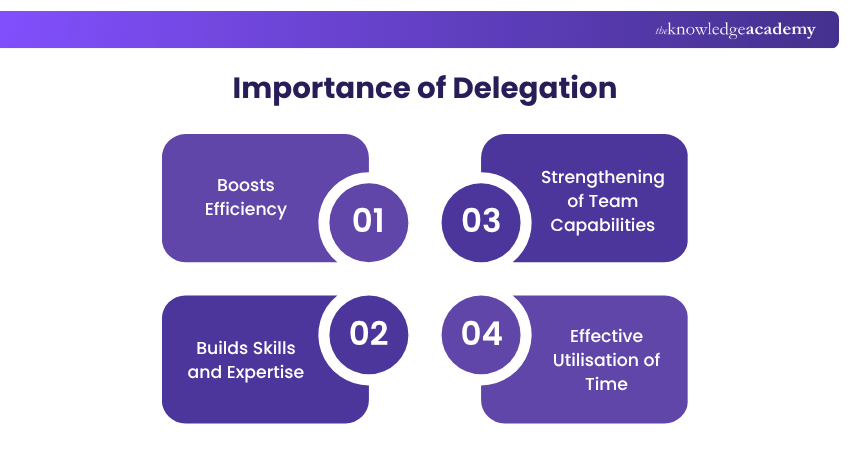
1) Boosts Efficiency
Delegation means tasks can be assigned to team members based on their skills and knowledge to achieve the best results. Assigning tasks according to employees’ skills and knowledge can improve efficiency and help teams produce better-quality work.
2) Builds Skills and Expertise
By assigning tasks, leaders let the team members take on new responsibilities and work on assignments that usually fall outside their responsibilities. This experience shapes their expertise, creating a culture of learning and growth within the organisation.
3) Strengthening of Team Capabilities
Effective delegation can encourage greater responsibility and accountability among team members. It will help them use their judgement and make decisions regarding their assigned tasks, increasing their work capabilities and encouraging teamwork and harmony.
4) Effective Utilisation of Time
Delegation allows managers to spend more time on strategic responsibilities such as planning, decision-making and performance management while team members handle appropriate operational tasks
Types of Delegation
Delegation can be classified in different ways based on its scope, formality, communication method and direction within an organisation. Here are the main types:
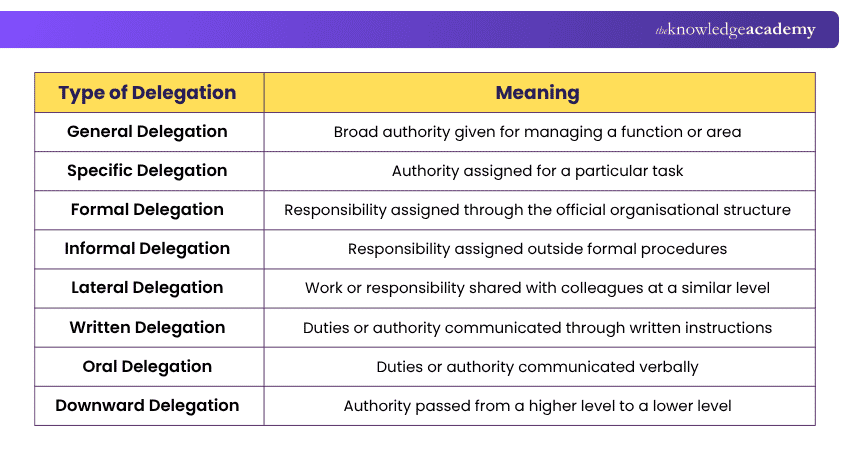
1) General or Specific Delegation
General delegation occurs when a manager grants a subordinate the authority to perform all functions within their department, such as organising, planning, and directing. The manager maintains overall control and can provide guidance as needed.
In contrast, specific delegation involves assigning a subordinate a particular task or function. These tasks are clearly defined. For example, an HR manager might ask an HR assistant to conduct interviews for a specific department over a set period.
2) Formal or Informal Delegation
Formal delegation is integrated into the organisational structure. When someone is assigned a task, they also receive the corresponding authority, meaning everyone automatically gains authority according to their duties.
Informal delegation arises from other circumstances. For example, an employee may temporarily take on a colleague’s responsibility to help complete an urgent project even though the task is not formally assigned to their role.
3) Lateral Delegation
Lateral delegation involves assigning or sharing work with someone at a similar organisational level, where organisational policies and authority allow it. It is commonly used when collaboration or specialised expertise is required.
4) Written or Oral Delegation
Written delegation involves assigning duties, authority or responsibilities through documented communication, such as emails, letters, instructions or formal agreements. It is useful when tasks are complex, deadlines are important or a clear record of responsibilities is required.
Oral delegation occurs when responsibilities are assigned through spoken communication, such as face-to-face discussions, meetings or phone calls. It is usually quicker and more flexible, making it suitable for routine tasks or situations that require immediate action.
5) Downward Delegation
Downward delegation occurs when authority and responsibility are passed from a senior employee or manager to someone at a lower level in the organisational hierarchy. It is one of the most common forms of delegation in management.
Gain the confidence to lead teams and manage business challenges with Business Administration Course – Register today!
Components of Delegation
Delegation is a crucial management practice that involves three critical components. Every leader must know these dimensions because if they are not implemented, teams will not achieve success. Let’s discuss more about these components:
1) Responsibility
Responsibilities mean the expected duties of the individual when they are allocated to do a specific task or job. The delegate's responsibility is to carry out a given task by applying delegation skills and power of will. They are responsible for meeting the standards and deadlines upon receiving an assignment.
2) Authority
In this case, the role of authority is to give the manager the power and the right to make decisions and take actions that may enable the work to be done. Here, the delegates are offered permission to carry on with different organisational resources, make decisions, and take actions that are in harmony with the goals of the project or task. A person having the required authority may do to his responsibility in a good way.
Trainer's Insight
Responsibility and authority should be appropriately aligned. If employees are expected to deliver an outcome, they should also have enough authority to make the decisions required to achieve it.
3) Accountability
Accountability means the delegate should take responsibility, follow the chosen plan, and report on the results. This process implies that the task to be given out is reviewed through the outcomes, and the person (the one to whom you have delegated the job) is responsible for producing the desired results. The employee is accountable for completing the delegated task and reporting results, while the manager normally retains overall accountability for the work they delegate
Gain the insights and tools to drive your team to success – Join our Leadership Courses today!
How to Delegate Effectively?
If you're in a leadership position, consider using the following steps to learn how to delegate effectively:
1) Know When to Delegate
The first step in delegating tasks is understanding when to delegate. For instance, if an employee is aiming for a leadership role, you can assign them some leadership tasks to help build and enhance their skills. Evaluate whether assigning a particular task can contribute to an employee's development or help them improve their skills before delegating any task.
2) Select the Right Candidate
Delegate tasks to a candidate who can effectively complete the task or benefit from it. If you notice that an employee needs to improve a specific skill, you can delegate tasks that will help them develop that skill.
For example, if an employee is uncomfortable speaking in public, you can assign tasks that require them to interact with others, thereby improving their communication and interpersonal skills. You may also delegate time-sensitive tasks to an employee who has the right skills and strengths to complete them promptly.
Pro Tip
Match tasks to both current capability and development potential. An appropriate stretch assignment can help employees build new skills while contributing to team goals.
3) Explain Your Reasoning
Explain to your subordinates why you are assigning them a particular job. This helps them understand how to approach the assignment and boosts their morale. For example, if you ask an employee to conduct an interview, explain that you know they aspire to become a manager and that this task will help them develop managerial and leadership skills. This can encourage them to take the task seriously and ask questions that will help them complete it successfully.
4) Describe the Goals and Provide Resources
Clearly describing the goals of a task helps the employee understand what is expected of them and what they need to achieve. Clear goals can help employees develop steps to complete the tasks, enhancing their creative and problem-solving skills. Provide them with the necessary resources to perform the assigned task, ensuring they can complete the project successfully without delays or challenges.
5) Give Feedback
Provide feedback to your subordinates after they complete the tasks. This helps them understand how they can improve for future assignments and can also build their confidence, especially if they meet your expectations. Additionally, guide the employee if you notice their method is not effective, helping them perform better in the future.
Use this decision tree before handing over a responsibility:
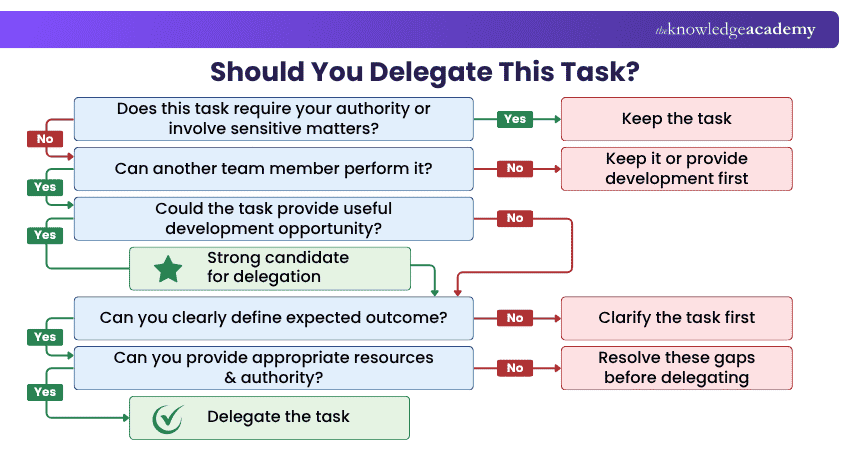
What Tasks Should You Delegate?
Not every task should automatically be delegated. Managers should consider the nature of the task, the employee's capabilities, available resources and the level of authority required. Here's a list of tasks that can be delegated:
1) Tasks that Can Be Suitable for Delegation
a) Routine or recurring responsibilities
b) Tasks another team member has the skills to complete
c) Work that provides an appropriate development opportunity
d) Tasks with clearly defined outcomes
e) Activities that do not require the manager's direct involvement throughout
2) Tasks to Consider Carefully
a) Complex tasks requiring significant guidance
b) New responsibilities requiring additional training
c) Time-sensitive work where the employee is still developing the necessary skills
3) Tasks that May Need to Stay with the Manager
a) Responsibilities requiring the manager's specific authority
b) Highly sensitive matters
c) Certain critical decisions that cannot appropriately be transferred
d) Matters where organisational requirements require direct managerial involvement
Trainer's Insight
A task being time-consuming does not automatically make it suitable for delegation. Consider its sensitivity, complexity, authority requirements and development value first.
Common Delegation Mistakes to Avoid
Even suitable tasks can produce poor results when the delegation process is unclear. Some common mistakes include:
1) Unclear Expectations: Failing to define the expected outcome can leave employees unsure about what successful completion looks like.
2) Choosing the Wrong Person: Assigning a task without considering the employee’s skills or development needs can affect the outcome.
3) Insufficient Authority: Giving responsibility without enough decision-making authority can prevent employees from completing tasks effectively.
4) Micromanaging: Excessive monitoring can restrict autonomy and undermine the purpose of delegation.
5) Lack of Follow-up: Failing to check progress can allow problems to go unnoticed until they affect deadlines or results.
6) Taking the Task Back Too Quickly: Stepping in too soon can prevent employees from solving problems independently and building confidence.
Delegation Readiness Checklist
Before delegating, check:
Is the task appropriate to delegate? Have I selected a suitable person? Is the expected outcome clear? Have I explained why the task matters? Does the employee have appropriate authority? Have I provided the necessary resources? Are priorities and deadlines clear? Have we agreed on suitable checkpoints? Am I allowing enough autonomy? Will I provide feedback afterwards?
Learn how to motivate, guide, and support high-performing technical teams with Technical Team Leading Training – Join now!

The Knowledge Academy develops accessible learning content across Project Management, IT, Cybersecurity, Data Science, Business Analysis, HR, Accounting and Finance, Leadership and Health and Safety. Its resources combine subject research with clear explanations to help professionals build practical knowledge across a wide range of disciplines.
View Detail

 If you wish to make any changes to your course, please


