


 Top Rated Course

We may not have the course you’re looking for. If you enquire or give us a call on +44 1344 203 999 and speak to our training experts, we may still be able to help with your training requirements.
Kaizen Tools for Continuous Improvement
James Smith 27 August 2026Kaizen Tools help teams identify waste, solve process problems and make practical improvements. This blog explains commonly used tools in Kaizen and how they can support continuous improvement.

Training Outcomes Within Your Budget!
We ensure quality, budget-alignment, and timely delivery by our expert instructors.
Table of Contents
Key Takeaways
a. Kaizen focuses on small, continuous improvements to processes and ways of working.b. Each Kaizen Tool supports a different need, such as finding root causes, organising work or managing workflow.c. Teams should choose a tool based on the problem rather than using the same method every time.d. Employee involvement and regular review are essential for sustaining improvements.e. Kaizen can be applied in manufacturing, services, healthcare, offices and digital teams.
Imagine your team is facing the same delay every week. Tasks move between people, deadlines slip, and everyone agrees that something in the process needs to improve.
But where should you begin?
Different problems require different approaches. Some tools help identify root causes, while others make workflows visible, organise work or test improvements.
Kaizen Tools provide practical ways to understand problems and make continuous improvement more structured. In this blog, we'll explore commonly used Kaizen Tools, their benefits and how to choose the right tool for different improvement needs.
What is Kaizen?
Kaizen is a Japanese term commonly translated as “change for the better”. In organisations, it refers to a continuous-improvement approach in which people make ongoing, practical changes to improve processes, quality, safety and customer value.
Kaizen is not limited to large transformation projects. It can involve small improvements made by the people who perform the work every day. This may include simplifying a handover, organising a workstation, reducing unnecessary approvals or preventing recurring errors.

What are Kaizen Tools?
Kaizen Tools are practical methods used to understand processes, identify problems, investigate causes and support continuous improvement. Different tools can help teams organise work, analyse workflow, prioritise issues or test possible improvements.
They can be applied across different working environments, including manufacturing, healthcare, service operations, technology and office-based processes.
Pro Tip
Start with the problem, not the tool. Teams sometimes use a familiar tool before they understand the issue. First, observe the process, speak with the people doing the work and collect basic evidence. Then select the Kaizen Tool that best helps you investigate or improve that specific problem.
Kaizen Tools for Continuous Improvement
Kaizen Tools provide practical ways to identify inefficiencies, solve problems and make small, continuous improvements to everyday processes. Let’s learn about the core tools below:
1) 5 Whys
The 5 Whys is a root-cause analysis technique that involves repeatedly asking why a problem occurred to move beyond its visible symptoms and investigate underlying causes.
Avoid This Mistake
Do not assume that asking “why?” exactly five times will always reveal the root cause. Five is a useful guide rather than a fixed requirement. Some problems may require fewer questions, while complex issues may need additional evidence or other analysis tools.
2) PDCA Cycle
The PDCA Cycle stands for Plan, Do, Check and Act. It provides a repeatable method for improving a process.
a) Plan: Define the problem, analyse the current situation and plan a change.
b) Do: Test the change on a suitable scale.
c) Check: Review the results against the expected outcome.
d) Act: Standardise a successful change or adjust the approach and repeat the cycle.
PDCA helps teams treat improvement as a learning process rather than assuming the first solution will always work.
3) 5S
5S is a workplace organisation method that supports visual control, consistency and easier access to the items people need. The five stages are:
a) Sort: Remove unnecessary items
b) Set in Order: Arrange essential items so they are easy to find and use
c) Shine: Clean and inspect the area regularly
d) Standardise: Create clear routines and visual standards
e) Sustain: Maintain the agreed practices over time
Although 5S is often associated with physical workspaces, it can also be applied to shared digital folders, inboxes and information systems.
4) Gemba Walks
A Gemba walk involves going to the place where work is performed to observe the process and speak with the people doing it. “Gemba” is commonly understood as the actual place where value-creating work happens.
The purpose is not to inspect or blame employees. It is to understand the real process, identify barriers and gather practical improvement ideas from those closest to the work.
5) Value Stream Mapping
Value Stream Mapping is a visual method for analysing the steps, information and material flow involved in delivering a product or service. It helps teams see the full process rather than focusing on a single task or department.
A current-state map shows how work happens now. Teams can then identify waiting time, rework, handover delays and unnecessary steps before designing an effective future-state process.
6) Kanban
Kanban is a visual, pull-based approach for managing the flow of work. A Kanban board commonly shows stages such as “To Do”, “In Progress” and “Done”, allowing teams to see where work is waiting or becoming blocked.
Kanban can also include work-in-progress limits. These limits help teams avoid starting too many tasks at once, allowing them to focus on completing existing work before taking on more.
Trainer’s Insight
Kaizen is not about asking employees to work harder or constantly change everything they do. It is about helping people make work clearer, safer and more effective. The best improvements often come from the people who understand the process most closely.
7) Fishbone Diagram
A Fishbone Diagram helps teams identify and organise possible causes of a problem. The problem is placed at the “head” of the diagram, while potential causes are grouped into categories.
It is particularly useful when a problem may be influenced by several factors, such as people, processes, equipment, materials, data or the working environment.
8) Pareto Analysis
Pareto Analysis helps teams prioritise issues by identifying which problems occur most often or have the greatest impact. It is commonly displayed as a Pareto chart, which combines bars showing frequency with a cumulative percentage line.
This tool is useful when teams cannot address every issue immediately. It helps them focus improvement efforts on the problems likely to produce the most meaningful results.
Benefits of Using Kaizen Tools
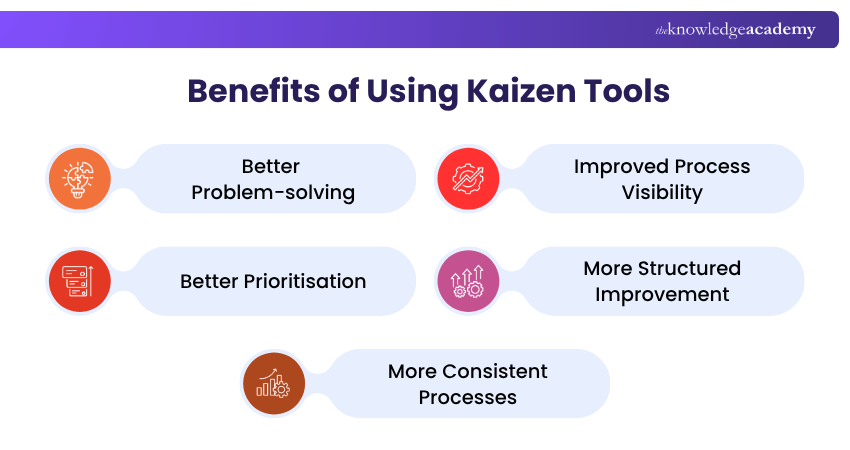
Kaizen Tools make continuous improvement more structured by helping teams understand problems, analyse processes and evaluate possible changes. Key benefits include:
1) Better Problem-solving
Tools such as the 5 Whys and Fishbone Diagram help teams investigate possible causes instead of responding only to visible symptoms.
2) Improved Process Visibility
Value Stream Mapping, Kanban and observation-based approaches can make workflow, delays, handovers and bottlenecks easier to identify.
3) Better Prioritisation
Tools such as Pareto Analysis help teams identify which issues deserve attention first, allowing improvement efforts to focus on areas with greater impact.
4) More Structured Improvement
Methods such as PDCA give teams a repeatable process for planning, testing, reviewing and adjusting changes.
5) More Consistent Processes
When an improvement works, teams can standardise the revised approach and continue reviewing its effectiveness over time.
Learn the language of continuous progress by joining the Certified Kaizen Foundation Training today!
How to Choose the Right Kaizen Tool?
The right Kaizen Tool depends on the problem you are trying to understand or improve. Start by defining the issue clearly, then choose the simplest tool that supports that need.
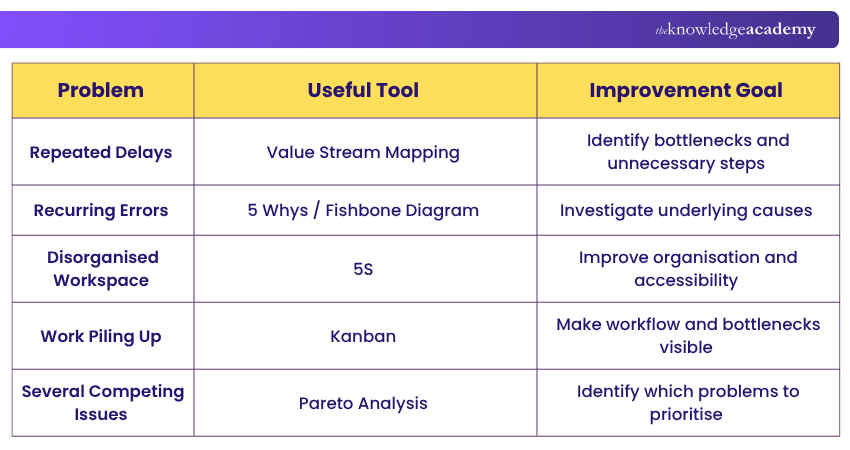
a) For an Unclear Process Problem: Use a Gemba Walk to observe how work actually happens and speak with the people involved.
b) For Recurring Problems: Use the 5 Whys to investigate underlying causes. A Fishbone Diagram can help organise multiple possible causes.
c) For Process Delays and Waste: Use Value Stream Mapping to visualise the complete flow and identify waiting, rework, handovers and unnecessary steps.
d) For Disorganised Work Areas: Use 5S to organise the workspace and establish consistent practices.
e) For Workflow Bottlenecks: Use Kanban to visualise work, identify blockages and manage work in progress.
f) For Prioritising Problems: Use Pareto Analysis to determine which issues occur most frequently or have the greatest impact.
g) For Testing an Improvement: Use the PDCA Cycle to plan a change, test it, evaluate the result and decide what to do next.
Checklist for Using Kaizen Tools Effectively
Before using a Kaizen Tool, check that you can:
Clearly describe the problem or improvement opportunity Involve employees who understand the day-to-day work Gather evidence through observation, data or feedback Select a tool that matches the type of issue Test improvements on a manageable scale Measure whether the change has improved the process Standardise successful changes and review them regularly
Conclusion
Kaizen Tools help teams turn everyday problems into practical opportunities for improvement. From identifying root causes to making workflow visible, these tools support clearer and more efficient ways of working. Choose the tool that fits the problem, involve the people closest to the process and review the results.
Lead change that improves work every day with the Certified Kaizen Foundation & Practitioner Training now!
Frequently Asked Questions
What is the Difference Between a Kaizen Tool and a Kaizen Template?

A Kaizen Tool is a method used to understand or improve a process, such as 5S, PDCA or the 5 Whys. In contrast, a Kaizen template is a ready-made format, such as a checklist, worksheet or diagram, that helps teams apply the tool consistently.
Do Teams Need Special Software to Use Kaizen Tools?
No, many Kaizen Tools can be used with paper, whiteboards, spreadsheets or simple digital templates. The most important factor is that the tool helps the team understand the problem and track the improvement.
Can Multiple Kaizen Tools be Used Together?
Yes. Kaizen Tools can be combined when a problem requires different types of analysis. For example, a Gemba Walk can help a team observe the process, a Fishbone Diagram can organise possible causes, the 5 Whys can investigate them further, and PDCA can then be used to test an improvement.

James Smith


Digital Marketing Manager and Trainer
James Smith is a digital marketing professional with over a decade of experience in SEO, content strategy, paid media and analytics. He has supported both SMEs and global brands in transforming their digital presence. James’s writing and training are rooted in results-driven tactics and the latest marketing trends.
View Detail

 If you wish to make any changes to your course, please


