


We may not have the course you’re looking for. If you enquire or give us a call on 01344203999 and speak to our training experts, we may still be able to help with your training requirements.
30 Problem-solving Techniques: Methods, Examples and How to Use Them
ByNilotpal SarmahLast updated on: 17 September 2026
Understanding when to use different techniques can make the problem-solving process more focused and manageable.

A recurring problem rarely stays small. A missed deadline can become a project delay, a customer complaint can reveal a process weakness, and a minor inefficiency can gradually consume time and resources.
The challenge is not simply finding a solution but identifying the right cause and choosing an approach that fits the situation. Problem-Solving Techniques provide structured ways to analyse issues, generate possible solutions, compare options, and take effective action.
What are Problem-solving Techniques?
Problem-solving Techniques are systematic ways to identify problems, break them down and develop appropriate solutions. These tools help individuals or teams tackle issues by dividing them into smaller parts for analysis, figuring out the root causes, and then building effective solutions.
Common tools like brainstorming, the 5 Whys method, root cause analysis, and mind mapping are often used in Problem-solving. Using these methods can help individuals and teams examine problems from different perspectives, explore multiple solutions and make more structured decisions.

A Step-by-step Foundational Problem-solving Process
Applying a structured approach helps individuals and teams resolve challenges more effectively. By following a clear sequence of steps, you can identify the root cause, evaluate possible solutions, and implement the most appropriate Problem-Solving Techniques. The following is a foundational problem-solving process:
1) Identify the Problem: Recognise the issue by comparing the current situation with the desired outcome. Gather initial information and ask relevant questions to understand what is happening and who is affected.
2) Define the Problem: Create a clear and concise problem statement that explains what is wrong, why it matters and what needs to change. Consider different perspectives and assess the impact on productivity, costs or overall performance.
3) List All Possible Solutions: Brainstorm as many ideas as possible without judging them too early. Encourage input from others, explore both short- and long-term options, and group similar ideas for easier evaluation.
4) Evaluate Options and Make a Decision: Assess each solution based on its effectiveness, feasibility, available resources, and potential risks. Use data, analysis, and decision-making tools to select the option that best addresses the problem.
5) Create a Plan and Begin Implementation: Divide the chosen solution into manageable tasks with clear responsibilities and realistic deadlines. Communicate the plan effectively, monitor progress, and make necessary adjustments to achieve the desired outcome. Following this structured process helps keep Problem-solving Techniques organised, practical, and focused on achieving sustainable results.
Transform conflict into collaboration and build harmonious workplaces with our Conflict Management Training – Sign up today!
30 Problem-solving Techniques
Different challenges require different approaches, making it important to choose the right method for each situation. Problem Solving Techniques provide structured ways to analyse issues, generate practical solutions, and make informed decisions.
Let's look in detail at Problem-solving Techniques that can help individuals and teams analyse challenges and develop practical solutions.
1) Complete Problem-solving Methods
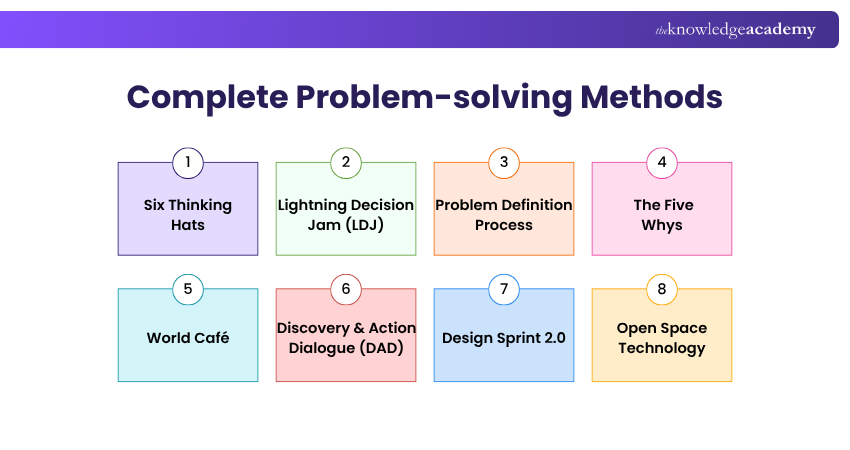
1) Six Thinking Hats: This technique encourages people to examine a problem from different perspectives, such as facts, risks, creativity, benefits and emotions. It helps teams reduce bias and consider challenges more comprehensively.
2) Lightning Decision Jam (LDJ): LDJ is a fast, structured method for identifying problems, generating ideas and prioritising solutions. Team members work individually first and then vote, helping reduce group bias and speed up decision-making.
3) Problem Definition Process: This method focuses on clearly identifying the core issue before attempting to solve it. Teams explore the problem from different angles to improve understanding and uncover alternative perspectives.
4) The Five Whys: The Five Whys technique identifies the root cause of a problem by repeatedly asking "Why?" about each answer. It helps teams move beyond surface-level symptoms and understand what is actually causing the issue.
5) World Café: World Café uses informal small-group discussions to explore complex problems and share ideas. Participants move between conversations, helping knowledge and perspectives circulate across a larger group.
6) Discovery & Action Dialogue (DAD): DAD encourages people to discuss challenges openly and identify practical actions together. It is particularly useful for increasing participation, reducing resistance and building shared ownership of solutions.
7) Design Sprint 2.0: Design Sprint 2.0 is a four-day process used to understand a problem, generate ideas, build a prototype, and test it. It helps teams validate potential solutions before investing in significant time or resources.
8) Open Space Technology: This method allows participants to organise discussions around topics they consider most important. It works well for large groups dealing with complex challenges that benefit from diverse ideas and active participation.
2) Techniques to Identify and Analyse Problems
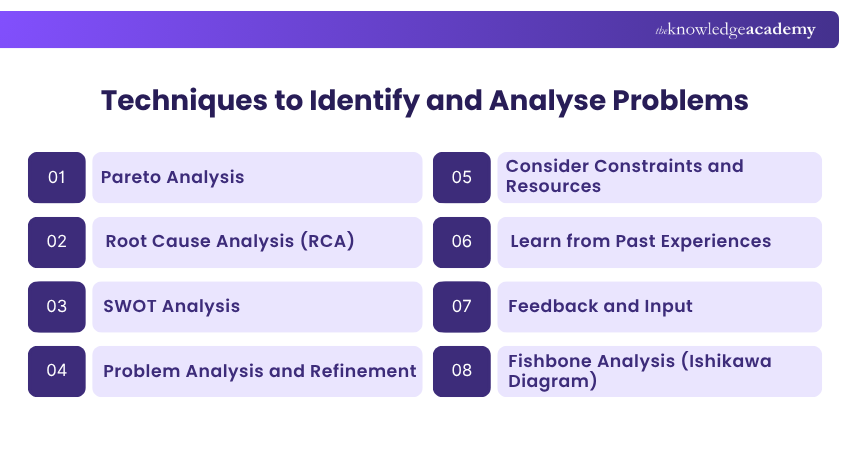
9) Pareto Analysis: Pareto Analysis helps teams identify which causes or problems contribute most significantly to an overall issue. Prioritising the highest-impact areas can help focus improvement efforts where they are likely to make the greatest difference.
10) Root Cause Analysis (RCA): Root Cause Analysis investigates the underlying factors responsible for a recurring problem. Instead of treating symptoms, it helps teams develop solutions that address the source of the issue.
11) SWOT Analysis: SWOT Analysis examines strengths, weaknesses, opportunities and threats related to a problem or situation. It helps decision-makers understand both internal factors and external conditions before choosing a direction.
12) Problem Analysis and Refinement: This technique breaks a broad problem into smaller, more manageable parts. Refining the problem statement makes the issue clearer and helps teams focus their efforts on the most important areas.
13) Consider Constraints and Resources: Problem-solvers should consider factors such as budget, time, people, technology and external limitations. Understanding these constraints helps ensure that proposed solutions are realistic and achievable.
14) Learn from Past Experiences: Reviewing previous successes and failures can reveal useful lessons for solving similar problems. It also helps teams avoid repeating mistakes and apply approaches that have worked before.
15) Feedback and Input: Seeking input from colleagues, stakeholders, mentors or users can reveal issues that may otherwise be overlooked. Different perspectives can improve both the understanding of the problem and the quality of the final solution.
16) Fishbone Analysis (Ishikawa Diagram): Fishbone Analysis visually organises possible causes of a problem into categories. It helps teams explore multiple contributing factors and identify potential root causes in a structured way.
3) Problem-solving Techniques for Brainstorming Solutions
17) Brainstorming Solutions: Brainstorming encourages people to generate as many possible solutions as they can before evaluating them. Delaying judgement helps create an open environment where unconventional ideas can emerge.
18) Creative Thinking: Creative Thinking encourages individuals to move beyond familiar or conventional approaches. Techniques such as lateral thinking, brainstorming and mind mapping can help generate fresh and innovative solutions.
19) Collaborative Problem-solving: Collaborative Problem-solving brings together people with different skills, experiences and viewpoints. Working together can produce more balanced solutions while strengthening engagement and shared responsibility.
20) SCAMPER: Encourages creative thinking by asking whether an existing idea can be substituted, combined, adapted, modified, put to another use, eliminated or rearranged. It can help teams generate alternatives without starting from scratch.
21) Mind Mapping: Mind Mapping visually organises ideas around a central problem or topic. It helps teams understand relationships between ideas, structure information and develop possible solutions more clearly.
Prevent recurring issues with our 8D Problem Solving Training – Register now!
4) Problem-solving Techniques for Developing and Refining Solutions
22) Pugh Matrix: This technique compares different solutions against agreed criteria and a reference option. It helps teams evaluate alternatives systematically when several ideas appear viable.
23) Solution Development: Solution Development turns promising ideas into practical approaches that can be implemented. Teams refine the concept, test feasibility, plan resources and consider how the solution will work in practice.
24) Continuous Learning and Adaptability: Effective Problem Solving requires teams to remain open to new information and changing circumstances. Continuous learning allows solutions and approaches to evolve when new challenges or opportunities arise.
5) Problem-solving Techniques for Making Decisions and Planning
25) Decision Matrix Analysis: A Decision Matrix compares several solutions against selected criteria, with each option scored according to its suitability. It provides a structured way to identify the most viable choice when several alternatives seem reasonable.
26) Risk Analysis: Risk Analysis examines potential problems or uncertainties associated with each solution. By considering likelihood, impact, and possible mitigation measures, teams can make more informed decisions before implementation.
27) 5W2H Method: The 5W2H Method structures an action plan around seven questions: What, Why, Where, When, Who, How and How Much. It helps turn a selected solution into clear responsibilities, timing and implementation requirements.
28) RACI Matrix: This method clarifies who is Responsible, Accountable, Consulted and Informed for different activities. It can help prevent confusion when implementing a solution across several people or teams.
29) Impact and Effort Matrix: The Impact and Effort Matrix compares solutions according to their expected impact and the effort required to implement them. It helps teams identify quick wins, major projects, and lower-priority activities.
6) Closing Activities for a Problem-solving Process
30) Control Chart: A Control Chart tracks process performance over time and helps identify unusual variation. It can be used after implementation to assess whether improvements are being sustained or whether further investigation is needed.
Example of Problem-solving Technique in the Workplace
Consider a customer service team receiving an increasing number of complaints about delayed responses. The team knows there is a problem, but immediately choosing a solution could mean treating the symptom rather than understanding its cause.
Here is how several Problem-solving Techniques could work together to solve this:
1) Step 1: Find the Cause
The team could begin with Fishbone Analysis to explore possible causes under areas such as people, processes, systems and workload.
They might then use the Five Whys to investigate one suspected cause in greater depth.
For example:
Problem: Customer responses are regularly delayed.
Why? Agents have a large backlog of unanswered enquiries.
Why? Many enquiries require manual information checks.
Why? Information is stored across several systems.
Why? Agents do not have one consistent way to retrieve it.
The exercise shifts attention from simply "working faster" towards a potentially deeper process issue.
2) Step 2: Generate Possible Solutions
The team could use Brainstorming or Mind Mapping to generate options without immediately rejecting ideas.
Possible solutions might include:
a) creating a central knowledge resource;
b) simplifying common enquiry workflows;
c) introducing reusable response templates;
d) changing how incoming enquiries are prioritised;
e) reviewing whether repetitive information checks can be reduced.
3) Step 3: Compare the Options
A Decision Matrix could then compare the proposed solutions according to criteria such as expected benefit, cost, implementation time and available resources.
A Risk Analysis could identify possible problems before the preferred option is implemented.
4) Step 4: Turn the Decision Into Action
Once a solution has been selected, SMART criteria can make the objective clearer.
For example:
"Reduce the average response time for standard customer enquiries by 20% within eight weeks by introducing a centralised knowledge resource and reviewing progress weekly."
5) Step 5: Review the Results
The team should then monitor the outcome and compare it with the original problem. If response times improve but complaints remain high, the process may need another round of analysis.
This example shows why Problem-solving Techniques do not have to be used independently. One technique can diagnose the problem, another can generate ideas, and another can support the final decision.
Enhance the art of leadership and accelerate your professional growth with our Management Courses – Sign up today.

Nilotpal Sarmah is a Senior Content Writer with 11+ years of overall experience spanning engineering, operations and content development. His technical knowledge and extensive writing experience enable him to simplify specialised topics across IT and Tech, Business Skills, Project Management, Health and Safety, and ISO and Compliance.
View Detail

 If you wish to make any changes to your course, please


