




We may not have the course you’re looking for. If you enquire or give us a call on 01344203999 and speak to our training experts, we may still be able to help with your training requirements.
Top 12 Technology Skills Shaping Careers in 2027
ByThe Knowledge AcademyLast updated on: 23 November 2026
As technology reshapes career opportunities, skills in AI, data, cloud computing and cyber security are becoming increasingly valuable. Discover the important technology skills for 2027 and how to choose the right ones for your career.
What to Expect
1. AI, data and cyber security are among the technology skill areas expected to grow in importance.2. Cloud computing, software development and DevOps support modern digital infrastructure and applications.3. Data engineering, database management and systems integration help organisations manage and connect information.4. Machine learning, automation and AI governance create opportunities for specialised technical expertise.5. Choosing the right skills depends on your career goals, existing knowledge and industry requirements.
Jobs are changing.
Tools are evolving.
And the skills employers value are changing with them.
From AI and cloud computing to cyber security and data analytics, technology is influencing how organisations operate and what they expect from their workforce.
So, which technology skills should professionals focus on developing? This blog focuses on the top 12 skills shaping career opportunities across industries. So, continue reading!
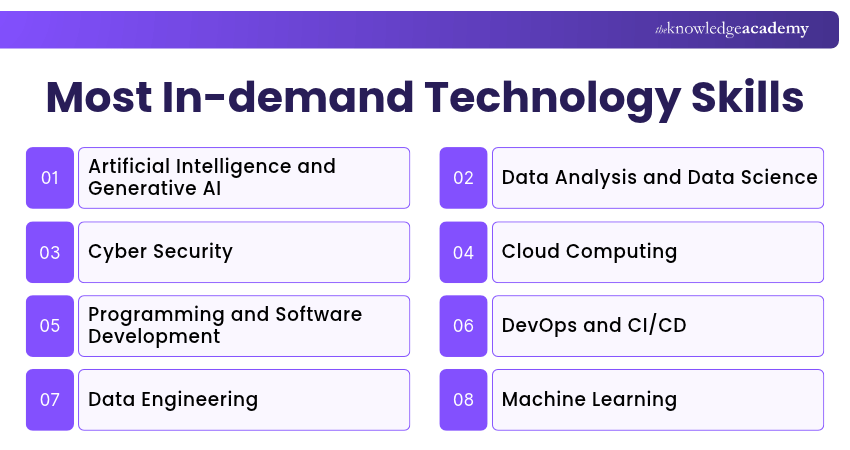
12 Most In-demand Technology Skills
Technology skills refer to the knowledge and practical abilities needed to use, develop and manage digital tools, systems and emerging technologies. As organisations embrace digital transformation, understanding which skills are gaining importance can help professionals make informed learning decisions and prepare for evolving career opportunities.
Below are 12 technology skills that are expected to remain valuable and support professional growth in an increasingly digital workplace:
1) Artificial Intelligence and Generative AI
Artificial Intelligence (AI) and Generative AI are becoming important skill areas as organisations adopt intelligent tools to support business operations, software development and decision-making. Professionals who understand AI capabilities, limitations and responsible use can contribute to developing and applying these technologies effectively.
Key skills include prompt engineering, working with Large Language Models (LLMs), model fine-tuning and developing AI-powered applications and workflows. Knowledge of agentic AI systems, which can plan and execute multi-step tasks using appropriate tools and oversight, is also becoming relevant to specialised AI roles.

2) Data Analysis and Data Science
Organisations collect large volumes of data that can provide insights into business performance, customer behaviour and operational trends. Data analysis involves examining and interpreting this information to support informed decisions, while data science extends into statistical modelling, predictive analytics and machine learning.
Professionals in these fields use statistical methods, data visualisation and programming to identify patterns and communicate findings. Tools such as Python, SQL, Power BI and Tableau support different stages of analysis, while predictive modelling helps data scientists investigate trends and potential outcomes.
3) Cyber Security
Cyber security involves protecting digital systems, networks and sensitive information from unauthorised access, cyber attacks and data breaches. As organisations increasingly depend on digital technologies, professionals with the ability to identify vulnerabilities, assess security risks and respond to potential threats play an important role in maintaining secure business operations.
Key cyber security skills include threat detection, vulnerability assessment, identity and access management, incident response and security risk management. Developing expertise in these areas can support career opportunities in security monitoring, engineering, incident response and information security management.
4) Cloud Computing
Cloud computing enables organisations to access computing resources, storage, applications and other services through cloud platforms. Services from Amazon Web Services (AWS), Microsoft Azure and Google Cloud support a wide range of business applications, creating opportunities for professionals who can deploy, secure and manage cloud environments.
Technologies such as Docker, Kubernetes and Terraform support containerised applications, orchestration and infrastructure automation. Knowledge of hybrid and multi-cloud environments is also useful for organisations operating across different infrastructure models.
Advance your technical expertise with practical cloud computing skills through Cloud Computing Training - Register now!
5) Programming and Software Development
Programming and software development skills are essential for designing, building, testing and maintaining applications and digital systems. Languages such as Python, JavaScript and Java are widely used across software development, automation and enterprise applications.
Modern software development involves more than writing code. Developers need to understand application architecture, debugging, testing and version control to produce reliable and maintainable software.
6) DevOps and CI/CD
DevOps combines development and IT operations to improve collaboration, automate delivery and enhance software reliability. Continuous Integration (CI) regularly integrates and tests code changes, while Continuous Delivery (CD) keeps software ready for release through automated processes.
DevOps practices help organisations improve how software moves from development into production. By incorporating automated testing, infrastructure management and continuous monitoring into delivery workflows, teams can identify problems earlier, reduce manual effort and support more reliable software releases.
Trainer's Insight
Learning the commands of a tool is only one part of developing technical expertise. Understanding why a particular approach works, when to use it and what limitations it has can help you apply your knowledge across different technologies.
Drive operational excellence through modern DevOps practices with the DevOps Foundation Certification Course. Join now!
7) Data Engineering
Data engineering involves designing, building and maintaining systems that collect, process, store and prepare data for analysis and other business applications. As organisations handle growing volumes of information, Data Engineers help ensure that data is accurate, accessible and reliable for reporting, analytics and AI-driven applications.
Essential skills include SQL, Python, data pipeline development, data modelling and cloud-based data platforms. Expertise in these areas helps professionals build scalable data infrastructure and support organisations in making effective use of their information.
8) Machine Learning
Machine Learning (ML) is a branch of AI that enables systems to learn patterns from data and use them to make predictions, generate outputs or support decisions without relying solely on explicitly programmed rules. It is used in applications such as fraud detection, recommendation systems, forecasting and image recognition.
Developing machine learning applications involves preparing datasets, training models, evaluating their performance and monitoring them after deployment.
9) Automation and Scripting
Automation and scripting skills help professionals reduce manual effort by creating scripts and automated processes for repetitive tasks. These capabilities are useful for file management, data processing, system administration and routine business operations.
Organisations use automation to improve the consistency and efficiency of everyday processes. Scripting languages such as Python, Bash and PowerShell allow professionals to automate repeatable tasks, while low-code platforms make certain workflows accessible with less programming.
Streamline your operations and future-proof your skills with AI Automation Course for Operations - Sign up now!
10) Database and SQL Skills
Database and SQL skills involve designing, managing and retrieving information using Database Management Systems (DBMS). SQL is used to define, query and manipulate data in relational databases, while database management involves maintaining data integrity, security and performance.
Professionals working with systems such as MySQL, PostgreSQL and Microsoft SQL Server support database design, query optimisation, access management and routine maintenance. These capabilities are useful in database administration, software development and data analysis, where reliable information storage and retrieval are essential.
Remember This
Data analysis, data engineering and database management are related but serve different purposes. Data Analysts interpret information, Data Engineers prepare and move data, and database professionals manage how information is stored, accessed and maintained.
11) API and Systems Integration
Application Programming Interface (API) and systems integration skills involve connecting different software applications, platforms and databases to enable seamless communication and data exchange. As organisations use multiple digital tools for their operations, professionals who can integrate these systems help improve connectivity, automate workflows and ensure information moves reliably between applications.
Key skills include REST APIs, API development, JSON, authentication protocols, webhooks and integration testing. Proficiency in these areas supports careers in software development, systems integration and cloud engineering, where connecting applications and maintaining reliable data exchange are essential.
12) AI Security and Governance
AI security and governance skills involve protecting AI systems from security threats while ensuring they are developed and used responsibly. As organisations integrate AI into business operations, professionals need to understand how to manage AI-related risks, safeguard sensitive data and maintain appropriate oversight of automated systems.
This field requires knowledge of AI risk assessment, prompt injection prevention, data privacy, model security, bias evaluation and AI governance frameworks. Developing expertise in these areas can support opportunities in AI Security, Responsible AI and Technology Risk Management.
How to Choose the Right Technology Skills for Your Career?
Choosing the right technology skills depends on your career goals, current experience and the demands of your industry. Rather than trying to learn every new technology, focus on skills that align with your interests and offer long-term career opportunities.
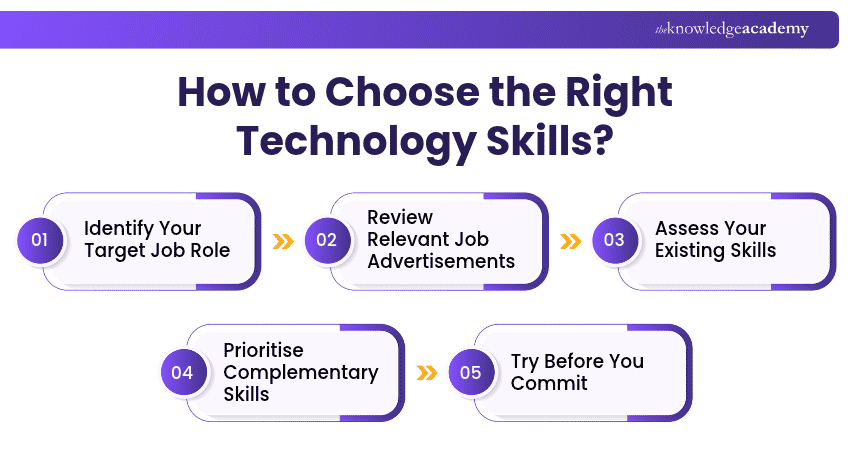
Here are five practical steps to identify relevant skills and plan your professional development:
Step 1: Identify Your Target Job Role
Choose a role you would like to pursue within the next two to three years, such as Data Analyst or Cloud Engineer. Having a clear career goal can help you identify which technical skills deserve priority.
Step 2: Review Relevant Job Advertisements
Review several current job advertisements for your target role and identify the technical skills, tools and qualifications employers frequently request. Compare the requirements across different organisations to understand which capabilities are consistently valued.
Step 3: Assess Your Existing Skills
Compare the skills identified in job advertisements with your current knowledge and experience. Determine which requirements you already meet and which areas need further development. This will help you identify specific skill gaps and plan your learning priorities.
Step 4: Prioritise Complementary Skills
Some technology skills become more valuable when developed together. Cloud computing and DevOps, for instance, support infrastructure management and software delivery, while data analysis and data engineering complement each other in preparing and interpreting information. Choose combinations that support the responsibilities of your target role.
Step 5: Try Before You Commit
Begin with an introductory lesson, guided exercise or small practical project to explore your chosen skill. This can help you assess its difficulty, relevance and suitability before committing to more extensive training. Use what you learn to refine your development plan.
Technology skills today go far beyond knowing how to code, and you do not need to master all twelve areas covered here. Pick two or three that fit your goals, start practising them this week and keep adapting as technology moves forward.
Discover how intelligent systems drive innovation across industries with the Machine Learning Course. Join now!

The Knowledge Academy develops accessible learning content across Project Management, IT, Cybersecurity, Data Science, Business Analysis, HR, Accounting and Finance, Leadership and Health and Safety. Its resources combine subject research with clear explanations to help professionals build practical knowledge across a wide range of disciplines.
View Detail

 If you wish to make any changes to your course, please


