


 Top Rated Course

We may not have the course you’re looking for. If you enquire or give us a call on 01344203999 and speak to our training experts, we may still be able to help with your training requirements.
Interpersonal Communication Skills: A Complete Overview
Charlotte Wilson 27 August 2026Interpersonal Communication Skills shape how people exchange ideas, understand others, and respond effectively. They support stronger interactions and relationships across personal and professional settings.

Training Outcomes Within Your Budget!
We ensure quality, budget-alignment, and timely delivery by our expert instructors.
Table of Contents
Key Takeaways
1. Interpersonal Communication Skills help people exchange information, thoughts and feelings effectively.2. Verbal, nonverbal, written and listening communication all influence interpersonal interactions.3. Active listening, empathy, clarity and constructive feedback support stronger conversations.4. Strong communication can improve collaboration, relationships, problem-solving and conflict management.5. Regular practice, reflection and feedback can help strengthen Interpersonal Communication Skills.
Ctrl + Z works brilliantly on a document. Unfortunately, conversations do not come with it. Once something is said, its impact cannot always be reversed with a quick “that’s not what I meant.”
Strong Interpersonal Communication Skills can prevent those moments by helping us communicate thoughtfully, listen actively and understand how our words and behaviour may be received. Let’s explore the skills that make those interactions work!
What are Interpersonal Communication Skills?
Interpersonal Communication Skills are the abilities people use to exchange information, express thoughts and understand others during interactions. They involve both verbal and non-verbal communication, including speaking, active listening, body language, tone of voice and the ability to give and receive feedback effectively.
These skills are used during face-to-face conversations, meetings, phone calls, video discussions, emails and many other forms of interaction. Strong Interpersonal Communication Skills can help individuals build better relationships, collaborate effectively, resolve misunderstandings and communicate more confidently in both personal and professional settings.
Myth vs Fact
Myth: Good interpersonal communication mainly depends on being a confident speaker.
Fact: Effective communication requires both expressing yourself clearly and understanding what the other person is communicating.
Types of Interpersonal Communication
Interpersonal communication can take several forms depending on how information is exchanged. Understanding these forms makes it easier to recognise where communication is working well and where improvement may be needed. Interpersonal Communication commonly involves four key forms and processes:
1) Verbal Communication: Uses spoken words to share information, ideas, and meaning. Word choice, clarity, pace, tone, and message structure can all influence how effectively the listener understands what is being said.
2) Nonverbal Communication: Uses facial expressions, posture, gestures, eye contact, and other physical cues. These signals can support spoken words or sometimes communicate a different message.
3) Written Communication: Uses emails, direct messages, letters and other written exchanges between people. Clear wording, an appropriate tone, and sufficient context help the reader understand the intended message.
4) Listening: Requires paying attention, interpreting meaning, and responding appropriately. It helps ensure that messages are understood rather than simply heard.
Remember!
Interpersonal Communication rarely relies on just one form. Spoken words, listening, body language, and written messages often work together to shape how effectively people understand one another.
Essential Interpersonal Communication Skills
Effective communication depends on several connected abilities rather than one single skill. The following Interpersonal Communication Skills are particularly important.
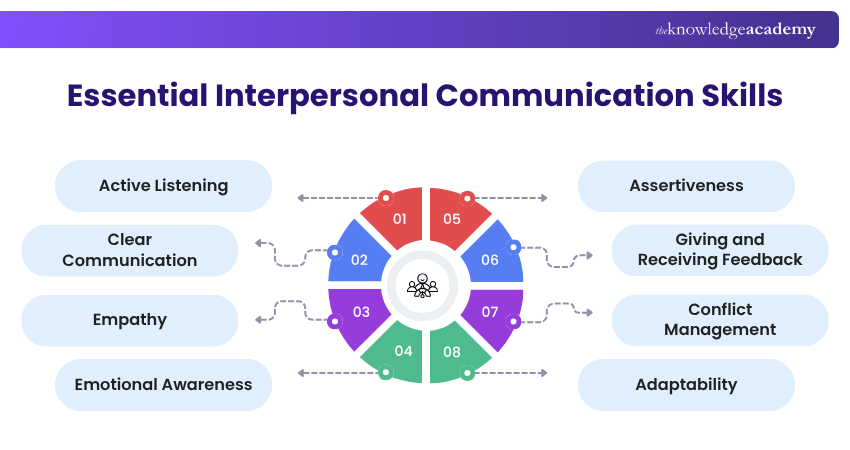
1) Active Listening
Active listening means giving another person your attention and making an effort to understand their message before responding. Useful behaviours include asking relevant questions, summarising important points and avoiding unnecessary interruptions.
2) Clear Communication
Clear communication involves expressing ideas in a way that is easy for the other person to understand. This usually means using direct language, providing enough context and avoiding unnecessary complexity.
3) Empathy
Empathy helps communicators consider another person's feelings and perspective. This can be especially valuable during sensitive discussions, disagreements or conversations where people have different experiences.
4) Emotional Awareness
Recognising your own emotions can help you manage how frustration, stress or defensiveness influences your communication. It can also make it easier to recognise emotional cues from others and respond appropriately.
5) Assertiveness
Assertive communication allows people to express their opinions, boundaries and requirements clearly without becoming aggressive or dismissive. For example, saying, “I can complete this tomorrow, but I cannot deliver it accurately by this afternoon,” communicates a clear boundary while remaining constructive.
6) Giving and Receiving Feedback
Constructive feedback focuses on behaviour, outcomes and possible improvements rather than personal criticism. Receiving feedback effectively also requires listening carefully and considering the information before reacting.
7) Conflict Management
Disagreements are not always avoidable, but communication can influence how they develop. Asking questions, clarifying assumptions and focusing on the issue rather than the individual can make conflict easier to manage.
8) Adaptability
Different people and situations may require different communication approaches. A detailed explanation may suit a technical discussion, while a short summary may be more appropriate for someone who only needs the main decision.
Decode the Conversation
Manager: “Can you finish the report soon?”Employee: “Sure, I’ll get it done.”What’s the problem?“Soon” is unclear. Both may have different expectations about the deadline.Better Communication:Manager: “Can you complete the report by 3 PM tomorrow?”Employee: “Yes, I’ll have it ready by then.”Takeaway: Replace assumptions with clarity to prevent misunderstandings.
Build confidence and presentation skills with the Public Speaking Course and communicate ideas clearly to any audience.
Examples of Interpersonal Communication Skills in Practice
Interpersonal Communication Skills become easier to understand when viewed through everyday situations. Here are a few examples of how they can be applied:
1) During a Team Discussion
A colleague proposes an idea that you do not fully understand. Instead of immediately rejecting it, you ask them to explain their reasoning and summarise what you understood before giving your view. This combines active listening, clarification and respectful disagreement.
2) When Giving Feedback
A manager needs to discuss missed deadlines with a team member. Rather than making a general statement about poor performance, the manager refers to specific examples, explains their impact and agrees on practical next steps. This makes the conversation focused and constructive.
3) During a Disagreement
Two colleagues disagree about how a project should proceed. Effective Interpersonal Communication helps them explain their concerns, listen to each other's reasoning and identify areas where compromise may be possible.
4) During a Customer Conversation
A customer is frustrated about a problem. Listening without interrupting, acknowledging the concern and explaining the next action clearly can help reduce confusion and move the conversation towards a solution.
Trainer's Tip: Before responding to an important conversation, make sure you understand the other person's point. A short clarification such as “Have I understood correctly that...?” can prevent an incorrect assumption from shaping the rest of the discussion.
Why are Interpersonal Communication Skills Important?
Strong Interpersonal Communication Skills can improve the quality of interactions in both professional and personal settings. Their importance can be seen in several areas:
1) Better Understanding: Clear messages and active listening reduce the likelihood of misunderstandings.
2) Stronger Relationships: Respectful communication can support trust and mutual understanding.
3) Improved Collaboration: Teams can exchange ideas, responsibilities and feedback more effectively.
4) Constructive Conflict Management: Good communication helps people discuss differences without unnecessarily escalating them.
5) Better Problem-solving: Asking questions and sharing perspectives can reveal information that one person may have overlooked.
6) Effective Feedback: People can address performance or behaviour while keeping the discussion focused on improvement.
These benefits are often interconnected. For example, better listening can reduce misunderstanding, which can make collaboration easier and prevent avoidable conflict.
7-Day Interpersonal Communication Challenge
Put your communication skills into practice with one simple task each day:
1. Day 1: Listen without interrupting2. Day 2: Ask three open-ended questions3. Day 3: Pay attention to your tone4. Day 4: Clarify one assumption5. Day 5: Give specific, constructive feedback6. Day 6: Practise assertive communication7. Day 7: Reflect on one important conversationGoal: Small daily changes can help build clearer, more thoughtful communication habits over time.
Ways to Improve Interpersonal Communication Skills
Interpersonal Communication Skills can be strengthened through deliberate practice. The most useful approach is usually to identify specific behaviours rather than simply deciding to “communicate better”. Let's check how you can improve this skill:
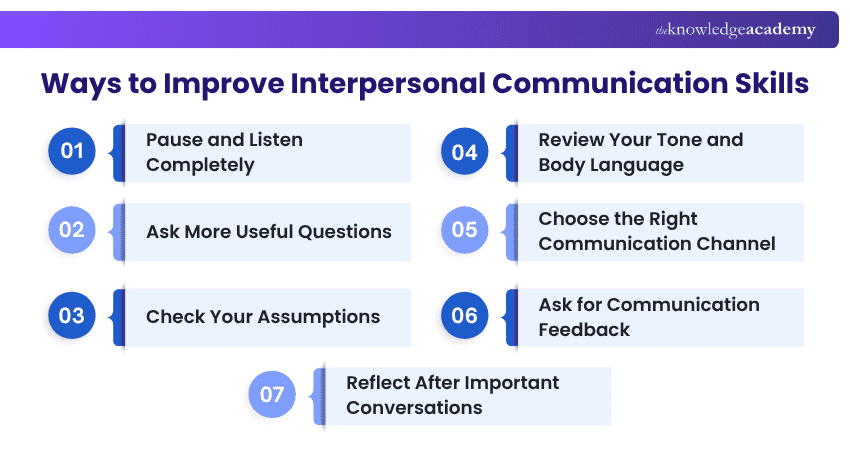
1) Pause and Listen Completely
Focus on understanding the complete message before deciding how to respond. Summarising what you heard can also help confirm that your interpretation is correct.
2) Ask More Useful Questions
Use open questions to uncover details and perspectives that may otherwise remain unclear. Use open questions to explore ideas and specific questions to clarify details.
3) Check Your Assumptions
Avoid assuming you know another person's intentions or meaning. Clarify anything uncertain before allowing an interpretation to shape your response.
4) Review Your Tone and Body Language
Consider whether your tone, posture and facial expressions support the message you intend to communicate.
5) Choose the Right Communication Channel
Match the method to the situation. Sensitive or complex discussions may be better handled through direct conversation than a short written message.
6) Ask for Communication Feedback
Invite trusted colleagues to identify areas where your communication could become clearer. Look for recurring patterns rather than focusing on one isolated comment.
7) Reflect After Important Conversations
Consider what worked, what created confusion and what you could handle differently next time. Regular reflection can turn everyday interactions into opportunities to improve.
Your Interpersonal Communication Checklist
Before or during an important conversation, use the following quick check:
Do I know what I need to communicate? Am I using language the other person can easily understand? Have I listened to their complete point? Have I checked any assumptions I am making? Do my tone and body language support my message? Have I given the other person an opportunity to respond? Is the communication channel appropriate for the discussion?
Common Barriers to Effective Interpersonal Communication
Even strong communicators can encounter barriers that reduce understanding. Recognising these barriers can help people address them earlier.
1) Poor Listening
Interrupting, becoming distracted or thinking about a response too early can cause important information to be missed.
How to Overcome it: Give the speaker your attention and clarify important points before responding.
2) Assumptions
People may believe they already understand another person's intentions without checking.
How to Overcome it: Ask questions instead of relying on interpretations that have not been confirmed.
3) Unclear Language
Jargon, vague wording and excessive detail can make a simple message difficult to understand.
How to Overcome it: Match the language and amount of detail to the person receiving the message.
4) Emotional Reactions
Recognise when emotions are affecting the conversation, pause if appropriate and return attention to the specific issue rather than reacting impulsively.
How to Overcome it: Recognise emotional reactions and focus the conversation on the specific issue being discussed.
5) Conflicting Nonverbal Signals
Tone, facial expressions or posture may contradict the spoken message.
How to Overcome it: Become more aware of whether verbal and nonverbal communication are conveying consistent meaning.
6) Choosing the Wrong Communication Channel
Not every discussion is suited to email, messaging or a meeting.
How to Overcome it: Match the communication method to the complexity, sensitivity and urgency of the conversation.
Conclusion
Interpersonal Communication Skills influence how clearly people express ideas, understand others, and respond in different situations. By recognising barriers, practising specific behaviours, and learning from feedback, people can gradually build more effective and confident communication.
Develop confident communication with Assertiveness Skills Training and express your ideas clearly and respectfully.
Frequently Asked Questions
What is the Difference Between Intrapersonal and Interpersonal Communication?

Interpersonal Communication takes place between two or more people. Intrapersonal communication happens within an individual and includes internal thinking, reflection and self-talk.
Can Interpersonal Communication Take Place Online?
Yes. Video calls, instant messages, emails and other digital channels can all involve Interpersonal Communication when people exchange information directly with one another.
Are Interpersonal Communication Skills Learned or Natural?
People may find certain communication behaviours easier than others, but Interpersonal Communication Skills can be developed. Practice, observation, feedback and reflection can all help improve how a person communicates.

Charlotte Wilson


Soft Skills and Business Training Manager
Charlotte Wilson is an expert in soft skills development, with over 14 years of experience helping individuals and teams improve communication, productivity and emotional intelligence in the workplace. Her training content is focused on enhancing interpersonal effectiveness and fostering positive, collaborative environments across all levels of an organisation.
View Detail

 If you wish to make any changes to your course, please


