


We may not have the course you’re looking for. If you enquire or give us a call on 01344203999 and speak to our training experts, we may still be able to help with your training requirements.
Essential Credit Controller Skills for Career Success
ByThe Knowledge AcademyLast updated on: 14 November 2026
Credit Controller skills are essential for managing customer accounts, recovering outstanding payments and reducing financial risks. Explore the important skills to build a successful career in credit control.
Quick Preview
1. Communication Skills: Discuss payment terms clearly and maintain professional customer relationships.2. Financial Analysis: Interpret financial information to assess creditworthiness and identify payment risks.3. Collections Management: Follow up on overdue payments and negotiate practical repayment arrangements.4. Technical Proficiency: Use accounting software and spreadsheets to track customer accounts.5. Regulatory Awareness: Follow relevant credit management policies and legal requirements.
Can you recover overdue payments?
Can you identify risky customer accounts?
Can you negotiate without losing customer trust?
If you're considering a career in credit control, these questions highlight just a few of the challenges you'll encounter. Explore essential Credit Controller skills that help you handle them effectively. Let's begin!
Skills Required for a Credit Controller
Credit Controllers need a combination of financial expertise, interpersonal abilities and technical knowledge to manage accounts effectively. The following are the essential Credit Controller skills:
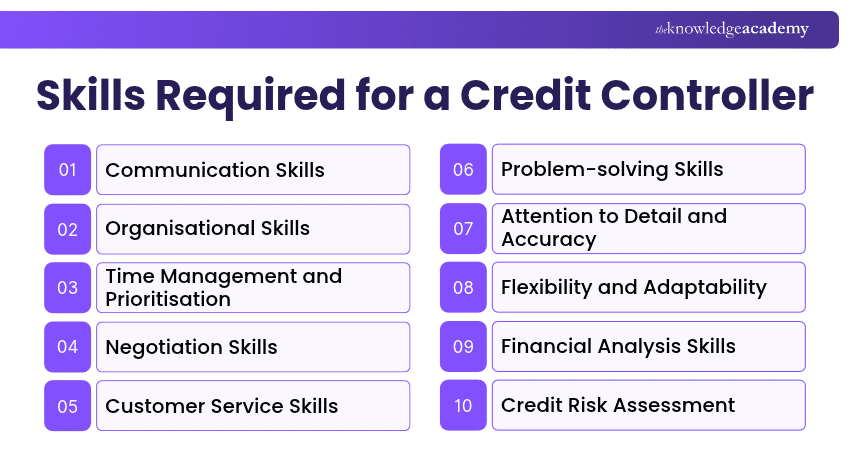
1) Communication Skills
Effective communication is essential for Credit Controllers when discussing payment terms, addressing customer concerns and following up on overdue invoices. Clear written and verbal communication, combined with active listening, helps customers understand their obligations, prevents misunderstandings and supports timely payments.

2) Organisational Skills
Credit Controllers manage multiple customer accounts, payment schedules and financial records simultaneously. Strong organisational skills help them maintain accurate documentation, track outstanding invoices and coordinate activities across departments, ensuring important follow-ups are completed without unnecessary delays.
3) Time Management and Prioritisation
Time management helps Credit Controllers balance responsibilities such as monitoring payment deadlines, responding to customer queries and following up on overdue accounts. For example, prioritising high-value overdue invoices, accounts approaching credit limits and customers with repeated payment delays helps address urgent matters while maintaining routine operations.
4) Negotiation Skills
Negotiation skills enable Credit Controllers to discuss repayment arrangements, resolve payment disagreements and reach practical financial agreements with customers. Effective negotiation requires understanding the customer's circumstances while protecting the organisation's financial interests.
Turn difficult conversations into agreements that work for everyone with the Negotiation Skills Training now!
5) Customer Service Skills
Customer service skills are essential because Credit Controllers regularly interact with customers regarding outstanding balances, invoice queries and payment arrangements. Providing accurate information, responding promptly to concerns and explaining payment options respectfully helps build trust and preserve long-term business relationships.
6) Problem-solving Skills
Problem-solving skills help them investigate issues such as disputed invoices, incorrect payment allocations and unexpected payment delays and determine appropriate solutions. For example, when a customer disputes an invoice, reviewing transaction records, verifying billing details and coordinating with the finance or sales department can help resolve the issue.
7) Attention to Detail and Accuracy
Credit Controllers handle financial records, invoices, customer account details and payment information that require a high level of accuracy. Even minor errors can result in incorrect balances, payment disputes or reporting discrepancies. Attention to detail helps identify inconsistencies, verify transactions and maintain reliable records.
8) Flexibility and Adaptability
Credit control practices continually evolve as organisations adopt new technologies, update internal policies and respond to changing economic conditions. Adaptable Credit Controllers can learn new accounting systems, respond to changing customer payment behaviour and adjust collection strategies while maintaining effective financial processes.
9) Financial Analysis Skills
Financial analysis skills enable Credit Controllers to interpret financial information and understand factors affecting customers' ability to pay. Reviewing financial statements, outstanding balances and payment histories can reveal trends such as increasing delays or repeated missed payments.
10) Credit Risk Assessment
Credit risk assessment involves evaluating the likelihood that customers may fail to meet their payment obligations. Credit Controllers may review credit reports, payment histories and other available financial information to identify potential risks. This helps them recognise warning signs, monitor credit exposure and recommend appropriate actions.
Trainer's Insight
Credit risk assessment is not a one-time activity. Customer circumstances can change, so reviewing payment behaviour and credit exposure regularly helps identify emerging risks before they become serious collection problems.
11) Collections Management
Collections management involves monitoring overdue accounts, contacting customers and implementing appropriate payment recovery procedures. Credit Controllers must maintain professional communication, record agreed payment dates and follow up consistently to encourage settlements, reduce overdue debt and improve cash flow.
12) Accounts Receivable Management
Accounts receivable management focuses on tracking payments owed by customers and ensuring that financial records accurately reflect outstanding balances. Credit Controllers use this skill to monitor unpaid invoices, reconcile customer accounts and investigate payment discrepancies.
13) Credit Control Software Proficiency
Modern Credit Controllers use accounting software, spreadsheets and credit management systems to monitor customer accounts and streamline routine activities. Familiarity with tools such as Microsoft Excel and accounting platforms helps them generate aged debt reports, track payment commitments and analyse outstanding balances.
14) Regulatory Compliance Awareness
Credit Controllers must understand relevant legal, regulatory and organisational requirements, including data protection, contractual payment terms and debt collection rules. In the UK, they must handle personal information in accordance with applicable data protection legislation and follow Financial Conduct Authority (FCA) requirements where regulated consumer credit activities are involved.
Make numbers work smarter and financial decisions count by joining the Financial Management (FM) Training today!
15) Reporting and Decision-making Skills
Credit Controllers need reporting skills to communicate the status of outstanding debts, payment trends and collection activities to management. Common measures include aged receivables, overdue balances and Days Sales Outstanding (DSO), where relevant. Interpreting these figures alongside customer payment histories helps identify collection priorities and recommend informed credit management decisions.
Bonus Tip: Prioritise Accounts Based on Risk
Not all overdue accounts require the same level of attention. Use aged debt reports, payment histories and outstanding balances to identify high-risk accounts and prioritise follow-ups. This helps you focus collection efforts where they are needed most, reduce payment delays and support healthier cash flow.
How to Improve Your Credit Controller Skills
Developing Credit Controller skills requires consistent practice, financial knowledge and familiarity with relevant tools. The following approaches can help improve professional capabilities:
1) Strengthen Financial Knowledge: Develop an understanding of accounting principles, accounts receivable processes and credit management practices.
2) Practise Negotiation Techniques: Use realistic payment scenarios to improve communication, objection handling, and repayment discussions.
3) Improve Technical Proficiency: Learn spreadsheet functions, accounting software, and credit reporting tools commonly used in finance departments.
4) Develop Analytical Skills: Practise interpreting aged debt reports, reviewing payment histories and identifying potential credit risks.
5) Stay Informed About Regulations: Keep up with relevant data protection, credit management and debt collection requirements.
6) Seek Practical Experience: Gain exposure to invoice processing, account reconciliation and customer payment follow-ups through relevant finance roles.
Balance the books, track every payment and keep finances flowing with the Accounts Payable and Receivable Training – Join now!

The Knowledge Academy develops accessible learning content across Project Management, IT, Cybersecurity, Data Science, Business Analysis, HR, Accounting and Finance, Leadership and Health and Safety. Its resources combine subject research with clear explanations to help professionals build practical knowledge across a wide range of disciplines.
View Detail

 If you wish to make any changes to your course, please


