


We may not have the course you’re looking for. If you enquire or give us a call on + 1-866 272 8822 and speak to our training experts, we may still be able to help with your training requirements.
Change Management Skills and How to Develop Them
ByDavid EvansLast updated on: 22 October 2026
Change management skills help professionals guide organisations through transitions while supporting employees and minimising disruption. From communication and leadership to emotional intelligence and stakeholder engagement, discover the essential skills and practical ways to develop them for successful organisational change.
Before You Begin
1. Change management skills help professionals guide organisational transitions and minimise disruption.2. Communication, leadership and active listening help build understanding and employee involvement.3. Research, analytical thinking and strategic planning support informed change decisions.4. Emotional intelligence and stakeholder engagement help address concerns and build trust.5. Measuring outcomes, gaining practical experience and seeking feedback strengthen change management capabilities.
Imagine your organisation is introducing a new digital system. The technology works well, the implementation plan is ready, and the launch date is approaching. Yet employees remain uncertain about how the system will affect their daily work. Without clear communication and appropriate support, even a carefully planned change can struggle to gain acceptance.
The nature of today's business environment has ensured that change is the only constant. This results in organisations facing pressures to navigate digital disruption successfully. This is why employees must be equipped with change management skills.
Developing the right skills can help managers, team leaders and other professionals guide transitions more effectively while building confidence among those affected. So, let’s get started and explore the change management skills!
Essential Change Management Skills
Effective change management is crucial for companies to navigate transitions successfully. Acquiring change management skills is necessary to navigate the complexities of transitions and guide teams and individuals through the process smoothly and effectively. Let’s look at the key skills below:
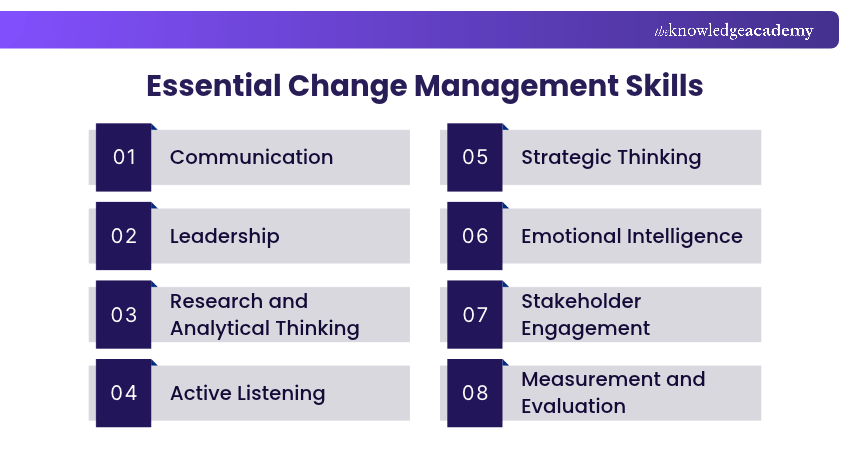
1) Communication
Possessing communication skills can help you encourage teamwork and enhance efficiency. By communicating your ideas properly, you can collect meaningful feedback from participants. Practical communication skills are essential for a Change Manager, who must communicate with individuals at all levels of an organisation.
During the strategy phase, it is crucial to communicate clearly about the objectives and goals of the change. During preparation, communication should explain why the change is happening, who will be affected and what support is available.
For example, when introducing a new Customer Relationship Management (CRM) system, a Change Manager might organise team briefings, share implementation timelines and provide updates on training arrangements.

2) Leadership
Leadership skills can provide a compelling example for those who are most impacted by changes to follow. These skills can provide the organisation with a clear and inspiring vision to guide its actions and decisions.
To be an effective Change Manager, one should possess strong leadership qualities. This entails that Change Managers must be versed in the following:
a) Inspiring and motivating others
b) Creating a positive work environment that encourages change
c) Making difficult decisions
d) Setting clear objectives
e) Ensuring the team is aligned with the company's vision
For example, a manager from a department introducing flexible working arrangements can help employees adapt by clarifying expectations, modelling the new practices and responding constructively to difficulties.
3) Research and Analytical Thinking
Research and analytical thinking help professionals understand organisational challenges and make evidence-based decisions during change initiatives. This includes reviewing existing processes, analysing performance data and examining employee feedback to identify potential risks and opportunities for improvement.
For example, if employees are struggling with a newly introduced workflow, a Change Manager could review task completion times, interview team members, and identify the steps creating delays. This evidence can inform targeted improvements instead of relying on assumptions.
4) Active Listening
Effective communication is a two-way process. To achieve the desired outcomes for your change management plan, you must invest as much time in listening to employees as you do in providing updates.
Expert Change Managers know how to actively seek feedback from individuals at all levels of the project and then incorporate that feedback into their future actions. When it comes to change management, active listening is an essential skill. Allowing employees to provide feedback throughout the organisational change process can help identify concerns, encourage participation and improve understanding of the proposed changes.
For example, an employee might resist a new reporting tool because they expect it to increase their workload. By listening carefully, the Change Manager may discover that the employee needs additional training or that the process contains unnecessary steps.
Build the confidence to navigate organisational change by joining the Change Management Foundation Training now!
5) Strategic Thinking
Strategic thinking helps Change Managers understand how proposed changes align with organisational goals and affect different business functions. It involves considering long-term implications, identifying potential risks, evaluating implementation options and planning how to achieve the intended outcomes while minimising disruption.
For example, before implementing a company-wide software upgrade, a Change Manager may recommend a phased rollout to allow teams to test the system, provide feedback and resolve problems before wider adoption.
Pro Tip
When introducing organisational change, explain why it is necessary before discussing what employees must do differently. Connecting the change to a clear problem or objective helps people understand its purpose. Use simple language, encourage questions, and explain how the change may affect everyday responsibilities.
6) Emotional Intelligence
Employees may experience various emotions during a change, from fear and resistance to excitement and enthusiasm. Emotional intelligence helps Change Managers recognise and respond appropriately to employees' emotional reactions during organisational transitions.
Change Managers with high emotional intelligence help employees navigate the change process. Emotional intelligence involves recognising and managing your own emotions while responding appropriately to those of others. During organisational change, this can help professionals handle difficult conversations, maintain trust and respond constructively to uncertainty.
For example, employees may worry that automation will change their responsibilities or make existing skills less relevant. Instead of dismissing these concerns, an emotionally intelligent Change Manager acknowledges them and helps employees understand the training or support available.
Trainer's Insight
Employee resistance does not always mean people are unwilling to change. It may reflect uncertainty, insufficient training, unclear expectations or concerns about their responsibilities. Instead of treating resistance as an obstacle to overcome, investigate its causes and respond with appropriate information, support, and involvement.
7) Stakeholder Engagement
Stakeholder engagement is the ability to identify, understand, and involve the individuals or groups affected by organisational change. These may include employees, managers, senior leaders, customers and external partners.
Different stakeholders may have different expectations, levels of influence and concerns. Engaging them appropriately helps Change Managers understand these perspectives and coordinate support throughout the transition.
For example, introducing a new procurement system may affect finance teams, purchasing staff, department managers and suppliers. Each group may require different information, training or opportunities to contribute to implementation decisions.
8) Measurement and Evaluation
Making organisational change is an intricate process that requires careful planning and execution. One crucial aspect of change management is to measure progress and ensure that the organisation achieves the desired outcomes.
To accomplish this, it is essential to identify the Key Performance Indicators (KPIs) that correspond to the project's objectives. By tracking KPIs before and after implementation, alongside measures of employee adoption and feedback, organisations can evaluate progress, assess outcomes and identify areas requiring further improvement.
For example, after introducing an automated approval system, an organisation could compare approval times before and after implementation while also checking whether employees are using the new workflow correctly.
Translate change strategies into meaningful workplace action with the Change Management Practitioner Training now!
How to Develop Change Management Skills?
Change management skills become more effective when knowledge is combined with workplace practice. Whether you are preparing for a Change Manager role or supporting an ongoing initiative, the following approaches can help you develop your capabilities. Let’s look at them below:
a) Participate in Change Initiatives: Volunteer to support process improvements, system implementations or team transitions. Observe how decisions are made, how stakeholders respond and which challenges arise during implementation.
b) Seek Constructive Feedback: Ask colleagues, managers and stakeholders for feedback on your communication, listening, leadership and problem-solving abilities. Use specific examples to identify areas for improvement.
c) Study Change Management Approaches: Explore recognised Change Management frameworks and methodologies to understand different ways of planning, communicating and supporting organisational transitions. Consider how their principles apply to your workplace.
d) Practise Communication and Facilitation: Develop your ability to explain change clearly, lead discussions and manage difficult conversations. Team meetings, presentations and collaborative projects can provide useful practice.
e) Review Outcomes and Learn From Experience: After participating in a change initiative, assess what worked, what caused difficulties and how the approach could be improved. Use these lessons to strengthen future planning and implementation.
Change Management Skills Development Checklist
Use the following checklist to turn learning into practical improvement:
□ Communication: Can I explain the purpose and expected impact of a change clearly?□ Leadership: Can I guide others through uncertainty while maintaining direction?□ Analysis: Can I identify problems using reliable evidence?□ Active Listening: Do I seek and respond constructively to feedback?□ Strategic Thinking: Can I connect change activities to organisational objectives?□ Emotional Intelligence: Do I recognise and respond appropriately to employees' concerns?□ Stakeholder Engagement: Have I identified and involved the people affected?□ Measurement: Can I evaluate whether a change is achieving its intended outcomes?
Choose one or two areas to improve first, practise them during real activities, and review your progress regularly.

David Evans creates accessible resources that help professionals understand different approaches to planning and delivering projects. His content addresses changing requirements, collaborative working and the practical demands of contemporary project environments.
View Detail

 If you wish to make any changes to your course, please


