


We may not have the course you’re looking for. If you enquire or give us a call on 01344203999 and speak to our training experts, we may still be able to help with your training requirements.
12 Essential Analytical Skills with Examples and How to Improve Them
ByShristi RoyLast updated on: 29 October 2026
Analytical skills help professionals examine information, recognise patterns, solve problems and make informed decisions. This blog explores 12 essential analytical skills with practical workplace examples, their importance across industries and effective ways to improve them for professional growth.

IThe Analytical Edge
1. Think Critically: Question assumptions, evaluate evidence and reach reasoned conclusions.2. Analyse Information: Identify patterns, interpret findings and understand complex situations.3. Solve Problems: Investigate underlying causes and develop practical solutions.4. Make Informed Decisions: Compare alternatives using evidence and logical reasoning.5. Strengthen Your Skills: Build analytical abilities through practice, feedback and reflection.
One report. Two different conclusions. Which one would you trust?
Imagine two colleagues reviewing the same sales report. One believes falling revenue means customers are losing interest. The other notices that several popular products were unavailable during the reporting period.
Both have the same information, but they interpret it differently.
This is where analytical skills become valuable. They help you examine evidence, question assumptions and understand what might be happening before making decisions.
Whether you're solving a workplace problem, evaluating financial information or planning a business strategy, these skills can improve how you approach complex situations.
But which analytical skills matter most, and how can you develop them? Let's explore 12 essential skills, their practical applications and ways to strengthen them.
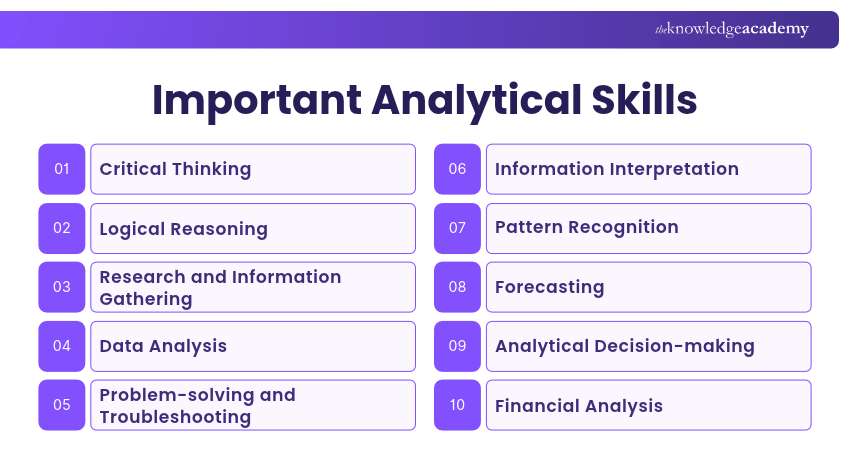
12 Important Analytical Skills
Different situations require different analytical abilities, from evaluating complex information to approaching challenges with logical reasoning. Developing a combination of these skills can help professionals work more effectively across various roles and industries.
Here are 12 important analytical skills and examples of how they can be applied in the workplace.
1) Critical Thinking
Critical thinking involves questioning information, evaluating arguments and examining assumptions before accepting conclusions. It helps professionals distinguish supported findings from opinions, incomplete evidence or misleading claims.
This skill is particularly valuable when facing conflicting explanations or making decisions with limited information. Critical thinkers assess source credibility, recognise possible biases and consider alternative interpretations before accepting a claim.
Example: A manager notices that employee productivity has declined. Rather than assuming motivation is the problem, they investigate workload, staffing levels and recent process changes before recommending improvements.
Trainer’s Insight: Question the First Explanation
The most obvious explanation is not always the most accurate. When investigating a workplace issue, consider at least one alternative explanation and identify what evidence would help distinguish between them.

2) Logical Reasoning
Logical reasoning involves using structured thinking to connect information, evaluate relationships and reach conclusions. It helps professionals understand whether a conclusion follows from the available evidence and assumptions.
This skill is useful when analysing procedures, evaluating arguments or working through complex tasks. Logical reasoning also helps identify inconsistencies and recognise when important information is missing.
Example: A project coordinator knows that system testing cannot begin until software development is complete. They use this dependency to explain why a delay in development may affect the testing schedule and project deadline.
3) Research and Information Gathering
Research skills involve finding, collecting and evaluating information relevant to a particular question or problem. Sources may include professional publications, internal records, interviews, surveys and industry reports.
Effective research requires identifying credible sources, comparing information and recognising limitations in the available evidence. Professionals must also distinguish verified findings from assumptions and ensure that information is sufficiently current for the decision being made.
Example: A Business Analyst investigates whether a company should enter a new market. They examine industry reports, customer research, competitor activity and relevant economic conditions before preparing recommendations.
Pro Tip: Keep a Simple Evidence Log
When researching an important decision, record each source, its publication date, the relevant finding and any limitation. This helps you trace where information came from and identify gaps before presenting recommendations.
4) Data Analysis
Data analysis involves collecting, organising, cleaning and examining structured or unstructured data to answer specific questions and identify meaningful findings. It may include checking data quality, calculating relevant measures, comparing results and presenting evidence to support further investigation.
Professionals often use spreadsheets, databases or analytical tools to investigate specific questions. Accurate analysis requires selecting appropriate measures and understanding that a visible pattern does not necessarily establish its cause.
Example: A marketing team compares monthly website visits, enquiries and conversion rates to understand changes in campaign performance.
Worked Example: Investigating a Sales Decline
A retailer records the following monthly sales:
|
Month
|
Sales Revenue
|
|
January
|
£50,000
|
|
February
|
£48,000
|
|
March
|
£42,000
|
Revenue fell by £8,000, or 16%, from January to March.
The analyst then examines product availability, pricing and customer demand to identify possible contributing factors. The sales figures reveal the size of the decline, but additional evidence is needed to understand its causes.
5) Problem-solving and Troubleshooting
Problem-solving involves identifying challenges, investigating contributing factors and developing suitable solutions. Troubleshooting applies this process to diagnosing faults or unexpected behaviour in systems, equipment or processes.
Professionals use these skills to identify underlying causes rather than repeatedly addressing symptoms. This may involve gathering evidence, testing potential causes, implementing corrective actions and checking whether the problem has been resolved.
Example: Employees report that a workplace application frequently crashes. An IT technician reviews error logs, checks recent software updates and tests different conditions to identify the source of the problem.
Learn root cause analysis and decision-making in diverse situations with our Problem Solving Course – Join now!
6) Information Interpretation
Information interpretation involves understanding the meaning, significance and limitations of available findings. It helps professionals connect evidence to the question being investigated and explain what the results may indicate.
While data analysis involves examining information to identify meaningful findings, information interpretation focuses on explaining what those findings mean in a particular context. It requires considering the relevance, limitations and possible implications of results before communicating conclusions.
Example: A customer satisfaction survey shows improved ratings but also reveals repeated complaints about delivery times. A Customer Service Manager interprets both findings to recognise that overall satisfaction has improved while a specific problem remains unresolved.
7) Pattern Recognition
Pattern recognition involves identifying recurring characteristics, trends or relationships within information. It helps professionals notice repeated behaviours, seasonal variations and unusual deviations that may otherwise be overlooked.
This skill is useful when reviewing customer behaviour, operational records and financial information. However, recognising a pattern does not automatically explain why it exists. Additional evidence may be needed to establish whether the relationship is meaningful.
Example: A retailer notices that demand for certain products increases during particular months. The team uses this recurring pattern to support inventory planning while considering other factors that could affect future sales.
8) Forecasting
Forecasting involves estimating possible future outcomes using historical information, current conditions and appropriate assumptions. It supports planning in areas such as sales, staffing, finance and inventory management.
Professionals may use trend analysis, statistical methods and scenario modelling to develop forecasts. Because future conditions can change, forecasting requires regular review and should not be presented as a guarantee of what will happen.
Example: A manufacturing company reviews historical orders and expected demand to forecast production requirements for the next quarter.
Pro Tip: Compare More Than One Scenario
Rather than relying on a single forecast, consider what could happen under different assumptions. For example, compare expected demand with higher-demand and lower-demand scenarios to understand the implications for resources.
9) Analytical Decision-making
Analytical decision-making involves comparing available options using relevant evidence, established criteria and professional judgement. It helps individuals understand the likely advantages, disadvantages and uncertainties associated with different choices.
This skill is especially useful when decisions involve competing priorities or limited resources. Professionals may compare factors such as cost, quality, risk, feasibility and expected outcomes before selecting an option.
Quick Example
A company experiences an increase in customer complaints. Rather than assuming that employee performance is the problem, its manager reviews complaint records, delivery times and recent process changes. The findings reveal that most complaints are related to delayed deliveries.
10) Financial Analysis
Financial analysis involves examining financial information to understand performance, expenditure, profitability and financial position. It requires interpreting financial statements, comparing figures and identifying changes that may influence business decisions.
Professionals use financial analysis to evaluate budgets, assess business performance and investigate financial concerns. It differs from general financial management because the emphasis is on examining financial evidence rather than managing every financial activity.
Example: A Financial Analyst compares budgeted and actual operating expenses across departments to identify significant variances and investigate their causes.
11) Strategic Analysis
Strategic analysis involves examining internal capabilities, external conditions and available options to support long-term planning. It helps organisations understand their position, identify opportunities and evaluate potential challenges.
Professionals may use tools and approaches such as SWOT analysis, PESTLE analysis and competitor analysis. These tools organise relevant information, but their usefulness depends on the quality of the evidence and the way findings are interpreted.
Example: A company considering expansion into a new region uses market research and SWOT analysis to examine its internal strengths and weaknesses, alongside external opportunities and threats, before evaluating whether expansion is appropriate.
SWOT Analysis Framework
|
Factor
|
What It Examines
|
|
Strengths
|
Internal capabilities and advantages
|
|
Weaknesses
|
Internal limitations or areas requiring improvement
|
|
Opportunities
|
External conditions that may create advantages
|
|
Threats
|
External challenges or risks
|
Boost your career prospects with a capacity for high-level thinking with our Strategic Planning and Thinking Course – Join now!
12) Observation and Attention to Detail
Observation involves noticing relevant information, behaviours or changes in a situation. Attention to detail helps professionals examine information carefully and identify errors, inconsistencies or unusual results.
These abilities support analytical work by improving the quality of information used in an assessment. However, careful observation should be combined with verification rather than treating initial impressions as established facts.
Example: A financial reporting assistant notices that an expense entry appears twice in a spreadsheet. They check the source records before correcting the duplicate, helping prevent an inaccurate expenditure report.
Why are Analytical Skills Important?
Analytical skills support professionals in understanding complex information, investigating problems and making decisions. Their usefulness extends across different roles because most organisations regularly evaluate evidence, compare options and respond to changing circumstances. Here are four important benefits:
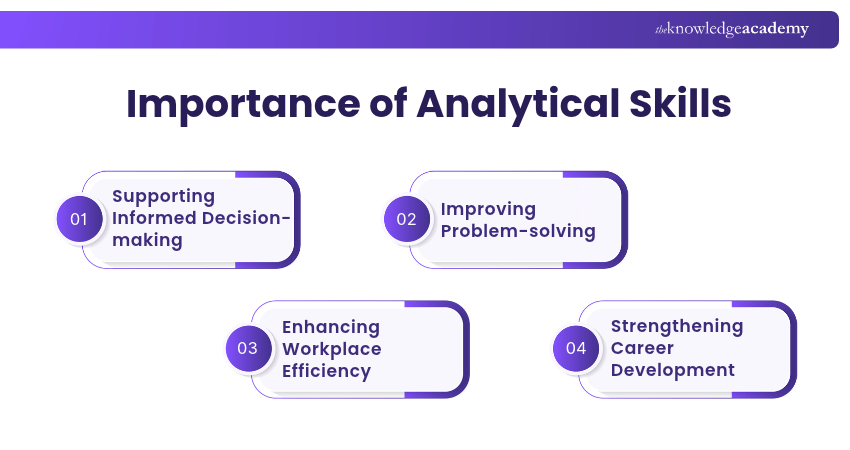
1) Supporting Informed Decision-making: Strong analytical skills help professionals recognise potential risks, justify recommendations and reduce reliance on unsupported assumptions when making workplace decisions.
2) Improving Problem-solving: Analytical skills help professionals address underlying issues rather than repeatedly responding to symptoms. This can support more effective and lasting workplace improvements.
3) Enhancing Workplace Efficiency: Examining processes and performance information can reveal bottlenecks, recurring errors and opportunities for improvement. Organisations can use these findings to make better use of available resources.
4) Strengthening Career Development: Analytical skills are transferable across industries and responsibilities. Demonstrating how you investigate challenges, interpret information and explain recommendations can support professional development.
How to Improve Your Analytical Skills?
Improving analytical skills requires regular practice, meaningful feedback and opportunities to apply structured thinking in real situations. Rather than attempting to develop every ability simultaneously, focus on the areas most relevant to your responsibilities.
The following steps can help you strengthen your analytical abilities.
1) Ask Questions and Challenge Assumptions: When investigating a situation, ask what is happening, why it may be happening and what evidence supports the explanation. Consider alternative viewpoints before reaching conclusions.
2) Practise Research and Data Interpretation: Choose a relevant question and gather information from reliable sources. Compare findings, identify patterns and practise explaining what the evidence does and does not establish.
3) Break Complex Problems into Smaller Parts: Divide a challenging situation into manageable components. Examine each part separately before considering how the components influence one another.
4) Work Through Realistic Problems: Use case studies, workplace projects or practical exercises to develop experience. For example, investigate changes in sales performance or compare alternative project solutions using clearly defined criteria.
5) Seek Feedback on Your Reasoning: Ask colleagues, mentors or trainers to review how you approached a problem. Discuss whether you used appropriate evidence, overlooked alternatives or made assumptions that need further examination.
6) Reflect on Decisions and Outcomes: Review the results of decisions you have made. Consider whether your original assumptions were reasonable, what changed and how your analytical approach could improve.
Learn how to maximise your potential, leading to a more fulfilling life with our Personal Development Courses – Join now!

Shristi Roy is a Content Writer with experience in journalism, article writing and web content development. Her experience researching and writing about Business Skills and Accounting and Finance enables her to communicate specialised information through clear, engaging narratives.
View Detail

 If you wish to make any changes to your course, please


