


 Top Rated Course

We may not have the course you’re looking for. If you enquire or give us a call on 01344203999 and speak to our training experts, we may still be able to help with your training requirements.
50 Most Asked Couchbase Interview Questions and Answers
Sienna Roberts 20 January 2026The ideal Couchbase Interview Questions cover topics like NoSQL, indexing, replication, N1QL, and performance optimisation to gauge your database expertise. Couchbase is often used for web, mobile and IoT applications that require the ability to handle large volumes of data through features like caching and distributed architecture.
Training Outcomes Within Your Budget!
We ensure quality, budget-alignment, and timely delivery by our expert instructors.
Table of Contents

Couchbase is a database that's enjoying the spotlight among Developers, and for good reasons. It's fast, flexible and built for the Cloud as it blends the best of key-value and document databases with powerful querying and real-time performance. It's the engine behind modern data experiences. So, if you are gearing up to apply for a role in this field, then we've got you covered with the 50 most asked Couchbase Interview Questions.
From architecture to indexing, and replication to N1QL, this curated list of Couchbase Interview Questions balances the technical must-knows with real-world relevance. So read on, crack the code behind Couchbase and turn the trickiest questions into your strongest talking points!
Table of Contents
1) Couchbase Interview Questions
a) What is Couchbase Analytics?
b) What is the DCP?
c) What is XDCR in Couchbase?
d) What is a full-text search in Couchbase?
e) What do you know about the VBucket?
f) What is the role of VBucket replicas in high availability?
g) How does the query engine in Couchbase process N1QL queries?
h) What is the Memcached protocol in Couchbase?
i) What kind of data storage does Couchbase utilise?
j) What is the role of the Administrator UI in Couchbase?
2) Conclusion
Couchbase Interview Questions
Whether you're a beginner or a pro, this section dives into the most frequently asked Couchbase Interview Questions, helping you decode concepts, clarify doubts and sharpen your responses. So, let's get started!
What is Couchbase Analytics?

This question is intended to assess your knowledge of analytics services within Couchbase.
Sample Answer:
“Couchbase Analytics is a service within Couchbase that enables large-scale analysis of JSON data stored in the database. It allows running complex queries like aggregations or joins on operational data without affecting performance. It uses a parallel processing engine and supports SQL++ to provide insights in real time, making it perfect for analytics use cases alongside your operational database.”

What is the DCP?
This will gauge your understanding of internal replication and data streaming.
Sample Answer:
“The Database Change Protocol (DCP) is Couchbase’s internal protocol for streaming changes like document mutations and deletions. It powers features such as replication, indexing, and backups by continuously delivering updates across nodes and clusters in a highly efficient way.”
What is XDCR in Couchbase?
This will assess how well you know the Cross‑data Centre Replication features.
Sample Answer:
“Cross-data Centre Replication (XDCR) allows Couchbase to replicate data between clusters in different regions. It ensures high availability, disaster recovery, and data locality. XDCR is key for global applications needing fast access and resilience across geographically distributed systems.”
What is a full-text search in Couchbase?
This question is intended to gauge your knowledge of search capabilities in Couchbase.
Sample Answer:
“Full-text Search (FTS) in Couchbase lets users search for text within documents using natural language queries. It supports tokenisation, stemming, fuzziness, and ranking, making it ideal for building search features like auto-complete or relevance-based results.”
What do you know about the VBucket?
This will help the interviewer assess how well you understand data partitioning in Couchbase.
Sample Answer:
“A VBucket is a logical data partition used to distribute documents across nodes. Each document maps to a VBucket using a hash of its key. VBuckets support rebalancing, replication, and failover, enabling Couchbase to scale efficiently.”
What is the role of VBucket replicas in high availability?
This will assess your understanding of replication and fault tolerance.
Sample Answer:
“Each active VBucket has replica copies stored on other nodes. If the primary VBucket fails, a replica takes over automatically. This design ensures high availability and protects against data loss, keeping applications running even during node outages.”
How does the query engine in Couchbase process N1QL queries?
This question will test your grasp of N1QL query execution.
Sample Answer:
“The query engine parses N1QL, optimises the query plan, and retrieves data using indexes or primary scan. It can JOIN, filter, and sort JavaScript Object Notation (JSON) documents like a relational database. Results are returned efficiently, especially when indexes are well-designed.”
What is the Memcached protocol in Couchbase?
This will assess your handle on caching protocol support.
Sample Answer:
“Couchbase supports the Memcached protocol for basic key-value operations. It’s useful when you want high-speed in-memory access without persistence. While newer features use more advanced APIs, Memcached compatibility helps migrate legacy cache-heavy applications.”
Learn data, predict trends, and drive innovation. Sign up for our Big Data and Analytics Training now!
What kind of data storage does Couchbase utilise?
This question is designed to evaluate your knowledge of storage formats.
Sample Answer:
“Couchbase uses a memory-first architecture where data is stored in RAM for fast access and then persisted to disk for durability. It supports various backends, and JSON is the default format for documents, offering flexibility and performance.”
What is the role of the Administrator UI in Couchbase?
This will test your understanding of management and monitoring UI in Couchbase.
Sample Answer:
“The Couchbase Web UI helps you manage clusters, monitor health, configure buckets, manage users, trigger rebalance, and more. It gives visual access to logs, metrics, and node stats. This makes operations user-friendly and accessible without needing CLI commands.”
How does Couchbase handle automatic failover?
This will test your grasp of failover handling.
Sample Answer:
“If a node becomes unresponsive, Couchbase automatically triggers failover. It promotes replicas to active status to avoid downtime. Admins can configure it as automatic or manual, giving flexibility in managing service continuity during node failures.”
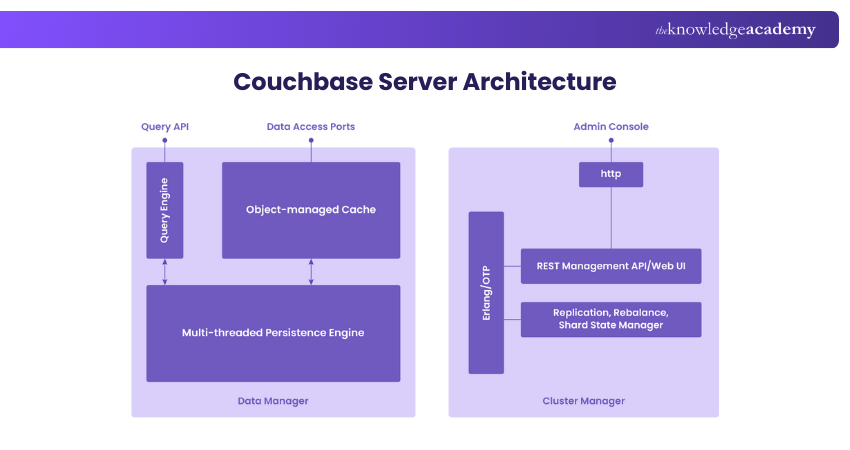
What are the functional blocks involved in Couchbase Server?
This will help the interviewer gauge how well you know Couchbase architecture.
Sample Answer:
“Core blocks include the Data Service, Query Service (N1QL), Indexing, Search, Analytics, Eventing, and the Cluster Manager. These services work together to store, retrieve, index, and analyse data in real time while managing high availability and scaling.”
What are the differences between JSON and binary document formats in Couchbase?
This question is intended to explore document formats and their use cases.
Sample Answer:
“JSON documents are human-readable and flexible, making them ideal for querying and dynamic apps. Binary formats are compact and faster to process but can’t be queried using N1QL. Use binary for performance-heavy use cases, and JSON when you need flexibility.”
Master high-dimensional data with our High-Dimensional Data Analysis Course and discover hidden patterns like never before!
Can capacity be added or removed from a live Couchbase cluster?
The intent behind this question is to check your knowledge of cluster scaling.
Sample Answer:
“Yes, Couchbase supports live scaling. You can add or remove nodes while the cluster is running. A rebalance operation redistributes data across the new set of nodes without any downtime, keeping services online.”
What exactly does the Vbucket Map represent in the Couchbase?
This will test how well you know metadata and routing info.
Sample Answer:
“The VBucket Map defines which node holds each active and replica VBucket. It helps the system and SDKs route read and write operations to the correct node, even during failovers or rebalancing.”
How does Couchbase handle indexing for large datasets?
Your answer to this question will gauge your expertise in scalability and indexing strategy.
Sample Answer:
“Couchbase uses Global Secondary Indexes (GSI) to handle large datasets efficiently. Indexes are distributed across nodes, can be built in parallel, and support partitioning. This setup ensures fast lookups and keeps query performance high even as data volumes grow.”
What is the significance of N1QL within the Couchbase ecosystem
Your grasp of query language knowledge will be assessed with this question.
Sample Answer:
“N1QL is Couchbase’s SQL-like query language for JSON. It brings the familiarity of SQL to NoSQL, allowing you to run SELECT, JOIN, and WHERE queries on documents. This bridges the gap between structured queries and flexible schema.”
How does VBucket sharding help in Couchbase performance tuning?
This is a test of how deep your knowledge of internal partitioning and performance benefits is.
Sample Answer:
“VBucket sharding splits data into 1024 partitions per bucket. These are distributed across nodes, balancing load and enabling efficient rebalancing. It improves performance by parallelising operations and simplifies scaling by letting Couchbase move data around easily when nodes are added.”
What’s the difference between ephemeral and standard buckets in Couchbase?
This will shed light on your understanding of the difference between memory-only and persistent storage.
Sample Answer:
“Standard buckets store data in memory and persist it to disk. Ephemeral buckets keep everything in memory with no disk writes. Ephemeral buckets are great for high-speed, transient data like caching, while standard buckets are used for durable storage and recovery.”
How many TCP ports are designated for listening to requests in Couchbase?
This question is intended to test your awareness of network configuration.
Sample Answer:
“Couchbase uses several TCP ports depending on services. Port 8091 is for the Admin UI, 11210 for data access, and others like 8093 for N1QL queries or 9102 for indexing. It’s important to configure firewall rules correctly based on these ports.”
Design the backbone of data-driven innovation with our Big Data Architecture Training - Register now!
What is Couchbase and how does it differ from traditional database software?
The intent is to assess your basic understanding of Couchbase as a NoSQL database.
Sample Answer:
“Couchbase is a NoSQL database that stores JSON documents. Unlike traditional relational databases, it supports dynamic schemas, built-in caching, horizontal scaling, and SQL-like queries. It’s designed for real-time applications with high availability and low latency requirements.”
Identify the essential elements present in a Couchbase Node and their roles?
This question will test your knowledge of node-level architecture.
Sample Answer:
“A Couchbase node may run services like Data, Query, Index, Search, and Analytics. The Data service stores documents, the Query service handles SQL queries, Index supports fast lookups, and others offer specialised processing like full-text search and analytics.”
Which Programming Language does the Cluster Manager in Couchbase utilise?
The intent is to assess your knowledge of the Programming Language behind Couchbase’s Cluster Manager.
Sample Answer:
“Couchbase’s Cluster Manager is built using Erlang. This language was chosen for its strength in building distributed, fault-tolerant systems. Erlang’s concurrency model helps Couchbase manage multiple nodes and services efficiently and reliably.”
What are the different durability levels in Couchbase and how do they impact data reliability?
The interviewer wants to assess your understanding of Couchbase’s durability options, how they work, and why they matter for ensuring data consistency and fault tolerance in distributed systems.
Sample Answer:
“Couchbase provides four durability levels: None, Majority, Majority and PersistToActive, and PersistToMajority. These define how strictly the database ensures a write is acknowledged. Stronger durability increases reliability by persisting or replicating data before confirming success, but it may slightly impact latency and throughput depending on configuration and workload.”
Enumerate compelling reasons for considering the adoption of Couchbase Server?
The intent here is to gauge your knowledge of Couchbase server’s key benefits.
Sample Answer:
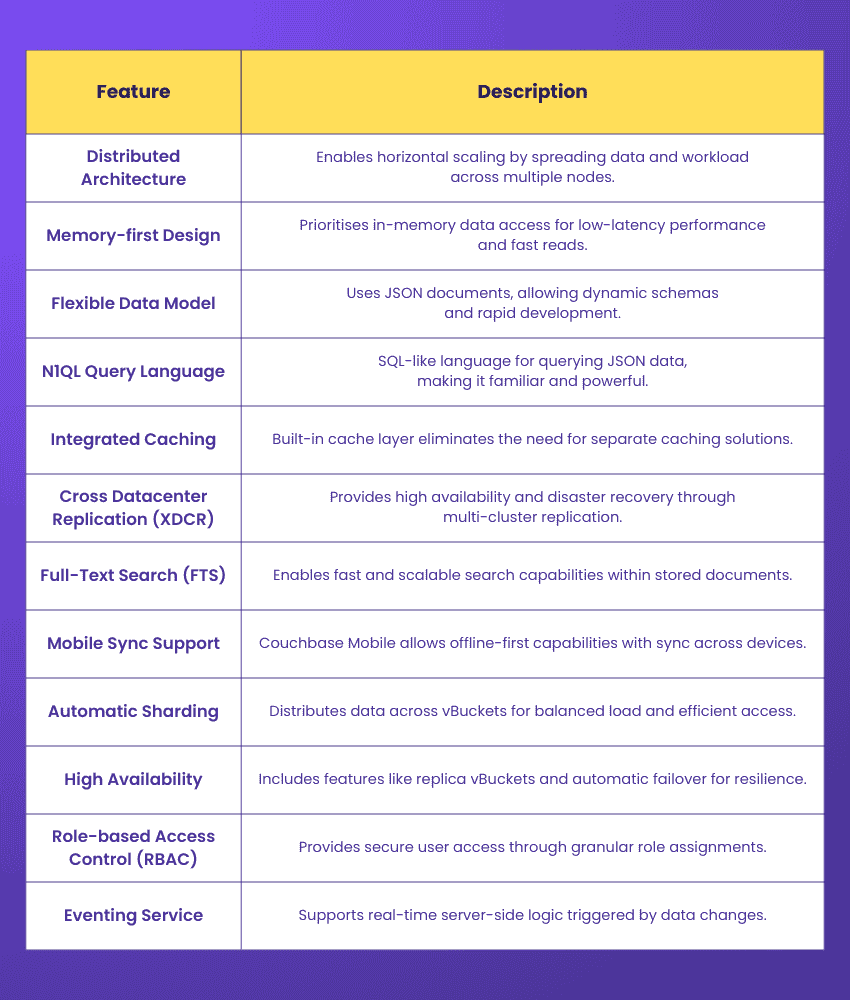
“Couchbase offers real-time performance, automatic scaling, full-text search, SQL-like queries with N1QL, cross-datacenter replication, and memory-first architecture. It’s ideal for applications needing low latency, flexibility, and high reliability; all while being easy to manage and cloud-friendly.”
What are the indexing strategies available in Couchbase for optimised search?
This question is designed to evaluate your knowledge of indexing types and performance impact.
Sample Answer:
“Couchbase supports primary, secondary, and composite indexes for structured queries, plus full-text indexes for search use cases. You can choose GSI for N1QL or FTS for unstructured search, allowing flexible and efficient querying based on your app’s needs.”
Is creating a data bucket within the Couchbase system considered essential? If so, why?
This question will reinforce your understanding of data organisation.
Sample Answer:
“Yes, buckets are essential in Couchbase. They act like logical containers that group and manage documents, memory usage, and replication settings. You can separate applications or environments using different buckets to simplify management and improve performance control.”
What is the Couchbase Mobile platform and how does it support offline-first apps?
This will test how well you know the Couchbase Mobile components and offline data syncing capabilities.
Sample Answer:
"Couchbase Mobile includes Couchbase Lite, Sync Gateway, and the server. Couchbase Lite runs on devices, enabling local data storage and offline access. Sync Gateway handles bi-directional sync when the device reconnects. This setup is ideal for apps needing seamless offline-first functionality, like retail or field services."
From raw data to real insights, your analytics journey starts here. Sign up for our comprehensive Big Data Analysis Training now!
Define the role and responsibilities of a Data Manager within the Couchbase Server architecture
The intent is to assess your understanding of the Data Manager’s function and responsibilities within Couchbase Server architecture.
Sample Answer:
“The Data Manager handles document lifecycle operations. It stores data in memory, persists it to disk, replicates it across nodes, and manages VBucket responsibilities. It ensures high-speed access, reliable persistence, and coordination with other services like indexing and querying.”
Discuss the data format employed by Couchbase and its implications for storage and retrieval
This question will assess your knowledge of Couchbase’s data format and its impact on storage efficiency and data retrieval.
Sample Answer:
“Couchbase uses JSON as its primary data format. JSON allows schema flexibility, is easy to parse, and supports nested data. This structure makes data retrieval with N1QL and full-text search efficient while supporting real-time, dynamic application needs.”
Can you tell me something about the subsystems which are compatible with all the nodes in a network?
This will gauge your understanding of Couchbase subsystems that operate consistently across all nodes in a cluster.
Sample Answer:
“Subsystems like the Cluster Manager, XDCR, indexing, and query services are compatible across nodes. Couchbase ensures services can communicate regardless of which node they’re on, which helps with scaling, failover, and workload distribution across the cluster.”
What is the strict upper limit on the storage capacity of a data bucket in Couchbase Server? Is it possible to extend the same?
This will check your awareness of scaling and limits.
Sample Answer:
“There's no fixed hard limit for bucket storage. It depends on the hardware and cluster size. We can add more nodes and rebalance to extend capacity as needed. Couchbase’s horizontal scalability makes it easy to grow without hitting bottlenecks.”
How does Couchbase handle Time-to-live (TTL) expiration in documents?
This question will help gauge your grasp on data lifecycle and automatic expiry.
Sample Answer:
“TTL in Couchbase lets you set an expiration time for each document. Once it expires, it’s marked for deletion and removed during cleanup. This is great for caching or temporary data, and it helps manage storage without manual deletion.”
How does Couchbase differ from MongoDB in terms of architecture and use cases?
This question will help assess your ability to highlight architectural distinctions and application scenarios.
Sample Answer:
"Couchbase has a memory-first, distributed architecture with built-in caching and Smart Clients, while MongoDB relies more on disk-based reads. Couchbase suits high-throughput, low-latency use cases, such as real-time applications, whereas MongoDB is well-suited for document storage and analytics-heavy applications. Both are powerful but serve different needs."
What is the Couchbase Eventing Service and how does it work?
This will help the interviewer gauge your familiarity with server-side functions and
automation using Couchbase’s Eventing Service.
Sample Answer:
“The Couchbase Eventing Service lets you run JavaScript functions in response to data changes. It helps automate tasks like data enrichment or notifications without external tools. It runs server-side, ensuring low latency and real-time responsiveness. It's great for reactive application logic right inside the database."
How does the Backup and Restore mechanism function in Couchbase?
This question is intended to test your knowledge of Couchbase’s data protection features.
Sample Answer:
"Couchbase uses cbbackupmgr to perform incremental or full backups of data and indexes. You can restore them using cbrestoremgr. It's all managed via CLI or scripts, making disaster recovery and data migration straightforward and reliable. It’s essential for maintaining business continuity and compliance."
Harness your Python skills and take the journey from numbers to visual narratives with our Data Analysis and Visualisation With Python Course - Sign up now!
Can you explain the differences between shared servers and dedicated servers, particularly in the context of Couchbase?
The intent is to assess your understanding of Couchbase servers and their impact on Couchbase deployment.
Sample Answer:
“In shared servers, multiple Couchbase services run on the same node, which saves costs. In dedicated servers, each node runs one service such as indexing or querying which allows better performance tuning. Couchbase supports both, depending on performance and budget needs.”
What is Smart Client technology in Couchbase and how does it contribute to performance?
This question will evaluate your understanding of how Couchbase Smart Client architecture improves performance.
Sample Answer:
"Smart Client in Couchbase knows the cluster topology and directly routes requests to the right node, avoiding bottlenecks. It reduces latency and improves performance by removing unnecessary network hops or central routing layers. It’s one of the reasons Couchbase scales so well under load."
In what ways does Couchbase leverage its status as an open-source technology to its advantage?
This question will help assess your understanding of how Couchbase benefits from being open-source.
Sample Answer:
“Couchbase benefits from an active open-source community, quick iteration, and transparency. Users can freely test and adapt it. The enterprise edition adds support and enhanced features, giving businesses flexibility without being locked into proprietary systems.”
How do the subsystems in Couchbase ensure compatibility across all nodes in a network?
This question will gauge your knowledge of how Couchbase subsystems maintain consistent behaviour.
Sample Answer:
“Couchbase subsystems use shared metadata and internal messaging to maintain consistency across nodes. Services like indexing, querying, and data replication are designed to sync seamlessly, ensuring that operations stay consistent and distributed, even during scaling or failover.”
What is the role of Cluster Manager in Couchbase, and how does it contribute to System Management?
This will test how well you understand cluster coordination in Couchbase.
Sample Answer:
“The Cluster Manager handles node communication, rebalancing, failover, and Configuration Management. It ensures all services work together seamlessly across the cluster. It’s essential for maintaining cluster health, managing membership, and coordinating system-wide operations like adding nodes or rebalancing.”
Can you explain what Role-based Access Control (RBAC) authentication means in Couchbase?
This question is designed to test your security model knowledge.
Sample Answer:
“Role-Based Access Control (RBAC) in Couchbase limits user access based on roles. Each role grants specific permissions like read, write, or admin access. This ensures security and compliance by allowing users to access only what they’re authorised to manage.”
Describe a document in the context of a database, particularly within Couchbase
This will assess your grasp on a Couchbase document's role in data storage.
Sample Answer:
“In Couchbase, a document is a JSON object that stores data in key-value format. It’s schema-less, meaning the structure can vary between documents. This flexibility supports dynamic applications and simplifies data modelling compared to rigid table structures in traditional databases.”
What are the potential factors contributing to Couchbase server failure, and how can they be mitigated?
This question will help evaluate your awareness of failure risks in Couchbase and effective mitigation strategies.
Sample Answer:
“Failures can result from node crashes, network issues, or hardware problems. Couchbase mitigates this through replica copies, automatic failover, and cluster rebalance. Monitoring tools, alerts, and best practices like scaling and resource tuning help prevent and recover from failures.”
How does Couchbase ensure Data Security, including Encryption at rest and in transit?
With this question, the interviewer will gauge your knowledge of Couchbase’s built-in security features.
Sample Answer:
"Couchbase ensures security through TLS/SSL encryption for data in transit and AES-256 encryption for data at rest. It supports Role-Based Access Control (RBAC) for fine-grained permissions and integrates with LDAP or Active Directory. Additionally, it provides audit logging, secure key management, and supports FIPS-compliant encryption standards for regulatory compliance."
What technical specialties are required to effectively handle and work with Couchbase
This question will help the interviewer assess your skill set fit.
Sample Answer:
“You’ll need skills in JSON, distributed systems, cloud platforms, and networking. Familiarity with N1QL, Docker, Kubernetes, and monitoring tools helps. Understanding Cluster Management, replication, indexing, and scripting also supports efficient deployment and maintenance of Couchbase environments.”
How do Couchbase Data Platforms address scalability in Application Development?
The intent is to evaluate your understanding of how Couchbase supports scalable Application Development.
Sample Answer:
“Couchbase scales horizontally by adding nodes, distributing data across VBuckets. You can assign services to specific nodes, like query or indexing, for efficient scaling. This flexible architecture helps applications grow without bottlenecks or downtime, supporting high-performance at scale.”
What are the core capabilities of the database engine utilised in Couchbase, and how do they enhance performance?
This question will examine your awareness of database engine strengths.
Sample Answer:
“Couchbase’s engine uses a memory-first design for speed, with disk persistence for durability. It supports key-value and query-based access, indexing, caching, and parallel processing. These features together provide fast reads/writes, resilience, and low latency under high workloads."
Can nodes be seamlessly added to Couchbase, or are there specific conditions that need to be fulfilled?
The intent is to assess your understanding of Couchbase’s scalability and the requirements for adding nodes to a cluster.
Sample Answer:
“Yes, nodes can be added dynamically. Once added, a rebalance operation redistributes data. The process is seamless but requires network connectivity, resource alignment, and version compatibility. Rebalancing ensures even data distribution and high availability without impacting cluster performance.”
How does Couchbase ensure durability and consistency of writes?
This question is designed to test your knowledge of Couchbase’s mechanisms for data durability and write consistency.
Sample Answer:
“Couchbase ensures durability by writing changes to memory and then persisting them to disk. You can also configure it to replicate writes to other nodes before confirming success. This setup helps maintain consistency and prevents data loss even if a node unexpectedly fails.”

 If you wish to make any changes to your course, please


