




We may not have the course you’re looking for. If you enquire or give us a call on 01344203999 and speak to our training experts, we may still be able to help with your training requirements.
ITIL® Version 5: All You Need to Know
ByThe Knowledge AcademyLast updated on: 26 November 2026
ITIL® Version 5 introduces updated guidance for managing digital products and services. Explore its key features, AI governance, integrated lifecycle management and certification pathways. Understand how the framework supports organisational transformation and continual value creation.
The world of IT service management is moving faster than ever, and standing still is no longer an option. For decades, ITIL® has helped organisations deliver reliable services across industries. With the arrival of ITIL® (Version 5), teams now gain a modern, practical framework connecting strategy to delivery, supporting digital transformation and measurable business outcomes.
This update reflects today’s reality, where technology, AI and customer expectations change constantly. ITIL® (Version 5) equips professionals with clear guidance for responsible innovation, uniting product and service thinking to improve performance.
In this blog, we'll explore what's new, why the update matters, the updated certifications and what stays the same. Let's dive in.
What is New in ITIL® (Version 5)?
ITIL® (Version 5) builds on its predecessors by introducing enhancements that directly tackle the demands of today's fast-paced, technology-centric world. These updates keep ITIL relevant and practical while reinforcing its globally recognised role in modern service management.
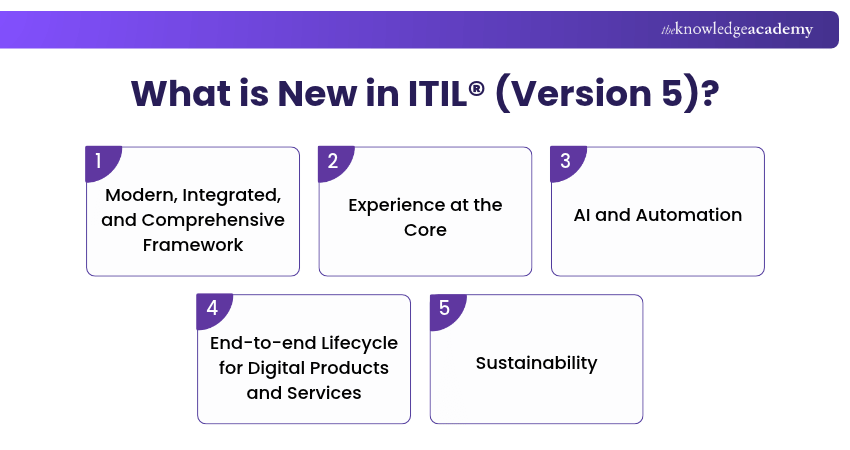
1) Modern, Integrated, and Comprehensive Framework
One of the standout features of ITIL® (Version 5) is its modern, integrated approach. Building on earlier ITIL guidance, which focused primarily on IT service management, this iteration places greater emphasis on digital product management.
It provides a unified framework that integrates strategy, delivery and operations, allowing organisations to manage both products and services seamlessly.
This comprehensive structure helps in creating a shared language and methodology for business and IT professionals, promoting collaboration and efficiency. The framework is designed to be adaptable, fitting into digital-first organisations where agility and integration are key to success.
2) Experience at the Core
A major shift in ITIL® (Version 5) is placing user experience at the heart of service management. Building on its established focus on value and outcomes, the framework emphasises designing and managing digital products and services that are user-centred and outcome-driven.
This means focusing on creating value through enhanced experiences, clear roles and responsibilities, all while committing to continual improvement. By prioritising experience, ITIL® (Version 5) helps organisations deliver services that better meet user expectations, supporting customer satisfaction and driving business growth.
3) AI and Automation
AI and automation are front and centre in ITIL® (Version 5), reflecting the transformative impact of these technologies on IT operations. The framework provides guidance on adopting AI responsibly, including identifying drivers for implementation, assessing risks and opportunities, and establishing appropriate governance.
Automation can support faster delivery of digital products and services, quicker responses to changes and smarter decision-making in daily workflows. This AI-ready approach helps organisations leverage these tools ethically and effectively, minimising risks while maximising benefits.
4) End-to-end Lifecycle for Digital Products and Services
ITIL® (Version 5) introduces the product and service lifecycle model, which connects digital product and service management through eight activities: discover, design, acquire, build, transition, operate, deliver and support. Through this integrated model, it covers the entire journey from discovery and design to delivery, support and ongoing improvement.
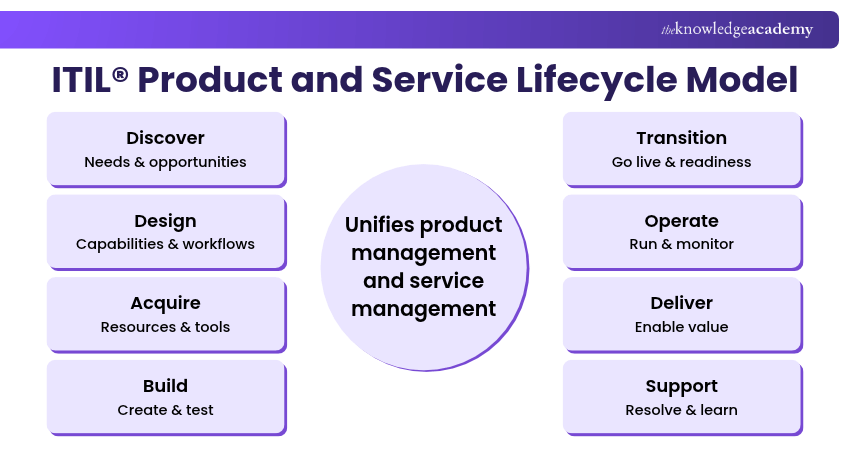
Such a holistic view helps ensure that products and services are developed and maintained with greater coordination, reducing silos and enhancing overall efficiency. By addressing the full lifecycle, the framework supports organisations in delivering high-quality, reliable digital solutions that align with business needs.
5) Sustainability
Sustainability is an important consideration, reflected throughout ITIL® (Version 5). The framework promotes sustainable transformation and continual improvement by aligning people, processes and technology toward long-term goals.
It encourages practices that support environmental and operational sustainability, such as efficient resource use and responsible technology adoption. The shift in focus helps organisations build resilient systems that not only drive immediate value but also contribute to lasting improvements in the service value system.
These innovations make ITIL® (Version 5) a valuable framework for navigating the complexities of modern IT landscapes, offering clearer guidance on agile practices, value demonstration and technological integration.
Learn to turn change into lasting business value with the ITIL® 5 Transformation Certification Training - Join now!
Why the Latest ITIL® Version was Required?
The transition to ITIL® (Version 5) wasn't arbitrary; it was driven by significant changes in the global business and technology environment since the release of ITIL 4. Here's a closer look at the key factors that influenced this update.
1) Digital Landscape
The digital landscape has transformed dramatically, with organisations now expected to deliver digital products and services at unprecedented speeds. Rapid response to market changes, integration of emerging technologies and maintaining competitiveness in a digital-first world demand a framework evolution. ITIL® (Version 5) addresses these needs by providing guidance for faster, more effective digital delivery.
2) The AI Revolution
The explosion of AI technologies has revolutionised how businesses operate, from automation of routine tasks to advanced data-driven insights. However, this revolution brings challenges like ethical concerns, risk management and governance. ITIL® (Version 5) responds to these challenges by offering structured guidance on harnessing AI's potential while mitigating its downsides, supporting responsible adoption across organisations.
3) Adaptability
In an era of constant disruption, adaptability is paramount. Work environments have shifted toward agile methodologies, remote collaboration and hybrid models. The previous ITIL version has been further developed to better support these changes, incorporating agile practices and flexible approaches to value creation to help organisations stay nimble and responsive.
4) Greater Interconnection and Value Focus
Today's businesses thrive on interconnection between strategy and execution. ITIL® (Version 5) emphasises aligning business and technology through shared approaches, focusing on value creation and measurable outcomes. This interconnection helps ensure that IT initiatives directly support business goals, enhancing overall organisational performance.
Trainer Insight
A digital initiative can meet its technical targets without delivering the expected business value. ITIL® (Version 5) encourages professionals to connect service performance, stakeholder experiences and business outcomes when evaluating success.
5) Simpler and Clearer Qualification Scheme
The certification pathways in ITIL v3 and ITIL 4 were sometimes seen as complex and difficult to navigate. ITIL® (Version 5) introduces a streamlined scheme with nine core modules and one AI Governance extension, organised into three advanced professional pathways. This clarity helps professionals choose qualifications that align with their roles and career goals.
These drivers underscore why ITIL® (Version 5) was introduced, positioning it as a framework ready for the future.
Build trust through responsible AI governance by joining the ITIL® 5 AI Governance Training now!
ITIL® (Version 5) Certification Pathway
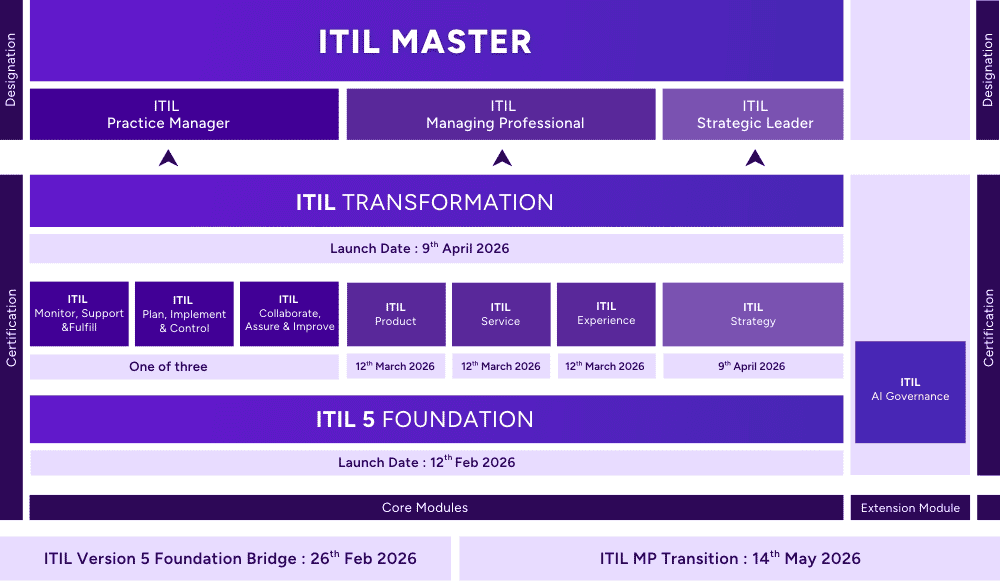
The certification scheme in ITIL® (Version 5) is more streamlined, consisting of nine core modules and one AI extension, leading to various designations. It promotes progressive learning, starting from foundational knowledge to mastery.
The scheme offers three advanced designations: Practice Manager, Managing Professional and Strategic Leader. These are separate pathways rather than compulsory sequential levels. ITIL Transformation is shared across all three, while completing all three designations leads to ITIL Master.
1) ITIL® Foundation
This entry-level certification introduces essential concepts, terminology and value creation principles. It covers how value is co-created for customers and organisations, defines roles and responsibilities, and highlights continual improvement. Ideal for beginners, it serves as the standard entry point for advanced paths.
However, professionals holding eligible ITIL® 4 certifications do not need to retake Foundation to access higher-level Version 5 modules. They can also choose the optional ITIL® Foundation Bridge to update their qualification.
Pro Tip
Already hold an ITIL® 4 certification? Check your eligibility before booking Foundation again. Recognised ITIL 4 qualifications can meet the prerequisites for higher-level Version 5 modules, while the Foundation Bridge remains optional.
2) ITIL® Practice Manager
Aimed at operational professionals, this designation builds skills in applying ITIL practices daily. The standard pathway requires ITIL® Foundation or an accepted prerequisite, ITIL® Transformation, and one of three specialised modules: Monitor, Support and Fulfil (MSF); Plan, Implement and Control (PIC); or Collaborate, Assure and Improve (CAI). Each module groups related practices for focused expertise.
Candidates need only one of these three specialised modules. Existing ITIL® 4 Practice Manager holders can upgrade their designation by completing ITIL® Transformation (Version 5).
3) ITIL® Managing Professional
For leaders in digital delivery, this focuses on service management, user experience and improvement. The standard pathway requires ITIL® Foundation or an accepted prerequisite, ITIL® Transformation, ITIL® Product, ITIL® Service and ITIL® Experience, covering digital product management, service delivery and stakeholder experience.
Eligible ITIL® 4 Managing Professionals and advanced ITIL v3 qualification holders can use the ITIL Managing Professional Transition (Version 5) route instead of completing every module separately.
4) ITIL® Strategic Leader
Targeted at senior strateg
ists, it covers digital strategy, governance and investment. The standard pathway includes ITIL® Foundation or an accepted prerequisite, ITIL® Transformation and ITIL® Strategy (connecting vision to execution).
Existing ITIL® 4 Strategic Leader holders can upgrade by completing ITIL® Transformation (Version 5).
5) ITIL® Transformation
A core module required for all three advanced designations, it guides sustainable change by aligning people, processes and technology. Completed once, it emphasises designing and managing improvements in the service value system.
It is a separate certification module, not a collection of the Product, Service, Experience, Strategy or Practice Manager modules.
6) ITIL® AI Governance
The ITIL® AI Governance extension module supports responsible AI adoption through governance, accountability, oversight and risk management. It has no formal prerequisite and is not required for the Practice Manager, Managing Professional, Strategic Leader or Master designations.
To achieve ITIL® Master through the standard pathway, professionals must complete all three advanced designations: Practice Manager, Managing Professional and Strategic Leader. No separate Master examination is required.
What Stays the Same in ITIL® (Version 5)?
Despite the updates, ITIL® (Version 5) preserves core elements from previous versions like ITIL v3 and 4. The foundational focus on best practices for value creation, roles, responsibilities and continual improvement remains intact.
Concepts like the ITIL Value System, guiding principles and governance continue to provide continuity, while the new product and service lifecycle model offers an updated approach to managing digital products and services.
Existing ITIL knowledge and certifications also remain valuable, with recognised pathways helping qualified professionals progress without unnecessarily repeating previous learning.
Learn to bring product and service thinking together with the ITIL® 5 Product Certification Training – Join now!

The Knowledge Academy develops accessible learning content across Project Management, IT, Cybersecurity, Data Science, Business Analysis, HR, Accounting and Finance, Leadership and Health and Safety. Its resources combine subject research with clear explanations to help professionals build practical knowledge across a wide range of disciplines.
View Detail

 If you wish to make any changes to your course, please


