Who should attend this Introduction to UML Training Course?
The Introduction to UML Course is a comprehensive course designed to provide delegates with the skills and knowledge needed to effectively use Unified Modeling Language (UML), a standardised visual language for modeling software systems and processes. This UML Certification course can be benefical for a wide range of professionals, including:
- Software Architects
- Software Developers
- Sytems Analysts
- Project Managers
- Quality Assurance Engineers
- Software Designers
- Technical Writers
Prerequisites of the Introduction to UML Training Course
There are no formal prerequisites for the Introduction to UML Course. However, a basic understanding of software development and UML can be beneficial for delegates planning to attend this UML Certification.
Introduction to UML Training Overview
This introduction to UML Certification Training offers a comprehensive overview of its methodologies and applications. Understanding UML is crucial for visualising, specifying, constructing, and documenting the artefacts of software systems. UML Training is tailored to provide a solid foundation in UML, ensuring delegates grasp the language's core concepts and their practical applications in real-world scenarios.
Proficiency in UML Certification is essential for Software Developers, System Analysts, and Project Managers aiming to excel in complex software projects. Mastery of UML Certification enables professionals to communicate system designs effectively, ensuring clarity and precision. UML Training is designed for those who wish to enhance their modelling skills to deliver high-quality software solutions.
This intensive 1-day UML Certification Training offered by The Knowledge Academy will equip delegates with the skills to use UML effectively. Delegates will learn to create various UML diagrams, understand their interrelations, and apply them to real-world scenarios. The course emphasises practical skills, ensuring delegates can apply UML techniques professionally.
Course Objectives
- To introduce the fundamentals of UML
- To demonstrate the creation and interpretation of UML diagrams
- To enhance proficiency in software design and documentation using UML
- To facilitate effective communication through standardised modelling techniques
- To provide insights into best practices in UML application
- To enable practical application of UML in real-world scenarios
- To foster critical thinking in system design and architecture
- To prepare delegates for advanced studies in UML and software engineering
After completing UML Training, delegates will receive a certification in Introduction to UML. This certification symbolises their newly acquired expertise and enhances their professional credibility. UML Training marks the beginning of a journey towards becoming proficient in UML, opening doors to advanced software design and development opportunities.
Skills Gained from the Introduction to UML Training
The Introduction to UML Training helps learners understand the fundamental concepts of the Unified Modelling Language (UML) and how it is used in software and system design.
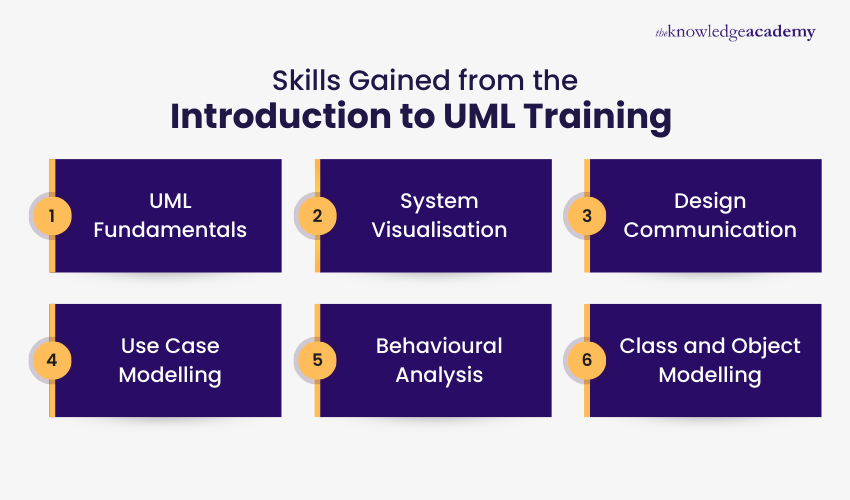
Key skills gained from this course include:
- UML Fundamentals: Professionals understand the basics of UML, its purpose, and how standardised notation supports clear system and software modelling.
- System Visualisation: Learn how to represent system structure, behaviour, and interactions visually, making complex systems easier to understand and explain.
- Design Communication: Improve communication between technical teams and stakeholders by translating requirements and designs into clear visual models.
- Use Case Modelling: Develop the ability to create use case diagrams that show how users interact with a system and how key functionalities are delivered.
- Behavioural Analysis: Examine how to use sequence, activity, and state diagrams to represent workflows, system behaviour, and interactions.
- Class and Object Modelling: Build skills in creating class, object, component, and deployment diagrams to represent system structure and data organisation.





 If you miss out, enquire to get yourself on the waiting list for the next day!













 If you wish to make any changes to your course, please


