Who should attend this Introduction to Test Automation with Selenium Web Driver Training Course?
The Introduction to Test Automation with Selenium WebDriver Course in High Wycombe is designed to provide members with an introductory information of the usage of Selenium WebDriver for automating net testing techniques. The course is beneficial for the following professionals:
- Software Testers
- Quality Assurance Engineers
- Manual Testers
- Test Analysts
- Test Automation Engineers
- Web Application Testers
- Product Managers
Prerequisites of the Introduction to Test Automation with Selenium Web Driver Training Course
There are not any particular prerequisites for taking this Introduction to Test Automation with Selenium Web Driver Training Course. However, a basic understanding of software testing, check automation, and Selenium may be useful.
Introduction to Test Automation with Selenium Web Driver Course Overview
The Selenium Web Driver Course embodies a critical segment in the evolving landscape of Software Development and quality assurance. Its relevance hinges at the rising call for for efficient and dependable Web Application Testing. This route delves into the tricky functionalities of Selenium WebDriver, a cornerstone device inside the area of test automation, providing in-intensity insights and realistic expertise.
Understanding the nuances of this path is pivotal for experts like Software Testers, QA Engineers, and developers. These people stand to benefit notably as they grasp the Best Selenium Web Driver Course, enhancing their abilties in Automating Web Application Testing, improving accuracy, and expediting development cycles.
The 1-day education furnished through the Knowledge Academy via its Selenium Web Driver Courses will equip delegates with a complete knowledge of Selenium WebDriver. This route is established to impart sensible talents and theoretical expertise, guarantees to be a transformative revel in for aspiring automation testers, contributing to their career development.
Course Objectives
- To impart foundational knowledge of Selenium WebDriver and its applications
- To enhance skills in writing and executing automated test scripts
- To provide insights into cross-browser testing strategies
- To enable understanding of Page Object Model and data-driven testing
- To prepare delegates for Selenium Certification through practical exposure
Upon completion of this Selenium Web Driver Course Online, delegates will have acquired the competence to confidently implement test automation strategies in their respective workplaces. Their newfound proficiency in Selenium Online Courses will not only elevate their professional capabilities but also position them as valuable assets in the dynamic field of software testing and quality assurance.
Skills Gained from Introduction To Test Automation with Selenium WebDriver Training
Introduction to Test Automation with Selenium Web Driver Training provides structured learning for automating software testing processes using Selenium and Java-based frameworks. It enables learners to understand automation concepts, configure testing environments, and execute web application tests efficiently.
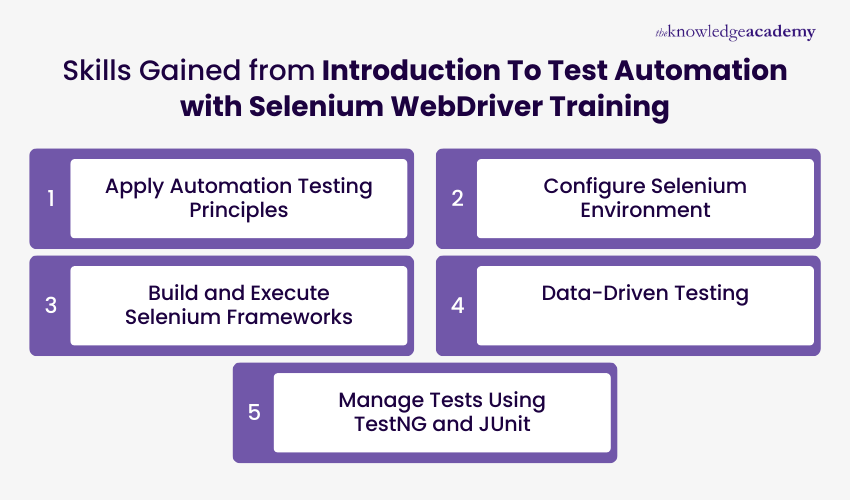
Key skills professionals will gain from this training include:
- Apply Automation Testing Principles: Understand automation testing concepts, advantages, and identify suitable scenarios for replacing manual testing with automation.
- Configure Selenium Environment: Install Java, Eclipse, Selenium WebDriver, and Selenese, creating a fully functional automation testing environment from scratch.
- Build and Execute Selenium Frameworks: Use Selenium Integrated Development Environment (IDE), WebDriver, and Grid architectures to design, compare, and execute scalable automated test frameworks.
- Data-Driven Testing: Create data-driven tests using Apache POI, apply effective locator techniques, perform browser operations, and retrieve application values accurately.
- Manage Tests Using TestNG and JUnit: Create automated test suites using Test Next Generation (TestNG), Java Unit Testing Framework (JUnit), annotations, assertions, and Maven project integration.





 If you miss out, enquire to get yourself on the waiting list for the next day!













 If you wish to make any changes to your course, please


