


 Top Rated Course

We may not have the course you’re looking for. If you enquire or give us a call on 01344203999 and speak to our training experts, we may still be able to help with your training requirements.
Tableau Developer Jobs: Roles, Skills, Salary and Career Path
The Knowledge Academy 04 September 2026Explore top Tableau Developer Jobs, key responsibilities, required skills, career paths, and salary insights to understand where Tableau expertise can take your data career.

Training Outcomes Within Your Budget!
We ensure quality, budget-alignment, and timely delivery by our expert instructors.
Table of Contents

Key Takeaways
1. Tableau Developers turn business requirements and data into interactive dashboards, reports and analytical solutions.2. Strong SQL, Data Visualisation, data modelling and Tableau platform skills are commonly valuable for these roles.3. Practical projects and a well-presented portfolio can demonstrate skills that qualifications alone may not show.4. Career progression can lead towards senior development, Business Intelligence, consulting, architecture or analytics roles.5. Tableau Developer salaries vary considerably according to location, experience, technical depth, industry and employer.
A dashboard may look simple when it reaches the person making a decision: a few charts, filters and KPIs arranged on one screen.
Behind that screen can sit a much larger job. Someone has to understand what the business is asking, find the right data, prepare it, define calculations, choose suitable visualisations, test the result, improve performance and make sure users can trust what they see.
That combination of business thinking, Data Visualisation and technical delivery is where Tableau Developer Jobs sit. For someone considering a career in analytics or Business Intelligence (BI), understanding the complete role is more useful than simply learning how to build attractive charts.
What is a Tableau Developer?
A Tableau Developer is a data and Business Intelligence professional who uses Tableau to convert data into dashboards, reports, visualisations and analytical experiences that help people understand information and make informed decisions.
The role can vary considerably between organisations. In one company, a Tableau Developer may focus primarily on dashboard design, calculations, and reporting. In another, the role may involve SQL, data modelling, security, performance optimisation, data preparation, platform administration, or integration with other systems.

Roles and Responsibilities of a Tableau Developer
The following are the key roles and responsibilities of a Tableau Developer.
a) Gathering and Analysing Business and Data Requirements: Tableau Developers work with stakeholders to understand reporting needs, identify relevant data sources, and define how information should be presented to end users.
b) Designing and Developing Tableau Dashboards and Reports: They create interactive dashboards, reports, filters, and visual elements that make complex information easier to explore and understand.
c) Creating Clear and Insightful Data Visualisations: Tableau Developers select appropriate charts, graphs, and layouts to communicate trends, patterns, comparisons, and key business insights effectively.
d) Maintaining Data Quality and Supporting Governance Standards: They validate data sources, check data accuracy and consistency, and follow organisational standards for data security, quality, and governance.
e) Collaborating with Cross-functional Teams: Tableau Developers work with Data Analysts, Data Engineers, IT teams, and business stakeholders to develop reporting solutions that align with organisational objectives.
Skills Required for Tableau Developer Jobs
Being comfortable with Tableau is important, but employers may expect a broader skill set. Current vacancies commonly combine Tableau knowledge with SQL, data preparation, modelling, performance, and stakeholder communication.
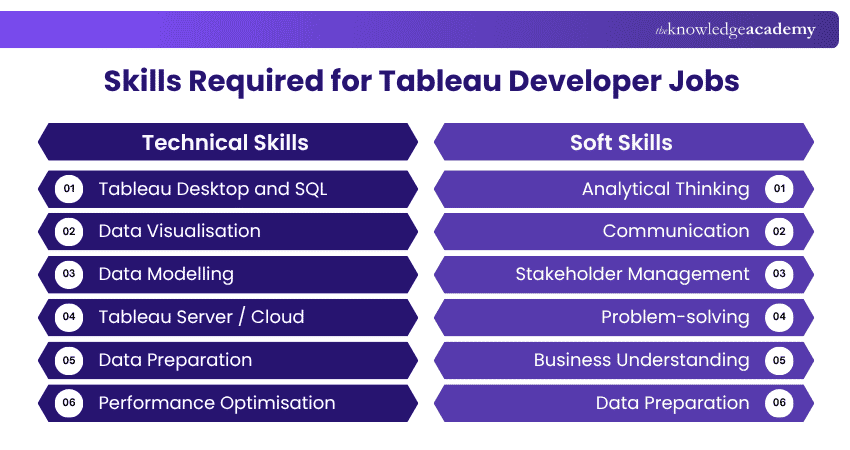
Technical Skills
Below are some technical skills required for Tableau Developer Jobs:
1) Tableau Desktop: Tableau Desktop is central to many development roles. You should be comfortable connecting to data, creating worksheets and dashboards, using filters and parameters, building calculations and structuring information clearly.
2) Tableau Server or Tableau Cloud: Knowing how published content is managed can become important in professional environments. Useful areas include publishing, permissions, refreshes, access control and maintaining analytical content.
3) SQL: SQL is one of the most transferable skills for Tableau Developer Jobs. It helps developers retrieve, filter, aggregate, and combine data before visualisation. More advanced positions may also require query optimisation and knowledge of database performance.
4) Data Visualisation Principles: A developer should understand when to use different chart types, how to guide attention, and how to avoid designs that distort or obscure the data. Effective dashboards balance clarity, usability, and analytical depth.
5) Data Modelling: Understanding relationships between tables, dimensions, measures and levels of granularity can help prevent inaccurate calculations and inefficient reporting.
6) Data Preparation and ETL/ELT Concepts: Real-world data is rarely ready for immediate visualisation. Familiarity with cleaning, transforming, and combining data is therefore valuable. Tableau Prep may be used for these workflows, while some organisations rely on other ETL or data-engineering platforms.
7) Tableau Calculations: Calculated fields, table calculations, parameters and Level of Detail (LOD) expressions can help developers answer more complex analytical questions.
8) Performance Optimisation: Developers should understand how dashboard design, filters, calculations, queries, extracts, and data volumes affect performance.
9) Security and Governance: Enterprise Tableau work may involve row-level security, permissions, trusted data sources and consistent metric definitions.
10) Broader Technical Skills: Python, R, cloud platforms, APIs, data warehouses and other BI tools may be useful for some positions, but they are not universal requirements. Current roles demonstrate this variation: some list Python or R as additional skills rather than core requirements, while Tableau's official developer resources place greater emphasis on APIs, embedding, extensions and automation for development-focused use cases.
Soft Skills
Technical ability helps you build the solution. Soft skills help ensure that the solution actually solves the right problem.
Important abilities include:
1) Analytical Thinking: Breaking an unclear business question into measurable components.
2) Communication: Explaining metrics, assumptions, and findings without unnecessary technical language.
3) Stakeholder Management: Understanding different expectations and reaching agreements on requirements.
4) Problem-solving: Investigating incorrect numbers, slow dashboards, and unexpected behaviour systematically.
5) Attention to Detail: Checking calculations, filters, labels and data before publishing.
6) Business Understanding: Recognising why a metric matters instead of treating dashboard creation as an isolated technical exercise.
7) Collaboration: Working effectively with Analysts, Engineers, administrators, and business teams.
Build practical data analytics skills for career growth with our Advanced Data Analytics Course - Register now!
Trainer's Tip
Do not practise Tableau only with perfectly prepared datasets. Take a messy dataset and complete the full journey: clean it, model it, define the KPIs, build the dashboard, validate the results, and explain your design decisions.
How to Become a Tableau Developer?
There is no single route to Tableau Developer Jobs. People can enter from Data Analysis, reporting, Business Intelligence, database, finance, operations or other data-heavy backgrounds. A useful approach is to build capability in stages rather than trying to learn every Tableau feature before applying for work.

1) Build the Right Educational Foundation
A degree in Computer Science, Information Systems, Data Analytics, Statistics, Mathematics or a related subject can provide useful foundations, and some employers explicitly ask for one.
However, educational requirements vary. The more important question is whether you can demonstrate the data, technical, and business skills required by the vacancy.
2) Learn Tableau and Supporting Data Skills
Start with the Tableau fundamentals, but do not stop at dashboard appearance.
A practical learning sequence can be:
a) Learn how Tableau connects to data.
b) Build basic charts, worksheets, and dashboards.
c) Practise filters, parameters, and calculations.
d) Learn data relationships and modelling concepts.
e) Develop SQL skills.
f) Practise preparing and validating data.
g) Learn dashboard performance principles.
h) Understand publishing, permissions and Tableau Server or Cloud.
i) Explore advanced capabilities that align with the jobs you want.
3) Consider Relevant Tableau Certifications
Tableau certifications can help demonstrate your knowledge of the platform and strengthen your professional profile, particularly when you have limited industry experience.
However, certification should complement practical skills. Combine hands-on dashboard development, data analysis, SQL knowledge, and real-world projects to demonstrate your overall capabilities to employers.
4) Build a Tableau Portfolio and Gain Practical Experience
A portfolio gives employers something concrete to evaluate.
Instead of filling it with many similar dashboards, build a small collection that demonstrates different skills. For example:
a) Sales Performance Dashboard: Show KPIs, trends, regional comparisons and useful filtering.
b) Operational Dashboard: Monitor service levels, exceptions or process performance.
c) Executive Dashboard: Reduce a complex dataset to a concise decision-making view.
d) Data Preparation Project: Demonstrate how raw data became an analysis-ready dataset.
e) Performance Improvement Example: Show how you diagnosed and improved a slow or inefficient workbook.
Tableau Developer Career Opportunities and Growth
Tableau expertise can support several career directions because the role sits between business analysis, visualisation and technical BI work.
A career might begin with reporting or junior analytical responsibilities and progress into positions involving larger data environments, complex calculations, governance, performance or technical leadership.
Common Career Paths and Related Roles
Below are some common career paths and related roles:
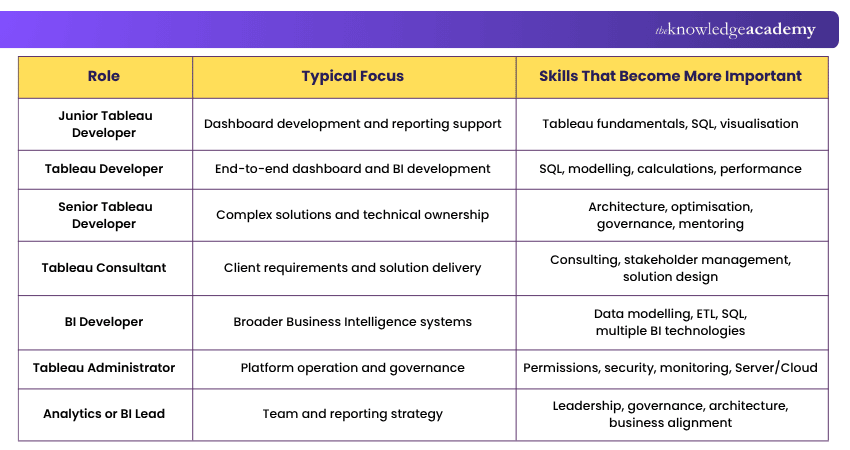

Tableau Developer Salary
Experience plays a crucial role in determining Tableau Developer salaries. Entry-level Tableau Developers with limited experience may start at the lower end of the salary spectrum. At the same time, seasoned professionals with several years of expertise and advanced skills can command higher salaries.
Industry demand and the organisation's size also influence Tableau Developer salaries. Companies in the technology, finance, healthcare, and consulting sectors often offer competitive compensation packages to attract top talent and remain competitive.
The following table illustrates the average salaries for a Tableau Developer across six countries:

Source: Indeed
Conclusion
Tableau Developer Jobs are more than making data look attractive. Strong developers connect business questions with reliable data, suitable visualisations and technically sound analytical solutions. The best preparation is therefore balanced: learn Tableau well, strengthen SQL and data fundamentals, understand how professional BI environments operate, and build projects that show how you think.
Strengthen your Reporting Skills with our Business Intelligence Reporting Courses – Join now!
Frequently Asked Questions
Is a Tableau Developer a Coding Job?

A Tableau Developer role is not purely coding-focused. It mainly involves creating dashboards, working with data, writing calculations, and using SQL. However, some roles may also require programming knowledge for automation, API integration, embedded analytics, or advanced customisation.
How Long Does It Take to Become Job-ready as a Tableau Developer?
The time required varies depending on your existing knowledge of SQL, databases, reporting, and data visualisation. Beginners may need more time, while those with related experience can progress faster. Building practical Tableau projects and demonstrating real-world skills is more important than following a fixed timeframe.
Can Tableau Developers Work Remotely?
Yes, many Tableau development tasks can be completed remotely, including dashboard creation, SQL work, testing, and collaboration. However, whether a role is remote, hybrid, or office-based depends on the employer, client requirements, data security policies, and the type of projects involved.

The Knowledge Academy


Global Training Provider
The Knowledge Academy is a world-leading provider of professional training courses, offering globally recognised qualifications across a wide range of subjects. With expert trainers, up-to-date course material, and flexible learning options, we aim to empower professionals and organisations to achieve their goals through continuous learning.


 If you wish to make any changes to your course, please


