


We may not have the course you’re looking for. If you enquire or give us a call on 01344203999 and speak to our training experts, we may still be able to help with your training requirements.
Product Manager Role and Responsibilities: A Complete Guide
ByThe Knowledge AcademyLast updated on: 04 November 2026
Explore the key role and responsibilities of a Product Manager, from customer research and product strategy to feature prioritisation and performance monitoring.

The Gist
1. Product Managers research customer needs, market opportunities and user problems to guide product decisions.2. They define product direction, goals and priorities that support organisational objectives.3. They work with engineering, design, marketing and other stakeholders to deliver customer value.4. They evaluate product performance, collect feedback and refine products after launch.5. Strategic thinking, communication, analytical reasoning and prioritisation support effective product management.
Ever used an app and thought, “Why haven’t they added this feature yet?” Or wondered why a feature you loved suddenly disappeared? Such changes involve important decisions about what users want, what works and what needs to change. That’s where a Product Manager comes into the picture.
However, balancing different expectations isn't always easy. Customers want more features, developers face technical limitations, and businesses have their own priorities. So, how does a Product Manager navigate these competing demands? In this blog, we'll explore the Product Manager role and responsibilities and discover how these professionals handle such challenges and make important product decisions. Let's get started!
Top 10 Responsibilities of a Product Manager
Product Managers perform several interconnected responsibilities, from understanding customer problems to evaluating product performance after launch. These activities can be illustrated through a simplified product management workflow involving discovery, strategy, development, launch and continuous improvement.
Product Management Workflow
Discover → Strategise → Develop → Launch → Improve
Customer feedback and performance data continuously inform these stages, helping teams refine their decisions and identify new opportunities. The following are ten important Product Manager responsibilities:
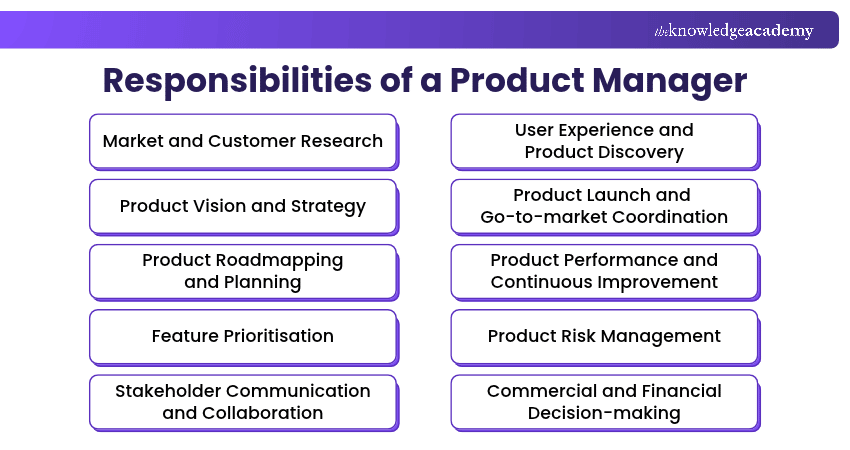
1) Market and Customer Research
Understanding customer needs and market opportunities is one of the primary responsibilities of a Product Manager. They investigate customer challenges, preferences and behaviours to identify problems worth solving. Research activities may include customer interviews, surveys, competitor analysis, market research and product usage analysis.
Product Managers use these findings to understand customer expectations, identify unmet needs and support decisions about product development. For example, a Product Manager working on an online shopping application may discover that customers frequently abandon purchases because the checkout process is complicated. This insight could help the team prioritise improvements to the purchasing experience.
Pro Tip
Combine customer interviews, surveys and product usage data to understand user problems. Avoid relying on a single source of feedback when making important product decisions.

2) Product Vision and Strategy
Product Managers help define the vision and strategic direction of a product. They connect customer needs with organisational objectives and identify how the product can deliver meaningful value. This responsibility includes establishing product goals, identifying target customers, defining the product's value proposition and evaluating competitive opportunities.
An effective product strategy explains which problems the organisation intends to solve, which opportunities it will prioritise and how these decisions support business objectives. For example, a Product Manager may define a strategy to improve customer retention by simplifying the onboarding experience rather than introducing several unrelated features.
3) Product Roadmapping and Planning
Product roadmapping translates product strategy into an evolving plan that communicates priorities, expected outcomes and the direction of future development. Product Managers collaborate with engineering, design and business teams to identify important initiatives, understand dependencies and determine which opportunities should be explored.
Their responsibilities may include:
a) Defining product initiatives based on strategic objectives.
b) Communicating priorities through a product roadmap.
c) Collaborating with teams to understand technical feasibility.
d) Reviewing dependencies and delivery considerations.
e) Updating plans as customer needs and business priorities change.
f) Clarifying product requirements and intended outcomes with delivery teams.
For example, a Product Manager may organise a roadmap around improving onboarding, strengthening existing features and introducing new capabilities.
4) Feature Prioritisation
Product Managers regularly evaluate competing requests, customer problems and development opportunities. Since teams have limited time and resources, not every proposed feature can be implemented immediately. Feature prioritisation involves assessing the potential value of an initiative against its effort, risks and strategic importance.
Common considerations include:
a) Customer Value: How effectively the feature addresses a meaningful user problem.
b) Business Impact: Its potential contribution to organisational goals.
c) Development Effort: The resources and technical work required.
d) Strategic Alignment: Whether it supports the product's direction.
e) Risk and Dependencies: Potential challenges that may affect implementation.
Product Managers may use prioritisation frameworks such as RICE or MoSCoW to support structured discussions. However, these frameworks assist decision-making rather than replace professional judgement.
5) Stakeholder Communication and Collaboration
Product Managers work with stakeholders across engineering, design, marketing, sales, customer support and senior management. Their responsibility is to communicate the product vision, explain priorities, gather relevant feedback and maintain alignment around product objectives.
Effective collaboration involves:
a) Communicating product goals and decisions clearly.
b) Understanding concerns raised by different stakeholders.
c) Encouraging collaboration between departments.
d) Explaining trade-offs when priorities conflict.
e) Sharing progress, outcomes and changes in product direction.
For example, a sales team may request a feature for a potential customer, while engineering recommends addressing an existing performance issue. The Product Manager can evaluate customer impact, technical urgency and business priorities before helping the teams agree on the most suitable approach.
6) User Experience and Product Discovery
Product Managers collaborate with designers, researchers and engineers to explore potential solutions and improve the overall user experience. Product discovery involves investigating customer problems, exploring potential solutions, evaluating assumptions and testing ideas before committing significant development resources.
Typical activities include reviewing user research, defining customer problems, assessing prototypes and interpreting usability testing results. For example, before developing a new dashboard, a Product Manager may work with designers to test a prototype with users. Their feedback could reveal that important information is difficult to locate, allowing the team to improve the design before development.
Master product roadmaps and agile practices from anywhere in the world. Sign up for the Online Product Manager Course now!
7) Product Launch and Go-to-market Coordination
Launching a product or new feature requires coordination across multiple departments. Product Managers help ensure that the launch supports customer needs and business objectives. They collaborate with engineering, marketing, sales, customer support and other stakeholders to prepare the product for release and adoption.
Their responsibilities may include:
a) Confirming product goals and intended customer outcomes.
b) Reviewing product readiness with the relevant teams.
c) Communicating important features and intended benefits.
d) Coordinating launch priorities with marketing and sales.
e) Supporting customer documentation and internal preparation.
f) Defining metrics for monitoring product adoption and performance.
For example, when launching a new subscription feature, the Product Manager may coordinate with marketing on customer messaging and with support teams on common questions or expected issues.
Product Launch Readiness Checklist
Before launching a product or major feature, check whether the following activities have been completed:□ Validate the customer problem and intended solution.□ Confirm the main requirements and acceptance criteria.□ Review testing results and unresolved issues.□ Coordinate launch activities with relevant departments.□ Prepare customer documentation and support information.□ Define success metrics and post-launch monitoring.□ Assign ownership of launch risks and follow-up actions.
8) Product Performance and Continuous Improvement
A Product Manager's responsibilities continue after a product or feature has been launched. They monitor performance, evaluate customer feedback and determine whether the product is achieving its intended objectives. This may involve analysing product adoption, retention, engagement, customer satisfaction and relevant financial results.
For example, if a new feature receives limited adoption, the Product Manager may investigate whether customers understand its value, whether the experience is difficult to use or whether the feature addresses the intended problem. These findings help teams decide whether to improve the feature, change the approach or focus on a different opportunity.
9) Product Risk Management
Product development involves uncertainty. Product Managers help identify and assess risks that could affect customer value, product adoption or business outcomes. Relevant product risks may include:
a) Market Risks: Changes in customer demand or competitive conditions.
b) Customer Risks: Developing solutions that do not address important user needs.
c) Technical Risks: Limitations that affect feasibility, performance or reliability.
d) Business Risks: Uncertain financial returns or changes in strategic priorities.
e) Compliance Risks: Requirements involving privacy, security or applicable regulations.
For example, before introducing a feature that processes sensitive customer information, a Product Manager may consult security, legal and engineering teams to understand the requirements and potential implications.
10) Commercial and Financial Decision-making
Product Managers must understand how product decisions affect business performance. They evaluate the potential commercial value of product opportunities while considering development costs, customer benefits and organisational objectives. Important responsibilities include:
a) Revenue Opportunities: Identifying how products or features may contribute to business growth.
b) Cost Considerations: Understanding the resources required to develop and maintain product capabilities.
c) Pricing and Value: Collaborating on pricing decisions and evaluating customer willingness to pay.
d) Business Performance: Reviewing product-related financial and operational outcomes.
e) Investment Decisions: Supporting discussions about where product resources can create meaningful value.
For example, a Product Manager may compare the potential benefits of introducing a new premium feature with the development and maintenance costs involved. Commercial awareness helps Product Managers balance customer needs with the long-term financial sustainability of the product.
Extra Insight
A Product Manager in the United Kingdom can earn an average annual salary of £58K.
Essential Skills for Product Managers
Product Managers require a combination of analytical, strategic, communication and leadership abilities to perform their responsibilities effectively. The following six skills are particularly important:
1) Strategic Thinking: Understanding the bigger picture, identifying opportunities and aligning product decisions with long-term business goals.
2) Communication and Storytelling: Explaining product goals, customer problems and priorities clearly to different stakeholders.
3) User Empathy: Understanding customer challenges, preferences and expectations through research and feedback.
4) Data-driven Decision-making: Using customer insights, product analytics and relevant experiments to evaluate opportunities and outcomes.
5) Leadership and Collaboration: Building alignment, encouraging teamwork and influencing decisions across departments.
6) Adaptability and Problem-solving: Responding to changing priorities, identifying challenges and adjusting approaches when new information becomes available.
Keep This in Mind
A Product Manager's responsibilities can vary depending on the organisation, industry and product. While some focus on strategy and customer research, others may take greater responsibility for product delivery, commercial decisions or performance monitoring. The role often requires balancing customer needs with business objectives.
Learn backlog management and value-driven product delivery practices with our AI-Empowered SAFe® Product Owner/Product Manager Course – Register now!

The Knowledge Academy develops accessible learning content across Project Management, IT, Cybersecurity, Data Science, Business Analysis, HR, Accounting and Finance, Leadership and Health and Safety. Its resources combine subject research with clear explanations to help professionals build practical knowledge across a wide range of disciplines.
View Detail

 If you wish to make any changes to your course, please


