


We may not have the course you’re looking for. If you enquire or give us a call on +1 7204454674 and speak to our training experts, we may still be able to help with your training requirements.
Linux Administrator Job Description
ByThe Knowledge AcademyLast updated on: 12 November 2026
Explore the Linux Administrator job description, covering server management, security, troubleshooting and automation. Discover the role's key responsibilities, essential technical skills, qualifications and a practical job description example for aspiring professionals and employers.

At a Glance
1. Linux Administrators install, configure, maintain and secure Linux-based systems.2. Their duties include monitoring performance, managing updates, troubleshooting issues and maintaining backups.3. Linux commands, scripting, networking, security and virtualisation are important technical capabilities.4. Relevant IT experience, education and certifications such as RHCSA or LPIC-1 can support career development.5. Senior Linux Administrators typically handle complex infrastructure responsibilities and provide technical guidance.
Ever wondered who keeps the servers running smoothly behind your favourite websites, applications and online services? While most people only notice technology when something goes wrong, Linux Administrators work behind the scenes to keep systems secure, stable and reliable.
But what does it take to manage these systems effectively? A Linux Administrator job description outlines the technical skills, responsibilities and qualifications required for the role. Whether you're considering this career or looking to hire the right professional, this blog explores what the position involves and what employers expect.
Who is a Linux Administrator?
A Linux Administrator is an IT professional responsible for installing, configuring, securing and maintaining Linux-based systems. They help organisations keep servers and applications running reliably by monitoring performance, managing updates, resolving technical problems and supporting system availability.
Depending on the organisation, Linux Administrators may also work with cloud infrastructure, virtualisation platforms and automation tools.

Linux Administrator Roles and Responsibilities
Linux Administrators manage the daily operation, security and performance of Linux-based systems. Their responsibilities involve preventing disruptions, resolving technical problems and ensuring infrastructure meets organisational requirements. Here are eight important Linux Administrator roles and responsibilities:
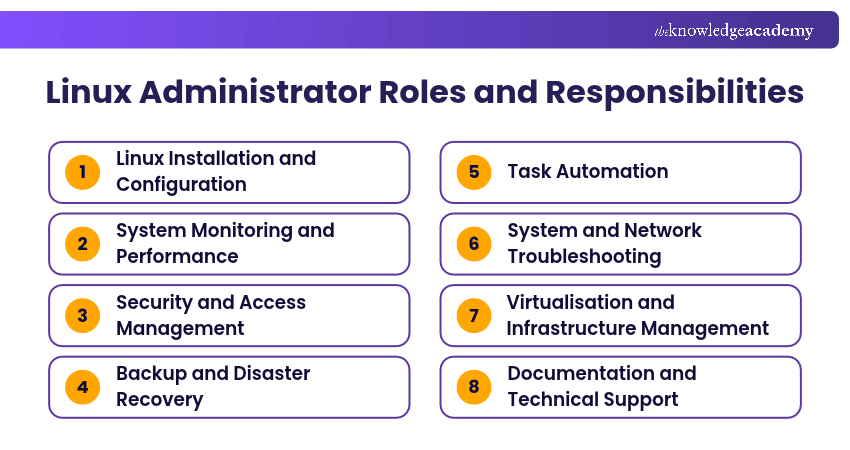
1) Installing and Configuring Linux Systems
Linux Administrators install Linux distributions, configure servers and manage essential software packages. They work with systems running Ubuntu Server, Debian or Red Hat Enterprise Linux (RHEL) to establish stable environments that meet business requirements.
They also configure system services, user accounts, storage and network settings to ensure systems are ready for operation.
2) Monitoring System Performance and Availability
Monitoring helps Linux Administrators identify performance issues before they affect users or applications. They track CPU usage, memory consumption, disk capacity, network activity and service availability.
By reviewing monitoring data and system logs, Linux Administrators can identify bottlenecks, investigate unusual behaviour and plan capacity improvements to maintain reliable operations.
3) Managing Security, Patches and Access Controls
Linux Administrators help protect systems by applying security updates, managing permissions and configuring appropriate security controls. They maintain user accounts, review access privileges, configure firewalls and support system hardening. Regular patch management and security reviews help reduce exposure to known vulnerabilities.
4) Performing Backups and Disaster Recovery
Linux Administrators manage backup procedures to protect important data, configurations and system information. They schedule backups, monitor their completion and maintain recovery processes. They also support disaster recovery planning to help organisations restore essential services following system failures, data loss or other disruptions.
Trainer Insight
Creating regular backups is important, but testing recovery procedures is equally essential. Periodically restore backups in a controlled environment to verify data integrity and confirm that recovery processes work when needed.
5) Automating Administrative Tasks
Automation helps Linux Administrators reduce repetitive work and maintain consistent system configurations. They use tools such as Bash, Python and Ansible to automate routine maintenance, software deployment and configuration tasks. Effective automation can save time, reduce manual errors and support more efficient infrastructure management.
6) Troubleshooting System and Network Issues
Linux Administrators investigate problems affecting system performance, connectivity and application availability. They analyse logs, check services and examine system resources to identify the causes of technical failures. They also collaborate with other IT teams when issues involve network infrastructure, applications or external services.
Trainer Insight
When a Linux server experiences performance or service issues, review available diagnostic information before restarting services, where practical. Check system logs, resource usage, network connectivity and service status to identify possible causes.
7) Managing Virtualisation and Infrastructure Resources
Linux Administrators may manage virtual machines, storage resources and cloud-based infrastructure. They work with technologies such as Kernel-based Virtual Machine (KVM) and VMware vSphere to support efficient resource utilisation.
Their responsibilities can include provisioning virtual servers, configuring storage, reviewing resource capacity and supporting infrastructure upgrades.
8) Maintaining Documentation and Providing Technical Support
Linux Administrators document system configurations, maintenance procedures, troubleshooting steps and infrastructure changes. Accurate documentation helps teams manage systems consistently and resolve recurring issues.
They also provide technical support, assist colleagues with system-related problems and coordinate maintenance activities. Depending on the organisation, this may involve scheduled on-call or out-of-hours support.
Linux Administrator Responsibilities Checklist
Use the following checklist to review the main duties involved in Linux administration:□ Install, configure and maintain Linux systems.□ Monitor server performance and availability.□ Apply security updates and manage access controls.□ Maintain backups and test recovery procedures.□ Automate routine administration using scripts and tools.□ Investigate system, application and network issues.□ Manage virtualisation and infrastructure resources.□ Maintain documentation and provide technical support.
Linux Administrator Skills and Qualifications
The skills and qualifications required for a Linux Administrator depend on the organisation, infrastructure complexity and level of responsibility. Employers generally look for practical Linux knowledge, relevant technical experience and the ability to maintain secure and reliable systems. Common skills and qualifications include:
1) Educational Background: A bachelor's degree in computer science, information technology or a related subject may be preferred, although equivalent practical experience can also be valuable.
2) Linux Administration Experience: Hands-on experience installing, configuring, maintaining and troubleshooting Linux operating systems.
3) Technical Knowledge: Familiarity with networking, storage, virtualisation, scripting and system security.
4) Automation Experience: Practical knowledge of Bash, Python or configuration management tools such as Ansible.
5) Problem-solving and Communication: The ability to investigate technical issues, document solutions and collaborate with IT teams.
While professional certifications can strengthen a candidate's professional profile, practical experience and job-specific skills remain important when applying for Linux Administrator positions.
Learn essential Linux commands through our Linux Certification – Register now!
Linux Administrator Job Description Example
A well-written Linux Administrator job description helps employers communicate the responsibilities, skills and experience required for the position. The following example illustrates how a job description can be structured for Linux administration roles:

Keep This in Mind
A Linux Administrator's role requires technical expertise, security awareness and problem-solving skills. From maintaining servers to troubleshooting issues, these professionals support reliable IT operations. A clear job description helps employers set expectations and candidates understand the skills required.
Acquire practical skills in configuring and maintaining Linux servers and networks with our Administering Linux Systems Training – Join now!

The Knowledge Academy develops accessible learning content across Project Management, IT, Cybersecurity, Data Science, Business Analysis, HR, Accounting and Finance, Leadership and Health and Safety. Its resources combine subject research with clear explanations to help professionals build practical knowledge across a wide range of disciplines.
View Detail

 If you wish to make any changes to your course, please


