


We may not have the course you’re looking for. If you enquire or give us a call on 01344203999 and speak to our training experts, we may still be able to help with your training requirements.
Cyber Security Jobs: Roles and Career Paths
ByJohn DaviesLast updated on: 11 September 2026
Cyber Security Jobs offer opportunities in threat monitoring, ethical testing, incident response, security engineering and leadership
It’s a Monday morning when unusual login attempts trigger a company’s security alert. Here’s what follows:
A SOC Analyst reviews the activity
A Security Analyst assesses the risk
When compromised accounts are discovered, an Incident Responder acts quickly to contain the threat
Later, a Penetration Tester examines the weakness, while a Security Architect improves the wider security design.
One incident, several professionals and completely different responsibilities. This is what makes Cyber Security such a varied career field. But with so many options, how do you know which role matches your strengths? This blog explores popular Cyber Security Jobs, their responsibilities and career paths to help you find the right direction.
What are Cyber Security Jobs?
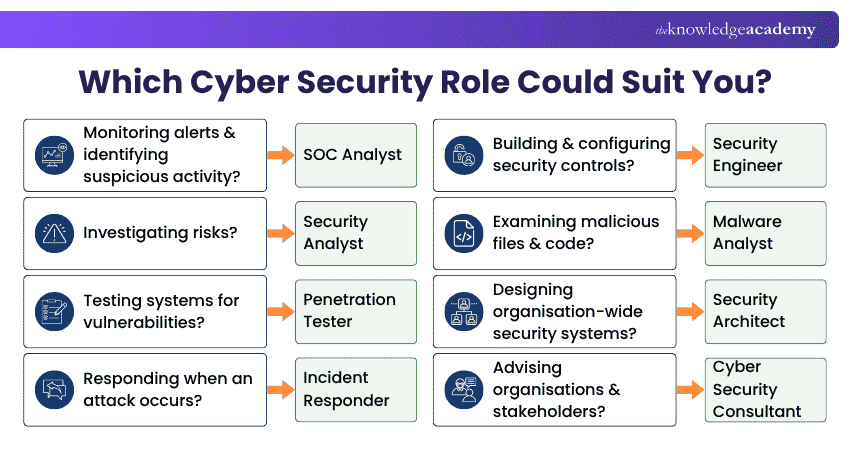
Cyber Security Jobs involve protecting systems, networks, applications and data from digital threats. Professionals in this field identify risks, monitor suspicious activity, respond to incidents and help organisations reduce their exposure to attacks. The work extends beyond stopping hackers.
It can include assessing business risks, configuring security controls, investigating malicious software, testing applications and explaining security issues to stakeholders. It also means anticipating problems before they happen, rather than only reacting once something has already gone wrong.

Top Cyber Security Job Roles
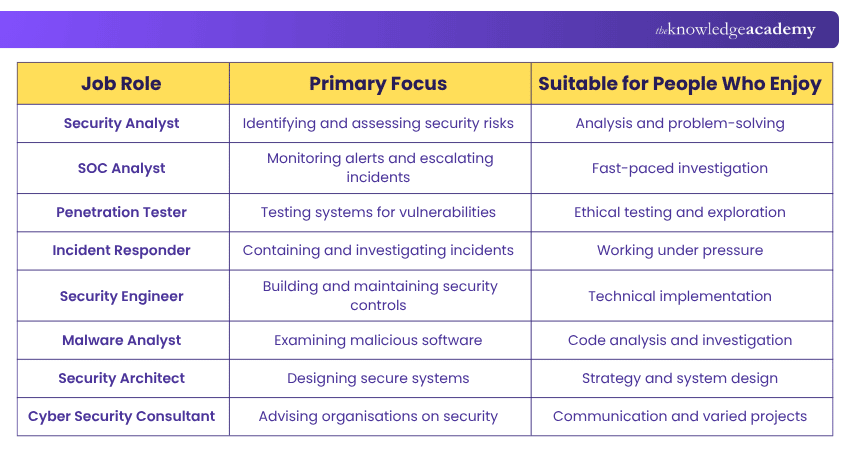
Cyber Security includes a wide range of roles. Some focus on detecting attacks, while others specialise in prevention, investigation, system design or strategic advice. The following table provides a quick comparison:
1) Security Analyst
A Security Analyst identifies vulnerabilities, reviews security events and helps protect systems from threats. Their work may include risk assessments, vulnerability management, access reviews and incident investigation.
Security Analysts need strong analytical abilities and an understanding of networks, operating systems and common security controls. The role can provide a foundation for progressing into engineering, incident response or security management.
2) SOC Analyst
A Security Operations Centre (SOC) Analyst monitors security alerts and investigates unusual activity. They use security tools to review logs, identify potential incidents and escalate serious threats. SOC roles can provide valuable exposure to real-world security events. However, the work may involve shifts because many Security Operations Centres operate continuously.
3) Penetration Tester
A Penetration Tester carries out authorised tests to identify weaknesses in systems, networks or applications. They document their findings and recommend practical ways to address the vulnerabilities. This role requires technical knowledge, methodical testing and clear reporting. All testing must be performed with proper permission and within an agreed scope.
4) Incident Responder
An Incident Responder investigates and contains Cyber Security incidents. They may isolate affected systems, preserve evidence, assess the impact and support service recovery. The role requires structured decision-making and the ability to remain calm under pressure. Incident Responders also document lessons learned to help prevent similar events.
Trainer’s Insight
Cyber Security job titles are not always standardised. One organisation’s Security Analyst may perform tasks similar to another organisation’s SOC Analyst. Compare the responsibilities, tools and experience requirements rather than relying only on the title.
5) Security Engineer
A Security Engineer designs, implements and maintains technical security controls. Their work may cover firewalls, endpoint protection, identity systems, monitoring platforms and cloud security configurations. Security Engineers usually need strong knowledge of infrastructure and system administration. They must understand how controls operate without unnecessarily disrupting business activities.
6) Malware Analyst
A Malware Analyst examines suspicious files or code to understand their behaviour, purpose and potential impact. Their findings can support threat detection, incident response and security research. The role may require programming, reverse engineering and knowledge of operating system behaviour. It is generally a specialised path rather than a typical first Cyber Security job.
Discover how malicious software works and gain the skills to combat it in our Malware Analysis Training - Sign up today!
7) Security Architect
A Security Architect designs security into an organisation’s systems, applications and technology strategy. They define security requirements and ensure that controls work together across the wider environment. This is commonly a senior position requiring broad technical and business experience. Security Architects must balance protection, usability, cost and organisational goals.
8) Cyber Security Consultant
A Cyber Security Consultant assesses risks and advises organisations on improving their security. They may work on governance, technical assessments, compliance, incident readiness or security transformation. Consultants need clear communication skills because they often explain complex
How to Get a Cyber Security Job?
There is no single route into Cyber Security. Some people begin with formal study, while others move from IT support, networking, software development, auditing or risk management. The following steps provide a practical starting point:
1) Choose a Career Direction
Research different roles and identify one or two that match your interests. A clear goal helps you select relevant skills, projects and certifications. Your first choice doesn't have to be permanent. Cyber Security professionals commonly move between related specialisms as they gain experience.
2) Learn IT and Security Fundamentals
Develop an understanding of networks, operating systems, identity, access control and common threats. These topics support many technical security roles. If you prefer governance, risk or compliance, you will also need to understand policies, controls, business processes and regulatory expectations.
3) Develop Role-specific Skills
Study the technologies and tasks associated with your preferred job. A future SOC Analyst might practise log analysis, while a Penetration Tester could focus on authorised vulnerability assessment. Avoid trying to learn every Cyber Security discipline simultaneously. Focused progress is usually easier to demonstrate and maintain.
4) Gain Practical Experience
Use safe laboratories, virtual machines and controlled exercises to apply your knowledge. You can practise analysing logs, configuring security controls or documenting simulated incidents. Apprenticeships, internships, volunteer opportunities and related IT positions can also provide valuable professional experience.
5) Build a Professional Portfolio
A portfolio can contain lab reports, risk assessments, detection rules, scripts and documented security projects. Each item should explain the objective, tools used, actions taken and lessons learned.
Pro Tip
Remove credentials, personal data and sensitive system information before publishing your work. Never include evidence taken from unauthorised testing.
6) Earn Relevant Certifications
Choose certifications according to your current level and career direction. A beginner may benefit from a foundation-level option, while experienced professionals may pursue specialised or management credentials. A certification can validate learning, but it does not guarantee employment. Its value becomes stronger when supported by practical evidence and relevant experience.
7) Prepare and Apply for Jobs
Tailor your CV to the responsibilities listed in each vacancy. Highlight relevant projects, transferable skills and measurable achievements rather than providing a long list of tools. Prepare to discuss how you approached a problem, what evidence you examined and why you selected a particular solution.
8) Build Professional Connections
Attend professional events, online communities and local Cyber Security groups. Meaningful networking can help you understand roles, discover learning opportunities and receive career advice. Focus on building genuine professional relationships rather than asking contacts for a job immediately.
Cyber Security Career Path and Progression
A Cyber Security career does not always follow one fixed ladder. Professionals may progress into senior positions or move horizontally into a different specialism. A typical pathway may look like this:
1) Entry-level Roles
Entry-level opportunities may include Junior Security Analyst, SOC Analyst and IT Support positions with security responsibilities. These jobs help professionals develop technical foundations and workplace experience.
2) Mid-level Roles
With experience, professionals may progress into Security Analyst, Incident Responder, Penetration Tester or Security Engineer positions. These roles normally involve greater independence and deeper specialist knowledge. Professionals may also move from technical work into risk, assurance or consulting.
3) Senior and Leadership Roles
Senior opportunities include Security Architect, Senior Consultant, Security Manager and Head of Cyber Security. These positions often combine technical understanding with strategy, leadership and stakeholder management. A Chief Information Security Officer usually provides executive-level security leadership and aligns Cyber Security priorities with organisational objectives.
Here’s a quick checklist to gauge your readiness:
Quick Readiness Checklist
Before applying for a Cyber Security position, check whether:
You understand the responsibilities of your chosen role. You have developed relevant foundational knowledge. You can demonstrate at least one practical project. Your CV focuses on relevant skills and achievements. You can explain your technical decisions clearly. You have checked the requirements in current job descriptions. Your projects are legal, authorised and safe to share.
Every cybercrime leaves a digital clue. Learn how to uncover and preserve electronic evidence with our Computer Forensics Foundation Training – Sign up now!

John Davies creates security-focused content that helps organisations understand digital risks and establish appropriate safeguards. His practical explanations connect regulatory expectations, governance principles and security controls with wider organisational priorities.
View Detail

 If you wish to make any changes to your course, please


