


We may not have the course you’re looking for. If you enquire or give us a call on 01344203999 and speak to our training experts, we may still be able to help with your training requirements.
Business Analyst Roles and Responsibilities: A Comprehensive Guide
ByNaveena VenkatesanLast updated on: 17 September 2026
Business Analyst Roles and Responsibilities centre on understanding business needs, analysing requirements and connecting stakeholders with solution teams.

Imagine a business needs to replace an outdated system. The management team wants greater efficiency, employees want something easier to use, and the technical team needs clear requirements before it can begin.
But everyone may have a slightly different idea of what the new system should actually do.
This is where a Business Analyst (BA) becomes important. Rather than simply recording everyone's requests, the BA investigates the underlying business problem, gathers requirements and helps translate business needs into information that solution teams can work with.
In this way, Business Analyst Roles and Responsibilities help bridge the gap between business objectives and potential solutions.
Who is a Business Analyst?
A Business Analyst is a professional who helps organisations understand business needs, identify problems and communicate requirements to the people responsible for delivering solutions. They often act as a link between business stakeholders and technical teams.
This requires an understanding of business requirements and, where relevant, the technical context of a project, so that information can be communicated clearly between different groups. Their work can involve analysing business processes, conducting interviews or workshops, documenting requirements and helping stakeholders assess potential solutions.

Roles and Responsibilities of a Business Analyst
A Business Analyst helps connect business needs with practical solutions by understanding problems, analysing requirements and facilitating communication between stakeholders and delivery teams. Their exact responsibilities vary by organisation and project, but commonly include the following:
1) Understanding Business Needs
Business Analysts identify business problems, objectives and opportunities for improvement. They examine existing processes and gather information to understand what the organisation is trying to achieve. This helps establish a clear foundation for determining the changes or solutions that may be required.
Pro Tip
Don't stop at asking, “What do you need?” Ask why it is needed. Understanding the objective behind a request can reveal the actual business problem.
2) Gathering and Analysing Requirements
BAs gather requirements through stakeholder interviews, workshops, existing documentation and other analysis techniques. They examine these requirements to identify business needs, priorities and expected outcomes. They also help clarify and organise requirements so they can be understood by relevant stakeholders and delivery teams.
3) Managing Stakeholders
Business Analysts work with executives, managers, end-users, technical teams and other stakeholders. They facilitate communication, clarify expectations and help maintain a shared understanding of objectives and project scope. They may also help address conflicting requirements and build agreement between different stakeholder groups.
Trainer's Insight
Different stakeholders may describe the same problem differently. A skilled BA identifies where their priorities align, where they conflict and what the organisation actually needs.
4) Modelling Business Processes
BAs document current and future business processes using techniques such as process flows, use cases and data flow diagrams. This can help identify inefficiencies, duplication and opportunities for improvement. These models also provide stakeholders with a clearer view of how the proposed changes could affect existing processes.
5) Assessing and Validating Solutions
Business Analysts work with relevant teams to evaluate whether proposed solutions address identified business needs. Their involvement can include feasibility assessment, impact analysis, risk assessment and cost-benefit analysis. This helps determine whether a proposed solution is practical and aligned with business objectives.
6) Documenting and Communicating Requirements
BAs communicate requirements through documents, user stories, use cases and discussions. They clarify ambiguities and help ensure business and technical teams have a common understanding of what needs to be delivered. Clear documentation can also provide a useful reference as requirements evolve throughout the project.
7) Supporting Implementation and Testing
A Business Analyst's work can continue during implementation and testing. They may clarify requirements, support delivery teams and help verify that the implemented solution aligns with agreed expectations. They can also help resolve requirement-related questions that emerge as the solution is developed and tested.
8) Supporting Continuous Improvement
Business Analysts can monitor processes and gather feedback after implementation to identify further opportunities for improvement. Post-implementation reviews can also help evaluate whether the solution achieved its intended outcomes. The findings can then inform future enhancements.
When businesses need problem-solvers, Business Analysts lead the way. Gain foundational knowledge on the same in our Business Analyst Fundamentals Training – Sign up now!
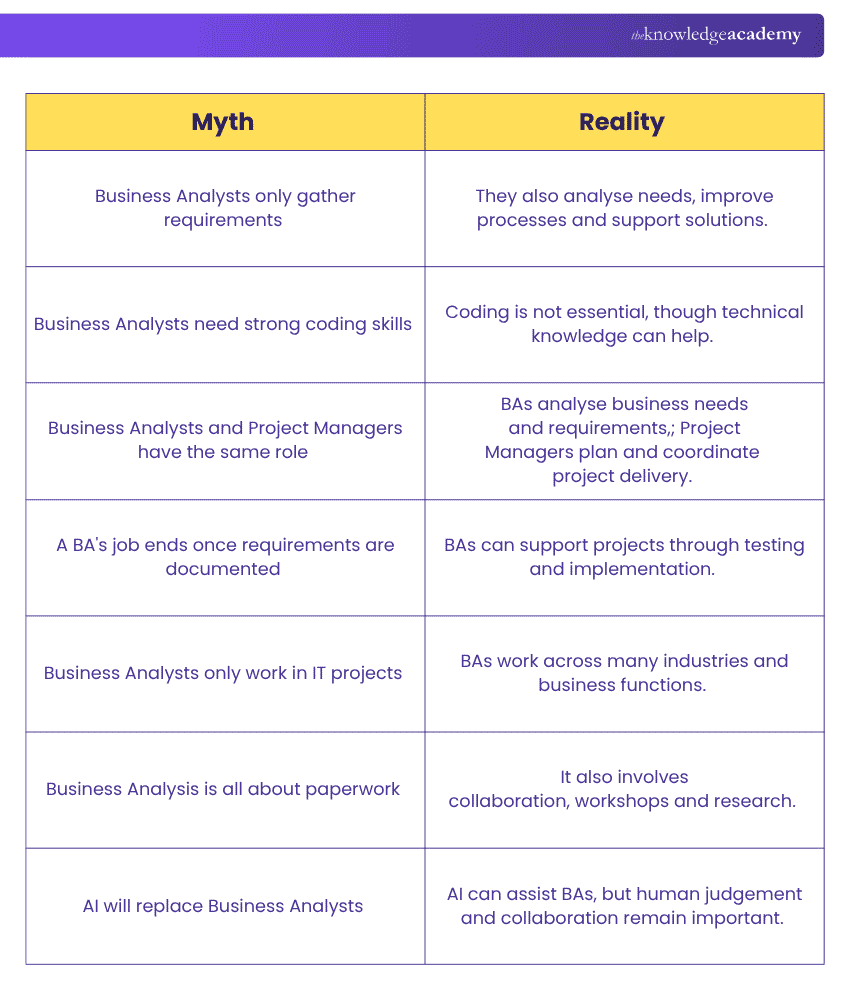
Here are some myths about Business Analysts to watch out for:
Types of Business Analysts
Business Analysts can work across different industries, functions and delivery environments. Top Business Analyst specialisations include IT, financial, healthcare, Business Intelligence, Agile and change management:
1) IT Business Analyst: An IT Business Analyst works closely with business stakeholders and technology teams. They help understand technology-related business requirements and communicate them to teams responsible for designing or implementing systems.
2) Financial Business Analyst: Financial Business Analysts operate within finance-related environments. Their work can involve analysing business requirements and processes while working with financial stakeholders and relevant regulatory requirements.
3) Healthcare Business Analyst: Healthcare Business Analysts apply Business Analysis within healthcare environments. They may work with healthcare providers, administrators and IT teams to understand requirements and support improvements to healthcare-related processes or systems.
4) Business Intelligence Analyst: Business Intelligence-focused analysts work more extensively with data, reporting and business insights. Business Analysts generally focus more on business processes, while data-focused roles place greater emphasis on interpreting information and identifying trends.
5) Agile Business Analyst: An Agile Business Analyst works within Agile delivery environments. They may collaborate continuously with stakeholders and delivery teams as requirements evolve.
6) Change Management Analyst: Change Management Analysts focus more closely on organisational change and its impact on people and processes. Their work can involve understanding the implications of change and helping organisations prepare stakeholders for new ways of working.
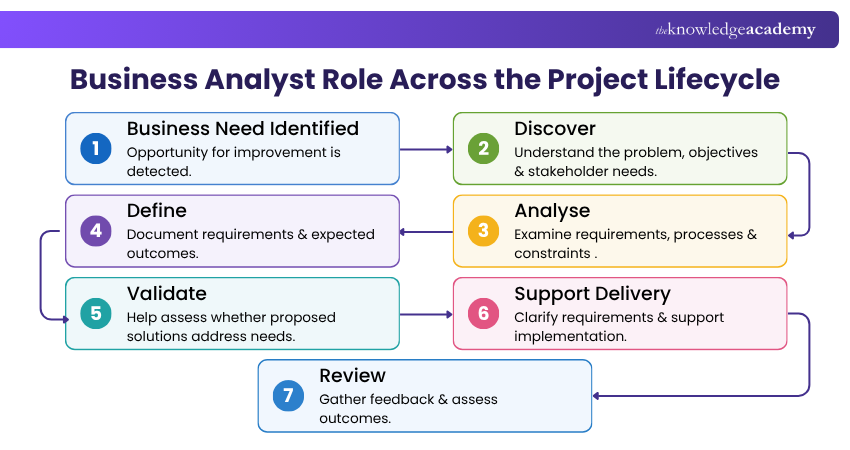
Here’s how a Business Analyst functions across the project lifecycle:
Essential Skills for a Business Analyst
Successful Business Analysts combine analytical, business, communication and interpersonal capabilities. Here are the key skills required of these professionals:
1) Analytical Thinking and Problem-solving
Business Analysts regularly deal with complex problems, requirements and information. Analytical thinking helps them break problems into smaller components, identify patterns and examine information. Strong problem-solving and critical thinking also help them identify root causes, question assumptions and compare possible solutions before supporting recommendations.
2) Communication and Facilitation
BAs need strong written and verbal communication skills because they interact with stakeholders who may have very different levels of technical or business knowledge. Facilitation skills are also valuable when conducting meetings, interviews and workshops.
3) Domain Knowledge
Understanding the industry or business area helps a BA interpret requirements within the right context. Domain knowledge can also help them understand processes, regulations and industry trends, enabling them to ask more relevant questions.
4) Technical Proficiency
Business Analysts do not necessarily need to be Programmers. However, technical understanding can help them communicate with technical teams and understand areas such as system architecture, databases and development methodologies.
5) Adaptability and Continuous Learning
Requirements, technologies and business priorities can change. Business Analysts therefore need to adapt to new information and continuously develop their knowledge of industries, methodologies and technologies.
6) Relationship Building and Collaboration
Business Analysis involves working with people across different functions and levels of an organisation. Building trust, influencing stakeholders, negotiating priorities and finding common ground can help BAs create stronger working relationships.
7) Attention to Detail and Documentation
Requirements and process documentation need to be accurate, consistent and understandable. Attention to detail helps Business Analysts identify gaps and inconsistencies before they result in misunderstandings later in a project.
Business Analyst Requirements Checklist
Before finalising requirements, check:
Is the underlying business need clearly defined?
Have the relevant stakeholders been consulted?
Are the requirements clear and unambiguous?
Have priorities and expected outcomes been agreed?
Are assumptions and constraints documented?
Have conflicting requirements been identified and discussed?
Can each requirement be traced back to a business need?
Have relevant risks and dependencies been considered?
Are the requirements understood by both business and delivery teams?
Is there a process for managing requirement changes?
Develop practical skills in data analysis, reporting, and business insight generation with our Introduction to Business Analytics Training – Join now!

Naveena Venkatesan is a Content Editor with 2+ years of experience in content writing, editing and linguistic quality assurance. Her research, fact-checking and editorial experience enable her to develop accurate, accessible resources across Business Skills, Human Resources, and Accounting and Finance.
View Detail

 If you wish to make any changes to your course, please


