




We may not have the course you’re looking for. If you enquire or give us a call on 01344203999 and speak to our training experts, we may still be able to help with your training requirements.
What Skills Do You Need to Become a Successful Project Manager?
ByThe Knowledge AcademyLast updated on: 19 August 2026
Discover the essential Project Manager skills for leading teams, managing risks, making decisions, communicating with stakeholders, and keeping projects moving towards successful outcomes.
Key Takeaways
1. Project Managers need a mix of technical and people skills2. Communication, leadership, planning, and decision-making are essential3. Different Project Management skills become important at different project stages4. Project control and people skills work together to handle real project challenges5. Project Management skills improve through practice, feedback, and continuous learning
9:00 AM → Planner
10:30 AM → Problem-solver
12:00 PM → Negotiator
2:15 PM → Risk Manager
4:00 PM → Team Leader
And that could all be the same Project Manager on the same day.
Projects constantly shift between deadlines, people, risks, resources, and unexpected decisions. The challenge is not simply knowing how to manage a project; it is knowing which skill to switch on when the situation changes.
So, what belongs in a successful Project Manager’s skill set? This blog explores the essential skills, how they work together, and how to strengthen them for real project situations.
What are Project Management Skills?
Project Management skills are the capabilities that help turn a project goal into coordinated action and, ultimately, a completed outcome. They enable Project Managers to organise work, guide people, manage uncertainty, make decisions, and keep delivery aligned with project objectives.
These skills are not used in isolation. A schedule delay may require planning and problem-solving, while a stakeholder disagreement may call for communication and negotiation. Effective Project Management comes from knowing which skills to combine as situations change.
The Project Manager's Skill EquationTechnical Skills + People Skills + Business Awareness + Adaptability = Well-rounded Project ManagementSuccessful Project Managers do not rely on one defining skill; they build a stack of capabilities that work together.

Essential Skills Every Project Manager Needs
A Project Manager’s skillset is less like a checklist and more like a toolkit for different project moments. A difficult conversation needs a different capability from a budget overrun or an emerging risk. Here are the skills worth having ready.
1) Communication
Project Managers are the communication link between teams, stakeholders, clients, sponsors, and suppliers. Strong communication helps clarify expectations, responsibilities, progress, decisions, and changes throughout the project.
Project Manager’s Move: Match the message to the audience; a technical team and a project sponsor may need the same update presented very differently.
2) Leadership
Leadership gives a project direction when people, priorities, and pressures compete for attention. It involves guiding the team, encouraging accountability, building collaboration, and keeping everyone connected to shared objectives.
Project Manager’s Move: When pressure rises, clarify priorities, responsibilities, and the way forward before pushing for faster delivery.
3) Planning and Organisation
Good ideas need structure before they can become successful projects. Planning and organisation help break objectives into activities, sequence work, manage dependencies, allocate resources, and establish realistic milestones.
Project Manager’s Move: Plan the connections between tasks, not just the tasks themselves.
4) Time Management
Time Management helps Project Managers coordinate schedules, prioritise critical activities, manage competing demands, and keep work aligned with key deadlines.
Project Manager’s Move: Prioritise by project impact, not by whichever task is making the most noise.
5) Risk Management
Risk Management prepares the project for uncertainty before it causes disruption. Project Managers identify threats and opportunities, assess their significance, plan responses, and monitor how risks change throughout delivery.
Project Manager’s Move: Shift the question from “What went wrong?” to “What could go wrong, and what can we do about it now?”
6) Problem-solving
When something goes wrong, treating the visible symptom may not solve the actual problem. Project Managers need to investigate causes, understand constraints, compare possible responses, and identify a practical way forward.
Project Manager’s Move: Before asking “How do we fix this?”, ask “What is actually causing this?”
7) Decision-making
Projects continuously require decisions about scope, resources, priorities, risks, timelines, and trade-offs. Effective Project Managers evaluate the information available, consider consequences, and make decisions at the point when action is needed.
Project Manager’s Move: Know when more information will improve the decision and when waiting will only delay it.
Make confident and informed decisions with our Decision-making Course - Sign up today!
8) Stakeholder Management
Stakeholders do not all have the same expectations, influence, interests, or information needs. Stakeholder Management helps Project Managers understand these differences and maintain appropriate engagement throughout the project.
Project Manager’s Move: Identify who needs to be informed, consulted, closely engaged, or involved in key decisions.
9) Budget and Cost Management
Many project decisions can have a financial consequence. Project Managers need to understand budgets, monitor expenditure, recognise cost variances, and consider how changes to scope, resources, or schedules may affect project costs.
Project Manager’s Move: When something changes, ask what it does to the budget; not just the schedule.
10) Negotiation
Resources are limited, deadlines compete, priorities clash, and stakeholders may want different outcomes. Negotiation helps Project Managers navigate these competing interests and reach workable agreements without losing sight of project objectives.
Project Manager’s Move: Look beyond positions such as “I need this by Friday” and understand the underlying need driving the request.
11) Adaptability
A good project plan provides direction, but it cannot predict everything. Adaptability allows Project Managers to respond when requirements, risks, resources, assumptions, or priorities change without losing sight of the intended outcome.
Project Manager’s Move: Protect the objective, but be prepared to change the route used to reach it.
How Project Management Skills Work Together?
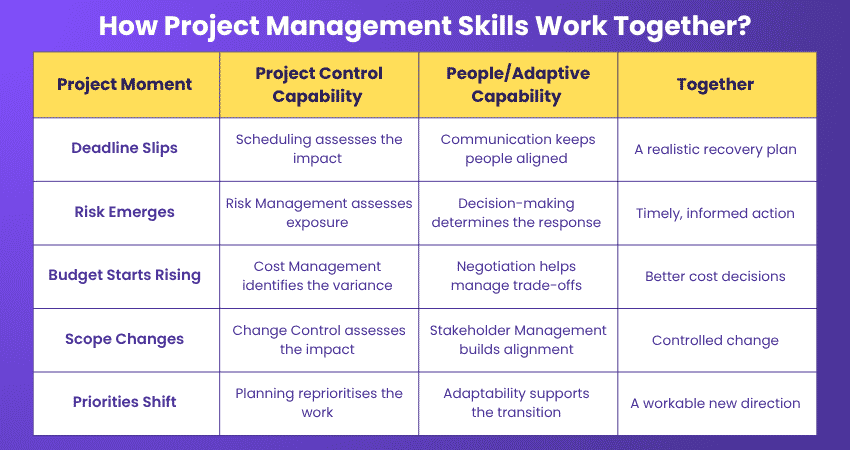
A Project Manager who understands schedules but cannot communicate may struggle to align the team. Someone with excellent people skills but limited planning ability may struggle to control delivery. That is why successful Project Management requires a combination of technical, management, people and adaptive capabilities. See how these skills work together:
The Crossover Effect
Project control capabilities answer: What needs to be managed?
People and adaptive capabilities answer: How do we move people and decisions forward?
A successful Project Manager needs both to turn project control into project progress.
How to Identify Your Project Management Skill Gaps
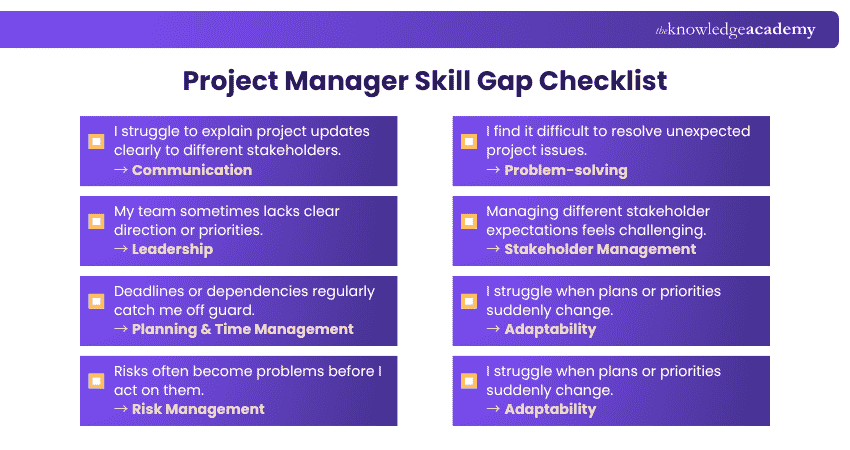
Skill gaps often become visible in situations you find difficult. Instead of rating every ability, look for patterns in how you manage projects.
Found a Pattern?
The items you tick most often point towards the skills worth developing first. Focus on the gaps that repeatedly affect your decisions, team, deadlines, or project outcomes.
Your Development Priority:
Which one skill would make your projects easier to manage if you improved it?
Develop the skills to lead, motivate, and guide teams effectively with our Leadership Skills Training - Join today!
How to Improve Your Project Management Skills
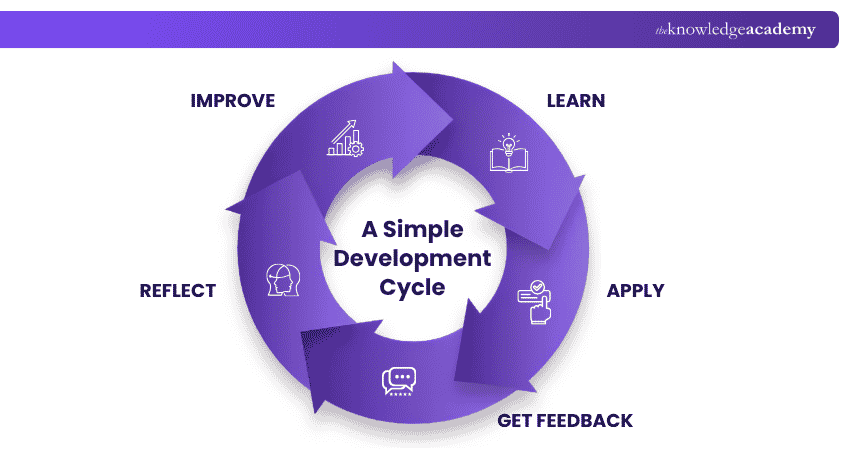
Project Management skills develop through a combination of learning, application, reflection, and feedback.
1) Take Ownership of Real Projects
Look for opportunities to plan work, coordinate people, manage deadlines, or contribute to project delivery. Practical situations help turn theoretical knowledge into judgement.
2) Ask for Specific Feedback
Instead of asking, “How am I doing?”, ask questions such as “Was my project update clear?” or “How could I have handled that risk discussion better?”
Specific questions tend to produce more useful feedback.
3) Learn From Completed Projects
Review what worked, what caused difficulty, and what you would approach differently next time. Lessons learned can turn one project experience into better performance on the next.
4) Strengthen Your Methodology Knowledge
Build familiarity with established Project Management approaches and understand where different methods, frameworks, and practices are appropriate.
5) Invest in Structured Professional Development
Structured Project Management training can help strengthen knowledge across planning, Risk Management, stakeholder engagement, governance, delivery, and other areas relevant to managing projects.
Conclusion
The goal is not to become perfect at every skill. It is to build a balanced skillset that grows with the projects and responsibilities you take on.
Each project gives you another opportunity to strengthen that skillset through experience, feedback, and learning. Focus on the capabilities that matter most to your role, keep developing where gaps appear, and let your skills evolve alongside your Project Management career.
Strengthen your Project Management skills and drive successful delivery with our Project Management Courses - Join today!

The Knowledge Academy develops accessible learning content across Project Management, IT, Cybersecurity, Data Science, Business Analysis, HR, Accounting and Finance, Leadership and Health and Safety. Its resources combine subject research with clear explanations to help professionals build practical knowledge across a wide range of disciplines.
View Detail

 If you wish to make any changes to your course, please


