




We may not have the course you’re looking for. If you enquire or give us a call on 01344203999 and speak to our training experts, we may still be able to help with your training requirements.
What is Team Development: Importance and Stages
ByScarlett AdamsLast updated on: 18 August 2026
This blog explains what Team Development means and why it matters for workplace performance. It also covers five common stages of Team Development, from forming to adjourning, based on Tuckman's well-known model.
Key Takeaways
1. Team Development is the process by which a group of individuals grows into a cohesive, high-performing team.2. Strong Team Development improves collaboration, trust, and overall productivity.3. Team Development is commonly described through five stages: forming, storming, norming, performing and adjourning.4. Teams don't always progress in a straight line. Change, conflict, or new members can send a team back to an earlier stage.
Put five strangers in a room and give them a shared goal. What happens next isn't teamwork. It's negotiation, hesitation, maybe a little friction, before anything resembling teamwork actually shows up.
That gap between a group of individuals and a team that actually clicks doesn't close on its own. It can happen through recognisable stages, although teams do not always follow the same path or progress in a fixed sequence.
A team that seems stuck or tense isn't necessarily failing. It may simply be working through a challenging stage of development. Understanding What is Team Development and recognising the stage a team may be experiencing lets a leader offer the right support instead of reacting to symptoms without understanding the cause.
What is Team Development?
Team Development is the process through which a group of individuals learns to work together effectively towards a shared goal. It covers how a team builds trust, defines roles, manages conflict and develops more effective ways of working together.
Team Development is an ongoing process that evolves as teams face new challenges, welcome new members or adapt to changing goals. Bruce Tuckman’s widely used model describes five stages of Team Development.

Importance of Team Development
Team Development isn't just a nice-to-have. It can influence how well a team performs, communicates and adapts under pressure. Key benefits include:
a) Stronger Collaboration: As teams move through the stages, members learn how to communicate and work with one another more effectively.
b) Higher Productivity: A team that has reached the performing stage works with less friction and delivers results more consistently.
c) Better Conflict Resolution: Teams that understand the storming stage are better equipped to work through disagreements rather than avoid them.
d) Increased Trust: As roles and expectations become clear, team members rely on each other with greater confidence.
e) Greater Engagement: Clear roles, supportive relationships and stronger team dynamics can help members feel more involved and committed to shared goals.
f) Faster Decision-Making: Teams that have moved through the early stages spend less time second-guessing each other and more time acting on decisions.
g) Greater Adaptability: A well-developed team can handle change, new challenges or shifting priorities more effectively than one still working out its dynamics.
h) Stronger Accountability: As trust and clarity build, team members take more ownership of their part in the work, rather than relying on the leader for ongoing direction.
Did You Know?
Tuckman originally proposed four stages of group development in 1965. In 1977, Tuckman and Mary Ann Jensen reviewed subsequent research and added a fifth stage, adjourning, to represent the completion and separation of a group.
Ensure ethics in action and excellence in teamwork with our Team and Management Ethics Training - Sign up now!
Stages of Team Development
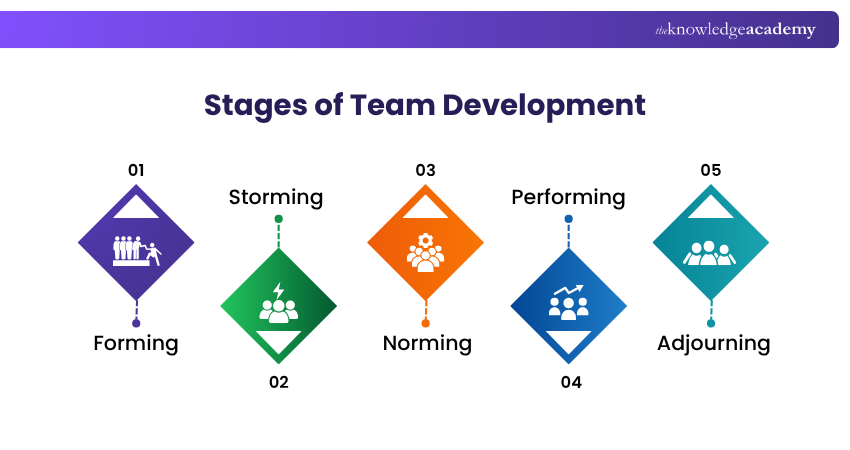
Team Development can be understood through five stages: forming, storming, norming, performing and adjourning. Teams may revisit earlier stages when circumstances change, such as when a new member joins or leadership changes. Here are the five stages in Tuckman's model:
1) Forming
This is the starting point, where team members first come together. There's often a mix of excitement and uncertainty, as people are still working out their roles and how they fit into the group. At this stage, the team typically relies heavily on the leader for direction and structure.
2) Storming
As people begin working together, differences in working style, opinion, and expectations start to surface. This can lead to friction or disagreement as team members push back and assert themselves. It's an uncomfortable stage, but working through disagreements constructively can help build a more cohesive team dynamic.
3) Norming
Once early conflicts are addressed, the team starts to settle. Roles become clearer, trust builds, and members begin collaborating more naturally. A shared sense of identity starts to form, and the team works with noticeably less tension than before.
4) Performing
At this stage, the team operates at its most effective. Members understand each other's strengths, work with a high degree of trust, and require minimal supervision to stay focused on shared goals. Decisions are made efficiently, and the team adapts well to new challenges.
5) Adjourning
Not every team is permanent. The adjourning stage occurs when a team's work is complete and the group disbands, whether that's the end of a project, a restructuring, or a natural conclusion to the team's purpose. This stage can bring a mix of accomplishment and, for longer-standing teams, a sense of loss.
Trainer's Insight
A team that starts disagreeing more may be entering the storming stage. Rather than suppressing constructive disagreement, leaders should clarify roles, encourage open communication and help the team address conflict productively.
Conclusion
Team Development is what turns a group of individuals into a team that works effectively together. Understanding What is Team Development and the five stages of forming, storming, norming, performing and adjourning can help leaders recognise their team’s needs and provide appropriate support. This can encourage stronger collaboration, trust and overall team effectiveness.
Shape the leader within you for greater organisational success with our range of Management Courses - Sign up now!

 If you wish to make any changes to your course, please


