




We may not have the course you’re looking for. If you enquire or give us a call on +918037244591 and speak to our training experts, we may still be able to help with your training requirements.
What is Oracle: A Beginner's Guide
ByNilotpal SarmahLast updated on: 12 October 2026
What is Oracle? Oracle is a multinational technology company known for database technology, cloud infrastructure, and enterprise applications. This blog explains Oracle Database, Oracle Cloud Infrastructure, Oracle SQL, key products, services, and common business use cases.
What You’ll Discover
1. Oracle provides database, cloud and enterprise technology solutions.2. Oracle Database is one of the company’s best-known products.3. Oracle SQL helps users interact with relational data.4. Oracle Cloud supports infrastructure, platforms and software services.5. Oracle technologies support areas such as finance, HR, data management and business applications.
Oracle can refer to Oracle Corporation, its database technologies, cloud services, and enterprise applications. For beginners, understanding these different meanings makes it easier to see how Oracle fits into modern IT and business systems. In this comprehensive beginner's guide, we will explore what is Oracle and its role in modern technology.
What is Oracle?
Oracle Corporation is a multinational technology company that develops database technology, cloud infrastructure, enterprise applications, and related software and services. Founded in 1977 by Bob Miner, Larry Ellison and Ed Oates, it is well known for its database software and cloud computing services. Oracle V2, released in 1979, is recognised by Oracle as the first commercially available SQL-based relational database management system.
In the technological context, Oracle Database is one of the flagship products of Oracle Corporation. It's a Relational Database Management System (RDBMS) that delivers a structured and organised way to store, manage, and retrieve data. Think of it as a digital version of a filing cabinet, where data is stored in tables, rows, and columns, making it efficient to search, manipulate, and analyse.
A few key Features of Oracle Database are as follows:
1) High Performance: Oracle Database is designed to handle large volumes of data with high performance and scalability. It's used by organisations around the world to manage critical data in various industries.
2) Data Security: Security is paramount in any database system. Oracle Database offers advanced security features, including encryption, authentication and access control mechanisms for safeguarding sensitive data.
3) Data Integrity: Oracle Database provides constraints and integrity mechanisms that help maintain data accuracy and consistency. It enforces rules and constraints to maintain the accuracy and reliability of the information stored within it.
4) Data Recovery: If there is an unfortunate data loss or corruption, Oracle Database provides tools and mechanisms for data recovery and restoration.
5) Support for Complex Queries: Oracle Database supports complex queries and data manipulation operations, making it suitable for applications ranging from online transaction processing (OLTP) to data warehousing.

What is Oracle Database?
Oracle Database is the flagship product of Oracle Corporation, widely recognised as a leading database management and warehousing system. It's used globally by organisations to efficiently manage and store their data.
Key Features:
1) Analytics and AI Capabilities: Oracle Database supports analytical workloads and, in current releases, includes capabilities such as machine learning and AI Vector Search.
2) High Data Availability: Designed for top-notch operational performance, it includes features like data replication, backup, and server clustering to ensure high availability.
3) Scalability: Oracle Database supports scaling across different deployment architectures, depending on edition, infrastructure, and workload requirements.
4) Security: With robust encryption and security risk monitoring, Oracle Database ensures data privacy and integrity.
Editions:
1) Enterprise Edition: Ideal for large organisations, this edition supports high-volume online transaction processing (OLTP) and intensive data warehousing. It can be enhanced with various Oracle options and packs for advanced analytics, security, and additional functionality.
2) Oracle AI Database Free: A free edition designed for learning, development, testing, and smaller workloads, subject to resource limits.
3) Personal Edition: This edition includes nearly all the features of the Enterprise Edition but is tailored for single-use development environments, making it a cost-effective choice for software developers.
4) Standard Edition: Providing essential Oracle functionality, this edition is perfect for workgroup, department-level, or web applications.
What is Oracle Cloud?
Oracle Cloud includes infrastructure, platform, and software services. Oracle Cloud Infrastructure (OCI) provides compute, storage, networking, database, analytics, and other cloud services, while Oracle Cloud Applications provide SaaS solutions for business functions such as finance, HR, supply chain, and customer management.
Through IaaS, Oracle Cloud provides the foundational building blocks required to establish a robust and scalable IT infrastructure. Organisations can harness this flexibility to swiftly deploy and manage their virtualised computing resources, storage, and networking components, all while minimising the complexities and costs associated with maintaining physical hardware.
PaaS takes innovation a step further by furnishing developers with a powerful and collaborative environment to create, deploy, and manage applications. This liberates development teams from administrative burdens, enabling them to focus on crafting transformative solutions that drive business growth.
SaaS, on the other hand, grants businesses access to a variety of fully-fledged software applications hosted on the cloud. This eliminates the need for extensive installations and maintenance, freeing users to embrace cutting-edge tools for productivity, customer relationship management, and more.
Oracle Cloud's impact reverberates across industries, from enabling data-driven healthcare advancements to powering e-commerce platforms that handle the demands of a global marketplace. Its high-performance computing, advanced analytics, and artificial intelligence capabilities open doors to innovation previously deemed unattainable.
In a landscape where adaptability is paramount, Oracle Cloud empowers enterprises to remain resilient, responsive, and primed for growth. As technology continues to reshape the world, Oracle Cloud stands as a resilient testament to the transformative touch of cloud computing, propelling organisations towards a future of endless possibilities.
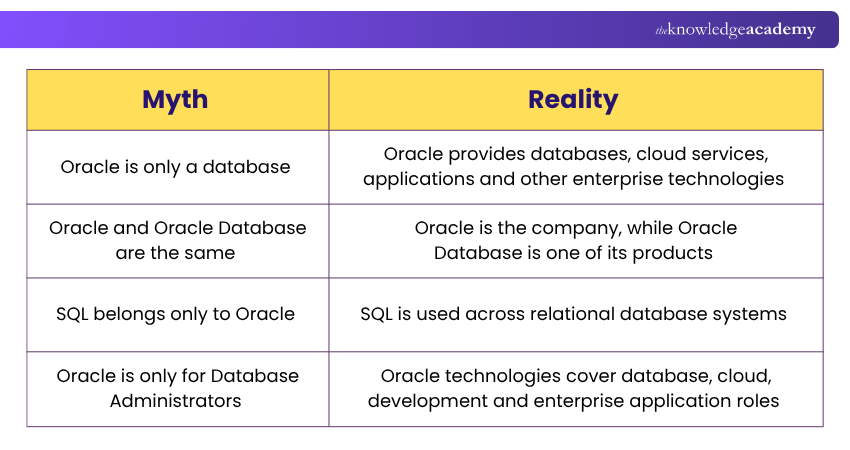
Here are some myths related to Oracle that you need to watch out for:
Oracle's Role in Enterprise Software
Oracle Corporation plays a pivotal role in the landscape of enterprise software, offering a diverse array of solutions for streamlining and enhancing various aspects of business operations. These solutions cater to the intricate needs of modern organisations, helping them optimise processes, improve customer experiences, and make data-driven decisions.
One of Oracle's primary contributions is in the realm of Customer Relationship Management (CRM). Its CRM applications enable businesses to manage and analyse customer interactions, enhance sales and marketing efforts, and nurture lasting relationships. Similarly, Oracle's Enterprise Resource Planning (ERP) solutions integrate and automate key functions like finance, procurement, and supply chain management, facilitating smoother and more efficient operations.
Oracle also excels in providing Human Capital Management (HCM) solutions, assisting organisations in managing their workforce, from recruitment to retirement. By harnessing data insights, these solutions aid in talent acquisition, employee development, and performance evaluation.
Furthermore, Oracle's suite of cloud-based applications empowers businesses to access cutting-edge technology without needing extensive infrastructure investment. This encompasses SaaS offerings that span industries, ranging from manufacturing and retail to healthcare and finance.
In essence, Oracle's role in enterprise software is about equipping organisations with the tools they need to thrive in a rapidly evolving digital world. By harnessing Oracle's expertise, businesses can streamline operations, increase efficiency and make better decisions that drive growth and innovation.
What is Oracle SQL?
Oracle SQL refers to Oracle's implementation of SQL used to query and manage data in Oracle Database. It provides the commands needed to work with data and define database objects within an Oracle Database environment.
Common commands include SELECT for retrieving data; INSERT, UPDATE and DELETE for modifying data; and CREATE and ALTER for defining or changing database objects. JOIN operations can also combine related data from multiple tables.
Learning Oracle SQL helps developers, database administrators and data professionals work effectively with Oracle Database. It supports tasks such as querying business data, managing database objects and maintaining accurate and organised information.
Here are the common SQL commands:
1. SELECT: Retrieves data2. INSERT: Adds data3. UPDATE: Modifies existing data4. DELETE: Removes data5. CREATE: Creates database objects6. ALTER: Modifies database objects7. JOIN: Combines related data from multiple tables
Unlock the power of data with our Oracle SQL Fundamentals Course – Register now and master the language of databases!
Key Oracle Products and Services
Oracle delivers a comprehensive suite of products and services designed to meet diverse business needs. From cloud applications and infrastructure to hardware, middleware, and software, Oracle provides robust solutions for modern enterprises.
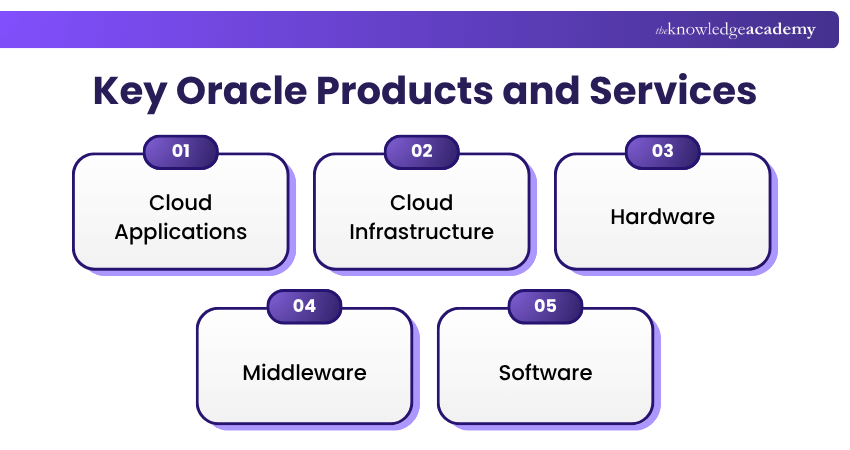
1) Cloud Applications:
The Oracle Fusion Cloud Application Suite is a comprehensive family of software-as-a-service (SaaS) applications tailored for various business needs. It includes the popular Oracle Fusion Enterprise Resource Planning (ERP) suite for financial management, project oversight, and compliance.
Additionally, it offers specialised platforms for sales, supply chain and manufacturing (SCM) and Human Capital Management (HCM). The cloud ERP also features industry-specific add-ons for sectors like higher education and consumer goods.
2) Cloud Infrastructure:
Oracle Cloud Infrastructure (OCI) is a versatile cloud platform that supports both traditional business applications and cutting-edge technologies including Machine Learning (ML) and Artificial Intelligence (AI). OCI offers various deployment options, including multicloud solutions, public cloud, hybrid cloud, and dedicated cloud environments within an organisation's data centres.
It provides tools for running applications, analysing data, and securely storing information, supporting Oracle applications and independent Software Vendor (ISV) applications for analytics, automation, networking, and storage.
3) Hardware:
Oracle provides a range of engineered systems designed for scalability. Oracle provides engineered systems and infrastructure platforms such as Oracle Exadata and Oracle Database Appliance, alongside related hardware and storage technologies. The Oracle Exadata platform, specifically developed to run Oracle Database, integrates database servers, storage, and networking for optimal performance.
4) Middleware:
Oracle offers a variety of middleware products to help developers integrate and deploy applications. Oracle Application Express (APEX) is a low-code web app builder, while Oracle Fusion Middleware is a suite of tools for enterprise applications, including data integration, Business Intelligence (BI), and content management. Fusion Middleware also supports infrastructure for Internet of Things (IoT) functionality, big data integration, and content management.
5) Software:
Oracle produces and licenses a wide array of on-premises applications to help businesses manage core functions. Notable offerings include:
a) PeopleSoft: An ERP solution for human resources, financial management, and campus solutions.
b) Oracle E-Business Suite: Covers order management, logistics, and other business functions.
c) Oracle Business Intelligence (OBIEE): Provides robust reporting and analysis capabilities.
d) Oracle Enterprise Manager: Oracle Enterprise Manager supports monitoring, administration, lifecycle management, and performance management across Oracle environments.
Trainer’s Insight
When exploring Oracle, group its technologies by purpose: databases manage data, OCI provides cloud infrastructure and enterprise applications support business functions.
Oracle Database Use Cases
Organisations across various industries rely on Oracle Database for a multitude of use cases, from maintaining sensitive data lakes to tracking massive real-time financial transactions. Some of the most popular applications include:
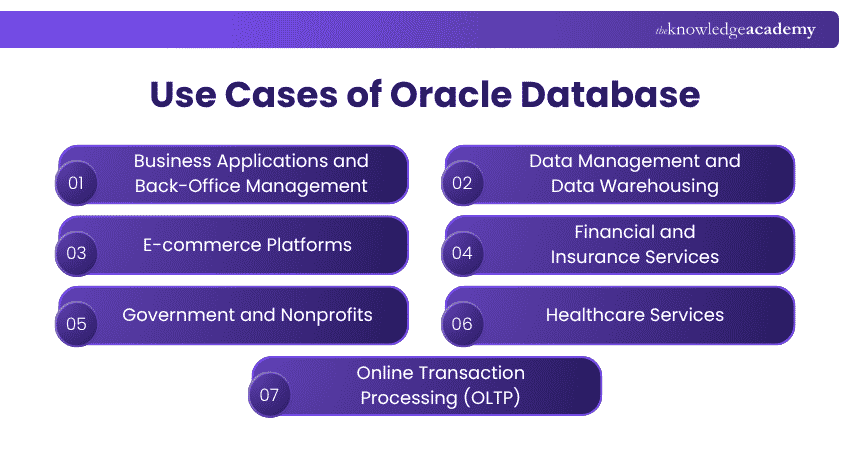
1) Business Applications and Back-Office Management:
Oracle Database supports applications like ERP, CRM, and HRM, providing interactive and up-to-date insights into a company's daily operations.
2) Data Management and Data Warehousing:
It serves as a central repository for vast amounts of structured data and as a data warehouse to facilitate analysis and reporting.
3) E-commerce Platforms:
Oracle's e-commerce solutions manage product catalogues, inventory, and transaction data, offering robust back-office support.
4) Financial and Insurance Services:
Financial firms and insurance providers use Oracle’s secure and encrypted database to manage payments, track transactions, and audit potential risks.
5) Government and Nonprofits:
Government agencies and public sector organisations can use Oracle technologies to manage operational, administrative, and regulated data workloads.
6) Healthcare Services:
In the healthcare industry, Oracle’s database solutions streamline operations, maintain data integrity, and support healthcare applications, data management, reporting, and analytics workloads.
7) Online Transaction Processing (OLTP):
From e-commerce to online banking and telecommunications, Oracle Database handles large volumes of real-time transactions efficiently.
Handle everyday database administration tasks with ease. Sign up for the Oracle Database 18c Administration Training now!
Challenges of the Oracle Ecosystem
Here are some common challenges you may encounter when navigating the Oracle ecosystem:
1) Complexity: While Oracle's technologies offer powerful capabilities, they can also be complex to manage and implement, especially for those new to the field of database management. It's important to invest time in learning the fundamentals and best practices.
2) Licensing Costs: Oracle products often come with licensing costs, which can be a major factor for organisations considering their adoption. Understanding the various licensing models and options is essential to avoid unexpected expenses.
3) Maintenance and Support: Maintaining and supporting Oracle solutions requires dedicated resources and expertise. Many organisations opt for partnering with experts or obtaining Oracle support to ensure the smooth operation of their systems.
Trainer’s Insight
Technical capability is only one part of choosing an Oracle solution. Organisations should also consider licensing, required expertise, integration needs and ongoing maintenance before implementation.
Best Practices of Oracle
Here are some best practices associated with Oracle:
1) Education and Training: Before diving into the world of Oracle technologies, it's advisable to undergo proper education and training. Online courses, tutorials, and official Oracle documentation can provide valuable insights into using Oracle products effectively.
2) Hands-on Experience: Practical experience is key to mastering Oracle technologies. Setting up a test environment or working on personal projects can help you gain confidence and proficiency.
3) Staying Updated: The technology landscape is constantly evolving, and Oracle regularly releases updates, patches, and new features. Staying informed about these changes ensures you're making the most of the latest advancements.
Oracle Beginner’s Checklist
Before getting started with Oracle, check whether you can:□ Explain the difference between Oracle Corporation and Oracle Database□ Understand the basic purpose of a relational database□ Recognise common SQL commands such as SELECT, INSERT, UPDATE and DELETE□ Distinguish between Oracle Database, OCI and Oracle Cloud Applications□ Identify which Oracle technology best matches your role or learning goal□ Practise using Oracle technologies in a hands-on environment□ Choose a suitable learning or certification path for your area of interest

Nilotpal Sarmah is a Senior Content Writer with 11+ years of overall experience spanning engineering, operations and content development. His technical knowledge and extensive writing experience enable him to simplify specialised topics across IT and Tech, Business Skills, Project Management, Health and Safety, and ISO and Compliance.
View Detail

 If you wish to make any changes to your course, please


