


 Top Rated Course

We may not have the course you’re looking for. If you enquire or give us a call on 01344203999 and speak to our training experts, we may still be able to help with your training requirements.
What is MLOps (Machine Learning Operations)? Explained
Scarlett Adams 15 December 2025Machine Learning Operations (MLOps) is the practice of deploying and maintaining Machine Learning (ML) to produce processes for developing ML models. It simplifies the ML lifecycle by automating tasks from model creation to deployment. Machine Learning Operations also ensures smooth collaboration and keeps models accurate over time.

Training Outcomes Within Your Budget!
We ensure quality, budget-alignment, and timely delivery by our expert instructors.
Table of Contents
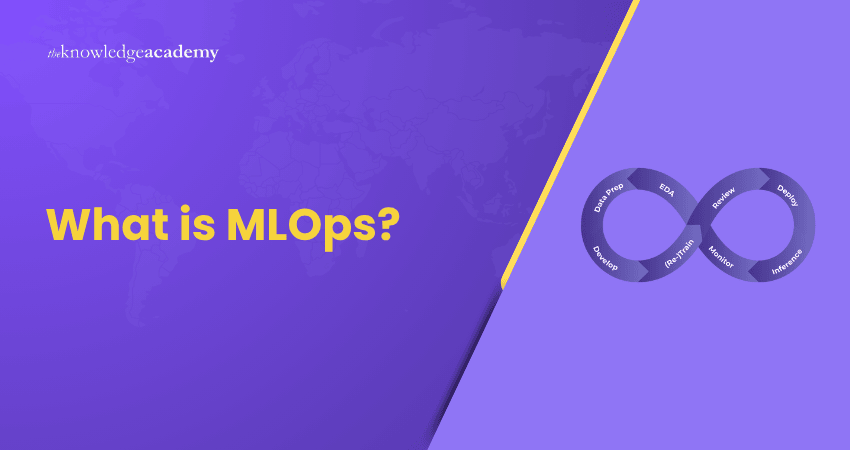
Machine Learning models are transforming industries, from predicting market trends to personalising healthcare and powering self-driving cars. Yet, building a model is only the beginning. The real test starts when it must perform reliably in live production environments where data changes constantly. This is where Machine Learning Operations (MLOps) takes centre stage.
It brings together Data Science and IT Operations to streamline how models are built, deployed, and monitored. By automating every stage of the Machine Learning lifecycle, MLOps ensures that models remain accurate and efficient. In this blog, we explore what MLOps is, how it works, and why it has become essential for modern Machine Learning projects.
Table of Contents
1) What is Machine Learning Operations (MLOps)?
2) How Does MLOps Work?
3) What are the Principles of MLOps?
4) What are the Components of MLOps?
5) What are the Benefits of MLOps?
6) Challenges of MLOps
7) What is the Difference Between MLOps and DevOps?
8) MLOps Best Practices
9) Conclusion
What is Machine Learning Operations (MLOps)?
Machine Learning Operations (MLOps) is a method that helps manage the complete Machine Learning process in an organised way. It focuses on automating different steps like building, testing, and deploying Machine Learning models. This makes the process faster, easier, and more efficient.
It follows ideas from DevOps, such as automation and continuous updates, and brings together Data Scientists, engineers, and operations teams. Machine Learning Operations ensures that Machine Learning models work smoothly, stay reliable, and remain accurate even after they are used in real-world applications.

How Does MLOps Work?
MLOps manages the entire Machine Learning lifecycle so that models are production ready. This system is divided into different stages, which makes it easy to create the model, deploy and monitor it. Below are explained four key cycles that are part of Machine Learning Operations.
1) Data Cycle: In this stage, data is collected and prepared for model training. Data is cleaned and transformed so that it is in a labelled and usable form. Feature engineering is also a part of this phase.
2) Model Cycle: Model training takes place here. After the model is created, new versions of it are tracked and tested for improvements. Tools like MLflow help manage this cycle.
3) Development Cycle: At this stage, the trained model is tested and validated for production. Continuous Integration (CI) and Continuous Delivery (CD) pipelines make deployment fast and automated.
4) Operations Cycle: This cycle is for model monitoring and retraining. If the performance of the model falls below the threshold, MLOps automatically starts the retraining process. This keeps the model always accurate and updated.
Understand how AI and Machine Learning power cognitive computing systems. Join our Cognitive Computing Training now!
What are the Principles of MLOps?
MLOps is based on some important principles that make Machine Learning workflows secure, scalable and efficient. These key principles are explained in a simple way below.
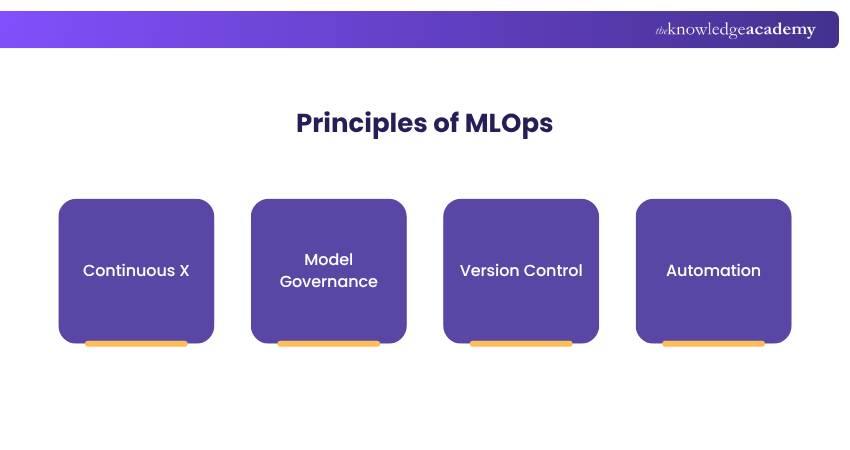
1) Continuous X
Some tasks keep running automatically even when changes are made in the system. MLOps has four continuous processes:
a) Continuous Integration: Tests and checks code and data automatically
b) Continuous Delivery: Deploys new models or services automatically
c) Continuous Training: Retrains models repeatedly with new data
d) Continuous Monitoring: Keeps track of model performance using business goals
2) Model Governance
This makes sure every part of the Machine Learning system is managed properly and safely. It helps teams stay organised and makes models ready for audits. Key practices include:
a) Good teamwork between Data Scientists and business teams
b) Clear documents and open communication
c) Regular feedback to improve performance
d) Watching security, access control, and rules compliance
3) Version Control
Version control tracks every change made to code, data, and models. It helps manage updates easily and keeps workflows simple and repeatable. Key points include:
a) Saves each update with a version number
b) Makes it easy to compare versions or return to older ones
c) Let’s work together without overwriting each other’s changes
d) Keeps the Machine Learning process organised and audit-friendly
4) Automation
Automation lowers manual work and speeds up the whole process. Many steps, from handling data to deploying models, can run automatically. Common triggers include:
a) When data or code changes
b) When an event or schedule starts a task
c) When monitoring tools find any changes
What are the Components of MLOps?
MLOps can be used in every stage of Machine Learning projects. Sometimes, it is limited to deployment only, and sometimes, it covers the entire ML pipeline. The components given below are part of every ML Operations project.

Components of MLOps are the basic steps to manage Machine Learning models easily. Here they are:
a) Exploratory Data Analysis (EDA)
b) Data Preparation and Feature Engineering
c) Model Training and Tuning
d) Model Review and Governance
e) Model Inference and Serving
f) Model Deployment and Monitoring
g) Automated Model Retraining
Acquire skills to use various techniques for using APIs to virtually solve any task. Join our OpenAI Training now!
What are the Benefits of MLOps?
MLOps adoption makes Machine Learning workflows more efficient, scalable and reliable. These system teams benefit from fast delivery, better model quality and risk-free operations. Some major benefits of ML Operations are explained below.

1) Scalability
MLOps helps in managing large-scale ML systems. If you have hundreds or thousands of models, Machine Learning Operations handles training, deployment and monitoring of all of them efficiently from a single platform. It makes the model lifecycle repeatable and scalable.
2) Speed and Efficiency
MLOps tools and pipelines allow data teams to build models quickly. Models are deployed quickly, and release cycles are shortened through automation and CI/CD workflows. This also helps in achieving business goals faster.
3) Reliability
MLOps ensures that Machine Learning models perform consistently and accurately over time. Through continuous monitoring, error detection, and version control, it prevents performance drift and reduces downtime. This reliability builds trust in AI systems and keeps business operations stable.
Challenges of MLOps
No doubt, MLOps is more efficient than traditional systems, but it also comes with its own challenges. Below are some common issues that teams face when implementing ML Operations.
1) Staffing
The Data Scientists who create models are not necessarily experts in deploying them. There can be a gap between developers and scientists. Therefore, it is important to have a team with diverse skill sets.
2) High Costs
There is a significant investment in infrastructure, tools, and training. This is especially a challenge for companies working on large-scale ML projects.
3) Imperfect Processes
The goal of MLOps is automation and error reduction, but there are still errors that require manual intervention. Process refinement has to be done over time.
4) Cyberattacks
ML systems store a large amount of data, which makes them an attractive target for cyber threats. It is very important to secure the MLOps setup and avoid data breaches.
Obtain hands-on experience in implementing deep learning models. Join our Deep Learning Course now!
What is the Difference Between MLOps and DevOps?
Both MLOps and DevOps aim to automate workflows and speed up delivery, but their focus areas differ.
a) DevOps is designed for Software Development, ensuring applications are built, tested, and released quickly using CI/CD pipelines and automation. It focuses on improving collaboration between development and operations teams.
b) MLOps extends these principles to Machine Learning. It focuses on managing data pipelines, model training, deployment, and continuous monitoring. While DevOps handles static code, MLOps deals with dynamic data and models that require regular retraining.
Both share the same goal of improving quality, delivery speed, and collaboration. However, MLOps adds an extra layer of complexity by handling data, experiments, and ML-specific tools that go beyond the traditional DevOps scope.
MLOps Best Practices
Here are the best practices that help teams use MLOps effectively and get the best results from their Machine Learning projects:
1) Start with Clean and Consistent Data
Good results begin with good data. Always clean, label, and validate data before using it. This prevents errors later and makes your model more accurate and reliable.
2) Use Reusable Pipelines
Create Machine Learning pipelines that can be reused for different projects. This saves time, ensures consistency, and helps maintain standard practices across your team.
3) Set Clear Performance Metrics
Decide how you will measure model success before deployment. Use metrics like accuracy, precision, or recall to track how well your model performs over time.
4) Keep Security and Privacy in Mind
Protect sensitive data used in training and testing. Always follow data security rules and use proper access control to avoid leaks or misuse.
Conclusion
We hope this blog on MLOps has helped you understand how it simplifies and automates the entire Machine Learning lifecycle, from building models to deploying and monitoring them. MLOps enhances collaboration, speeds up workflows, and keeps models accurate and reliable. It helps businesses scale and deliver smarter, more efficient solutions, making it an essential part of modern Machine Learning success.
Gain the ability to increase productivity and save money through automation with our Artificial Intelligence & Machine Learning Training – Join now!
Frequently Asked Questions
What is the Primary Goal of MLOps?

The primary goal of MLOps is to automate and make Machine Learning workflows reliable. It streamlines model development, deployment, monitoring, and retraining so that models can easily scale and perform consistently.
What Does an MLOps Engineer do?
The MLOps Engineer makes ML models production ready. They build pipelines, automate deployment, set up monitoring, and ensure that models are secure, scalable, and updated. They bridge the gap between Data Science and DevOps Teams.
What are the Other Resources and Offers Provided by The Knowledge Academy?
The Knowledge Academy takes global learning to new heights, offering over 3,000 online courses across 490+ locations in 190+ countries. This expansive reach ensures accessibility and convenience for learners worldwide.
Alongside our diverse Online Course Catalogue, encompassing 19 major categories, we go the extra mile by providing a plethora of free educational Online Resources like Blogs, eBooks, Interview Questions and Videos. Tailoring learning experiences further, professionals can unlock greater value through a wide range of special discounts, seasonal deals, and Exclusive Offers.
What is The Knowledge Pass, and How Does it Work?
The Knowledge Academy’s Knowledge Pass, a prepaid voucher, adds another layer of flexibility, allowing course bookings over a 12-month period. Join us on a journey where education knows no bounds.
What are the Related Courses and Blogs Provided by The Knowledge Academy?
The Knowledge Academy offers various Artificial Intelligence & Machine Learning Courses, including the Machine Learning Course, Neural Networks with Deep Learning Training and the Advanced Data Science Certification. These courses cater to different skill levels, providing comprehensive insights into Exploratory Data Analysis.
Our Data, Analytics & AI Blogs cover a range of topics related to Machine Learning, offering valuable resources, best practices, and industry insights. Whether you are a beginner or looking to advance your Machine Learning skills, The Knowledge Academy's diverse courses and informative blogs have got you covered.
Upcoming Data, Analytics & AI Resources Batches & Dates
Date
 Machine Learning Course
Machine Learning Course
Fri 12th Jun 2026
Machine Learning Course
Fri 2nd Oct 2026
Machine Learning Course
Fri 4th Dec 2026

 If you wish to make any changes to your course, please


