




We may not have the course you’re looking for. If you enquire or give us a call on 01344203999 and speak to our training experts, we may still be able to help with your training requirements.
What is Import and Export: An Overview
ByGaurav KalitaLast updated on: 02 October 2026
International trade drives global collaboration and economic growth through the exchange of goods and services. Understanding import and export is essential to grasp its basics. Discover what is import and export, the key aspects of international trade and how exports send domestic products abroad in this blog. Keep reading!
The Main Idea
1. Imports and exports help explain how products and services move between countries.2. International trade can involve both physical goods and services.3. The same transaction can be viewed differently by the buying and selling countries.4. Governments use measures such as tariffs, quotas and trade agreements to influence trade.5. Trade surpluses and deficits describe the relationship between a country's exports and imports.
A large part of the global population is involved in international and local trade, either as buyers or sellers of goods and services. However, they do not know what is import and export exactly. These terms are essentially used to describe the movement of goods and services across national boundaries. But their process is much more intricate and complex. In this blog, we will give you an overview of what is import and export, and why they are important for the global economy and society.
What is Import?
Imports are goods and services purchased by businesses or consumers from another country. This results in an outflow of funds from the purchasing country. While most nations strive to export more than they import to boost domestic revenue, a high level of imports can also signal a growing economy. This is particularly true if the imports consist of productive assets like equipment and machinery, which can enhance the receiving country's economic productivity.
For example, a paper manufacturing company in the UK might choose to import a new machine from Italy, highlighting the difference between import and export. This approach is often more cost-effective than building the machine themselves or buying it from a domestic supplier. Once the machine is installed, it can increase the company's production capacity for paper products. This can boost their revenue and let them export more goods in the future.
Trainer Insight
Do not assume that higher imports are automatically harmful. Imports can give businesses access to machinery, technology, materials and other inputs that support domestic production.

What is Export?
Export is the economic activity of sending goods, services, or information from one country to another. It supports international trade by enabling nations to exchange products, expertise, and resources across borders.
Exports contribute to economic growth by helping countries use their comparative advantages and access global markets. They include manufactured goods, raw materials, and services such as technology, finance, and consultancy, while encouraging innovation, quality, and efficiency.
Beyond economic benefits, exports can also promote the exchange of culture, ideas, and technology. This strengthens international relationships, supports collaboration, and helps countries improve their competitiveness and resilience in the global economy.
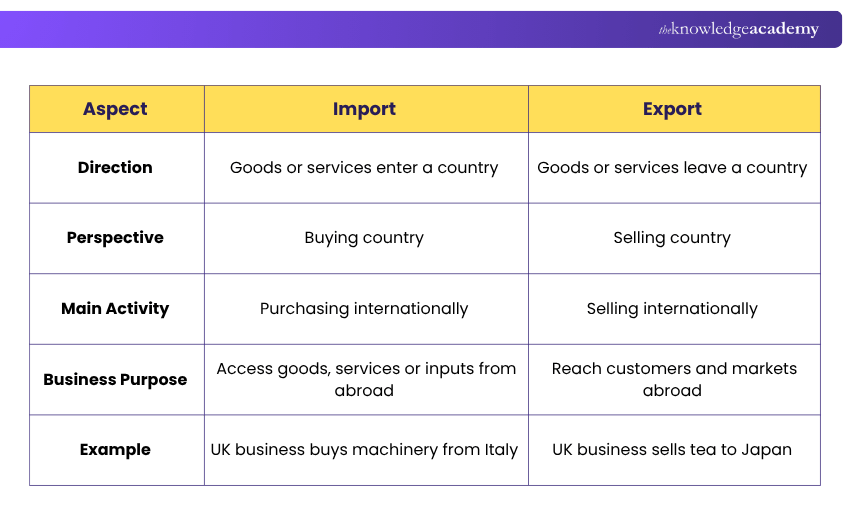
So, imports and exports represent opposite sides of international trade. The easiest way to distinguish them is to consider whether goods or services are entering or leaving the country being analysed. Here are the key differences at a glance:
Why are Imports and Exports Crucial?
Exports and imports are key parts of a country's economy. Together, they form the balance of trade, which shows the economic health of a nation. In a strong economy, both exports and imports grow, indicating sustainability and fostering long-term economic growth.
To fully grasp the significance of exports and imports in economics, it's helpful to understand their impact on a country's Gross Domestic Product (GDP), Exchange Rate, Inflation Level, and Interest Rates. Here is more information on each of these topics:
1) Gross Domestic Product (GDP)
Imports and exports are integral components contributing to a nation's Gross Domestic Product (GDP). GDP is a key metric measuring a country's economic output. Exports directly contribute to GDP by representing the value of services and goods produced domestically but consumed internationally.
Conversely, while subtracted from GDP calculations, imports reflect the demand for foreign products, showcasing the interconnectedness of economies. A healthy balance of exports and imports indicates a robust economy, demonstrating that a nation actively participates in global trade. If you are looking to understand a country's economic strength, knowing how to calculate GDP is essential, as it considers the impact of both imports and exports.
Trainer Insight
Imports are subtracted in the expenditure approach to GDP because they are not produced domestically, not because importing itself automatically weakens an economy.
2) Exchange Rates
The relationship between imports, exports, and exchange rates is intricate. Exporting goods and services enhances a country's foreign exchange reserves, positively influencing its currency's value.
On the other hand, imports may lead to a domestic currency depreciation if the demand for foreign goods outstrips exports. Exchange rates, in turn, impact the cost and competitiveness of a nation's products in the global market. By actively managing these relationships, countries can influence their economic standing and maintain a competitive edge in International Trade.
3) Inflation Levels and Interest Rates
The retreat and flow of imports and exports also influence a nation's inflation and interest rates. A surge in imports may contribute to inflationary pressures, as increased demand for foreign goods could outpace domestic supply.
Governments may adjust interest rates as a monetary policy tool to manage inflation. Additionally, a healthy export sector can generate foreign income, potentially reducing the need for higher interest rates to attract foreign capital.
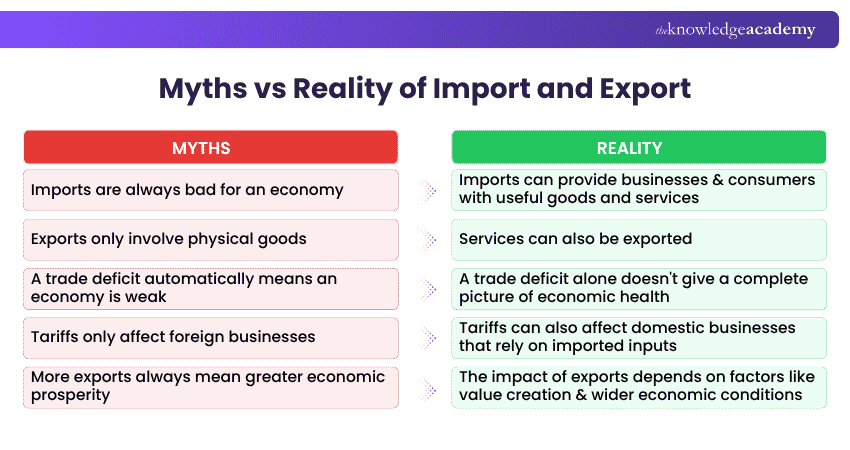
Here are some myths related to imports and exports that you need to watch out for:
Methods for Reducing Imports and Enhancing Exports
In International Trade, nations employ various strategies to balance their trade deficits, aiming to reduce imports and bolster exports. Here are four essential methods used by countries to achieve this delicate equilibrium:
1) Taxation and Import Limits
Governments often resort to imposing taxes and import limits to curb the inflow of foreign goods and encourage consumption of domestically produced items. Tariffs and taxes levied on imported goods can make foreign products more expensive, providing a competitive edge to local industries.
Additionally, import quotas set restrictions on the quantity of specific goods that can be imported, safeguarding domestic enterprises from excessive foreign competition. While these measures can protect local businesses, they should be carefully calibrated to avoid retaliatory actions and disruptions in global trade dynamics.
2) Financial Support
Providing financial support to domestic industries is a proactive approach to enhancing export competitiveness. Governments may offer subsidies, grants, or low-interest loans to industries engaged in export activities. These financial incentives can offset production costs, making locally produced goods more competitive internationally.
Furthermore, investing in research and development to foster innovation can create high-quality, value-added products that appeal to global consumers. Countries can strengthen their export capacity and diversify their product offerings by strategically supporting key industries.
Crossing borders shouldn't mean crossing compliance lines. Learn how to manage export requirements with the Export and Trade Compliance Training – Sign up now!
3) Trade Pacts
Engaging in trade pacts and agreements with other nations is a diplomatic approach to boosting imports and exports. Bilateral or multilateral agreements can open new export markets while granting preferential access to imported goods.
By negotiating mutually beneficial terms, countries can create an environment conducive to increased trade, promoting economic growth and collaboration. These agreements often involve reducing or eliminating tariffs, facilitating smoother trade flows and fostering positive economic relationships.
4) Depreciation of Currency
A deliberate depreciation of a country's currency can make its exports more competitively priced in the global market. When a currency loses value, foreign buyers find domestically produced goods more affordable, increasing export demand.
This method is particularly effective for countries seeking to stimulate economic growth through export-led strategies. However, it requires careful management, as excessive depreciation may lead to inflation and other economic challenges.
Trade-off to Remember
Measures intended to support exports or limit imports can have wider effects. Consider their impact on consumers, domestic businesses, supply chains and trading partners rather than looking only at the trade balance.
Examples of Import and Export
Looking at both sides of a transaction can make the difference between imports and exports easier to understand.
Example of Import: Suppose a UK furniture manufacturer purchases specialised machinery from Germany. From the UK's perspective, the machinery is an import because it is being purchased from another country.
Example of Export: Now imagine that the same UK manufacturer uses the machinery to produce furniture and sells its finished products to customers in France. From the UK's perspective, those furniture sales are exports because the products are being sold to another country.
From Import to Export
Step 1: UK company purchases machinery from Germany
↓
ImportStep 2: Company uses the machinery to manufacture furniture
↓
Domestic productionStep 3: Furniture is sold to customers in France
↓
Export
What Does Tariff Mean?
A tariff refers to a tax imposed by a government on imported goods and services. It is used to regulate international trade by increasing the cost of foreign products. This makes them less competitive with domestic goods.
For example, the UK might impose tariffs on certain imported items to protect local industries or generate additional government revenue. While tariffs can support domestic businesses, they can also result in high prices for consumers and potential trade tensions between nations.
Import and Export Transaction Checklist
Before trading internationally, check:
□ Confirm the countries involved in the transaction□ Check whether tariffs or import restrictions may apply□ Consider how exchange rates could affect costs or revenue□ Review transport and other international trading costs□ Check relevant trade agreements between the countries□ Consider how currency changes could affect pricing□ Understand the potential impact on the buyer and seller□ Confirm whether the transaction involves goods, services or both□ Review the overall costs and benefits before proceeding

Gaurav Kalita is a Content Writer with 2+ years of experience in content development, research and storytelling. His background in English literature and teaching, combined with his growing interest in AI and Machine Learning, supports his writing across Business Skills and IT and Tech.
View Detail

 If you wish to make any changes to your course, please


