




We may not have the course you’re looking for. If you enquire or give us a call on 01344203999 and speak to our training experts, we may still be able to help with your training requirements.
What is Emotional Intelligence and Why is it Important?
ByVidhya NairLast updated on: 18 September 2026
Emotional Intelligence refers to understanding and managing your emotions while recognising other’s feelings to improve relationships and decision-making. It plays a core role in how people think, behave, communicate, and build relationships, while also influencing how they manage stress, conflicts, and challenges in life and at work.
While presenting an idea at work, if a colleague suddenly criticises it in front of everyone, what’s your first response? Your instinct might be to defend yourself, become frustrated or stop engaging altogether.
But there’s another option: recognise your reaction, understand what triggered it and choose how to respond.
That ability is at the heart of What is Emotional Intelligence. Emotional Intelligence helps people recognise and manage their own emotions while understanding those of others. This is why some people stay calm under pressure, communicate clearly and handle difficult situations at ease
What is Emotional Intelligence?
Emotional Intelligence means blending thinking and feeling to make better decisions. To put it simply, means being thoughtful with feelings. It helps people navigate complex emotions, relationships, and real-life challenges with clarity and purpose. This involves noticing feelings, understanding what they mean, and responding thoughtfully.
Emotional Intelligence is about understanding how emotions influence decisions, behaviour, performance, and relationships. Once this awareness is developed, it can be used to lead a more balanced and fulfilling personal and professional life.
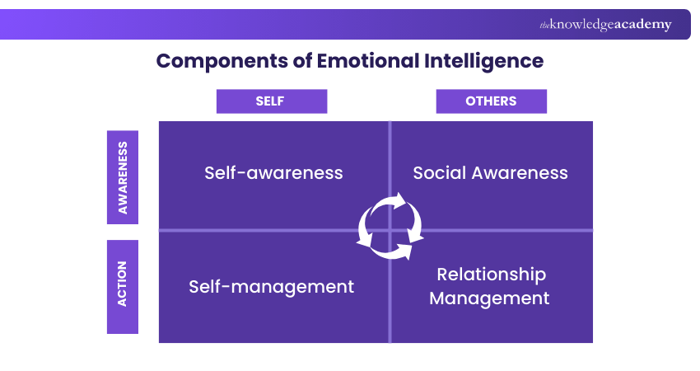
Components of Emotional Intelligence
From self-awareness to relationship management, EI has four key components. Let's take a look at them below for a better understanding of What is Emotional Intelligence:
1) Self-awareness
Self-awareness is a crucial aspect of Emotional Intelligence that involves gaining a profound understanding of one's own emotions, strengths, weaknesses, values, and beliefs. It goes beyond simply recognising basic feelings by delving into the underlying causes and effects of these emotions on one's thoughts and behaviour. Developing self-awareness can help you in various ways, and it is an essential skill to cultivate for personal growth and success.
a) Recognise Emotions: Identify and label various emotions accurately, including subtle nuances in feelings.
b) Monitor Reactions: Be mindful of emotional reactions in different situations, helping to avoid impulsive behaviour.
c) Understand Triggers: Pinpoint triggers that lead to specific emotional responses, allowing for proactive management.
d) Acknowledge Strengths and Weaknesses: Acknowledge personal strengths and weaknesses, facilitating personal growth and development.
e) Enhance Decision-making: Make more informed decisions by considering emotions' influence on choices.
f) Improve Relationships: Understand how emotions impact interactions with others, leading to improved relationships.
Trainer's Pro Tip
Try to identify the specific emotion you are experiencing before deciding how to respond. Moving beyond broad labels such as “good” or “bad” can help you understand what triggered the reaction.
2) Self-management
Self-management is a vital component of EI that encompasses an individual's ability to control and regulate their emotions, impulses, and behaviour effectively. It involves developing strategies to manage emotional reactions and maintain composure in various situations. Let's explore the key aspects of self-management:
a) Impulse Control: The capacity to resist impulsive reactions and make thoughtful decisions even in emotionally charged circumstances.
b) Stress Management: Techniques and coping mechanisms to handle stress and pressure constructively.
c) Adaptability: The ability to adapt to changing events and bounce back from setbacks.
d) Emotional Control: Maintaining emotional balance and preventing emotions from negatively influencing actions.
e) Goal Orientation: Setting and working toward goals while maintaining focus and determination.
f) Time Management: Efficiently utilising time and resources to achieve objectives.
Manage emotions calmly and confidently with Anger Management Training – Join now!
3) Social Awareness
Social awareness is a critical component of EI that revolves around an individual's ability to recognise and comprehend the emotions, perspectives, and needs of others. It involves being attuned to the feelings and reactions of people in various social situations. Here are the key aspects of social awareness:
a) Empathy: It is the capacity to comprehend and share the emotions of others, fostering compassion and connection.
b) Non-verbal Communication: The ability to interpret and respond to nonverbal cues like facial expressions as well as body language.
c) Sensitivity to Diversity: Recognising and respecting cultural differences, individual preferences, and diverse backgrounds.
d) Conflict Resolution: Skilfully addressing conflicts and mediating disputes in a fair and constructive manner.
e) Active Listening: This ability includes paying complete attention to what others are saying, demonstrating genuine interest, and providing thoughtful responses.
f) Perspective-taking: Seeing situations from different viewpoints boosts understanding and collaboration.
Trainer's Pro Tip
When interpreting someone else's emotions, treat your interpretation as a possibility rather than a fact. Ask questions and listen before deciding what another person is feeling.
4) Relationship Management
Relationship management involves the ability to build, nurture, and maintain positive connections and interactions with others. It leverages emotional awareness and social skills to create and sustain healthy relationships, both personally and professionally. Key aspects of relationship management include:
a) Sharing ideas: Skilfully conveying thoughts, ideas, and emotions while promoting understanding and trust.
b) Team collaboration: Working collaboratively within a team, fostering synergy, and achieving collective goals.
c) Influence and leadership: Leveraging Emotional Intelligence to inspire, motivate, and lead others effectively.
d) Building rapport: Establishing genuine connections and trust with individuals, contributing to strong relationships.
e) Adaptability: Adjusting one's communication style and approach to suit different individuals and situations.
Consider this:
Emotional Intelligence in Action
Situation:A colleague strongly disagrees with your idea during a team meeting.Self-awareness→ Recognise that you are becoming frustrated.Self-management→ Pause instead of responding defensively.Social awareness→ Consider why your colleague may have concerns.Relationship Management→ Ask questions, discuss the disagreement constructively and work towards a solution.
Achieve greatness through our Motivation and Goal Setting Training – Sign up now!
Benefits of Emotional Intelligence
Emotional Intelligence is a core attribute for effective leadership. Let's explore the importance of Emotional Intelligence in Leadership:
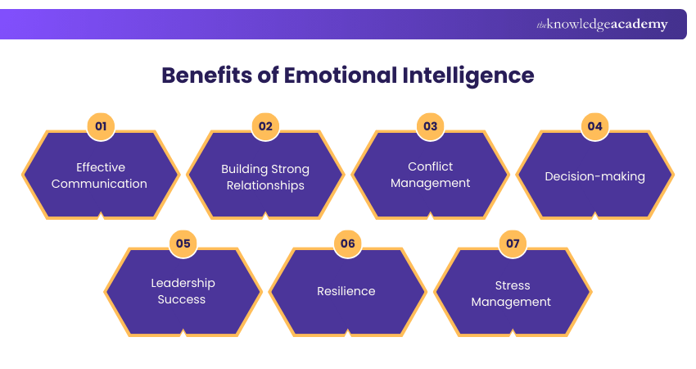
1) Effective Communication
Effective leaders with high EI possess exceptional communication skills. They listen actively to their team members, creating an environment where everyone feels heard and valued. These leaders can convey their ideas, visions, and expectations clearly and adapt their communication styles to suit various situations and individuals.
2) Building Strong Relationships
The Importance of Emotional Intelligence is evident in how leaders build and nurture strong, positive relationships. Leaders with high EI establish trust, empathy, and rapport with their team members and stakeholders.
3) Conflict Management
Conflict is an inevitable part of any team or organisation. Leaders with high EI approach conflicts as opportunities for growth and resolution rather than as problems. They are skilled at managing conflicts constructively, seeking win-win solutions that benefit all parties involved.
4) Decision-making
EI influences leaders' decision-making processes. Leaders with high EI consider not only rational factors but also emotional ones when making choices. They are attuned to the emotions of their team members and stakeholders, understanding how decisions may impact them emotionally.
5) Leadership Success
Emotional Intelligence is essential for effective leadership. Leaders who can recognise and understand their emotions are better able to reflect and respond thoughtfully. This self-awareness helps them make balanced decisions, communicate clearly, and inspire trust within their teams and across the organisation.
6) Resilience
Resilience is the ability to adapt and stay steady during challenges, and Emotional Intelligence plays a central role in developing it. Recognising emotions, revisiting core values, and focusing on opportunities rather than limitations can turn difficult experiences into moments of learning and self-reflection.
7) Stress Management
Emotional Intelligence supports healthy stress management by helping individuals recognise emotional signs proactively. Understanding deeply what you feel and why you feel enables you to respond constructively and mindfully instead of feeling overwhelmed by your emotions.
Develop mental strength and adaptability with our Resilience Training – Join now!
How can Emotional Intelligence be Measured?
Emotional Intelligence can be measured in different ways. There are a number of tests and assessments that can help you determine the different levels of Emotional Intelligence. These tests are primarily divided into two categories:
a) Self-report tests: These are some of the most commonly used tests because they can help you measure your Emotional Intelligence easily. These tests are designed in such a way that the respondents only have to answer the questions or rate themselves according to the statements.
b) Ability-based tests: These tests involve several people responding to the same questions or situations and then assessing their Emotional Intelligence skills. These tests are then rated by a third party after the participants showcase their abilities.
KEY INSIGHT
The Mayer-Salovey-Caruso Emotional Intelligence Test is an example of the Ability-based test. This measures the four branches of Mayer and Salovey’s model. Here the participants have to identify their ability to perceive, identify, understand and manage their emotions.
How to Develop Emotional Intelligence Skills?
Emotional Intelligence is a vital aspect of personal growth and success, and fortunately, these skills can be developed and strengthened over time. Here are some realistic steps to enhance your Emotional Intelligence:
1) Practise Self-reflection: Regularly reflect on situations that created strong emotional responses. Ask what you felt, what triggered it and how your reaction affected the situation.
2) Recognise Your Triggers: Identify situations, behaviours or circumstances that repeatedly create strong reactions. Recognising patterns can help you prepare for them more effectively.
3) Pause Before Responding: When emotions become intense, create a short gap between the feeling and your response. Use that time to consider what outcome you want from the situation.
4) Practise Active Listening: Focus fully on what another person is communicating rather than planning your response while they are speaking. Pay attention to words, tone and non-verbal signals.
5) Develop Empathy: Try to understand situations from another person's perspective. You do not need to agree with someone to understand why they may think or feel differently.
6) Seek Constructive Feedback: Ask trusted colleagues, friends or mentors how your communication and behaviour affect them. Feedback can reveal patterns that are difficult to recognise through self-reflection alone.
7) Improve Conflict Management: During disagreements, focus on understanding the issue rather than winning the argument.
8) Separate the problem from the person and look for areas of common ground.
9) Set Development Goals: Choose a specific EI capability to improve rather than attempting to change everything at once. For example, you might practise pausing before responding during difficult conversations for several weeks and then reflect on whether it changed the outcome.
Trainer's Pro Tip
When emotions rise, avoid making your first reaction your final response. A short pause can give you time to recognise what you are feeling and respond more deliberately.
Take control of your goals, habits, and emotions with Self-Management Training today!
Difference Between EQ and IQ
Intelligent Quotient (IQ) and Emotional Intelligence measure different but important abilities. IQ focuses on cognitive skills, such as logical reasoning, problem-solving and memory. It reflects how well a person understands and processes information. It is commonly measured through standardised test and used in academic and analytical settings.
Emotional Intelligence relates to understanding and managing emotions. It includes self-awareness, teamwork, leadership, and stress management. While IQ remains relatively stable, EQ can be developed over time. Strong EI often improves workplace relationships, communication, and decision-making.
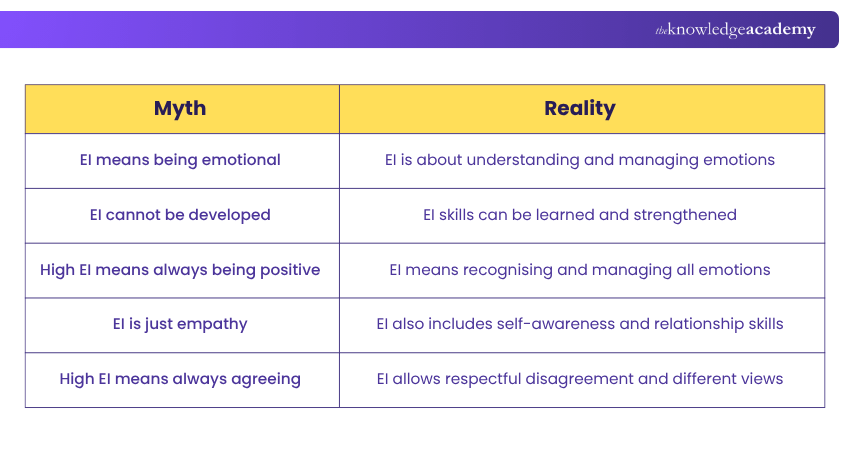
Common Myths About Emotional Intelligence
Several misconceptions can make Emotional Intelligence seem simpler than it really is. Here are some common myths and the realities behind them:

Vidhya Nair is a Senior Copywriter with 7+ years of experience across copywriting, content writing and communication. Her extensive research and editorial experience supports her ability to present topics across Business Skills and Human Resources with clarity and purpose.
View Detail

 If you wish to make any changes to your course, please


