




We may not have the course you’re looking for. If you enquire or give us a call on 01344203999 and speak to our training experts, we may still be able to help with your training requirements.
What is Data Architecture: Key Concepts, Types, and Benefits
ByAkhil KLast updated on: 03 October 2026
Data architecture outlines the process of collecting, storing, managing and using data. It efficiently connects business goals with technical data solutions. It is crucial for data-driven initiatives, like business intelligence, analytics, and machine learning, enabling organisations to leverage data effectively.
Quick Snapshot
1. Purpose: Organises how data is collected, stored, integrated, and used.2. Core Elements: Data sources, databases, data lakes, governance, analytics.3. Key Goal: Create consistent, accessible, and reliable data across systems.4. Business Value: Supports better integration, scalability, compliance, and decision making.
Every organisation generates data, but without a clear structure for storing, integrating, and managing it, that data can quickly become fragmented and difficult to use. Understanding what is data architecture explains how organisations create a framework that keeps data organised, accessible, and aligned with business needs.
In this blog, we will understand what is data architecture and why it acts as the backbone of reliable data management. You will gain insight into its purpose, key components, and how it supports scalable, informed, and strategic business decisions. Let's get started!
What is Data Architecture?
Data architecture is the framework that defines how data is collected, transformed, stored, integrated, and used across an organisation. It establishes how data flows between systems and supports business requirements. It lays down the models, rules, and frameworks that control data management and allow trustworthy data processing and analytical activities to thrive.

Components of Data Architecture
From data collection and storage to integration, governance and access, here are some of the key components of data architecture:
1) Data Sources
Systems, applications, and external feeds that produce raw structured and unstructured data. They provide the inputs that flow through the data architecture.
2) Databases
Databases store structured or semi-structured data for operational and transactional purposes. They support data access, updates, and integration with other systems.
3) Data Lakes
Data lakes store large quantities of structured, semi-structured, and unstructured data in their native formats. They support flexible analytics, processing, and future data use.
4) Data Analytics
Data analytics uses analytical tools to examine data, extract insights, and support decision-making. Common applications include reporting, real-time analysis, and advanced analytics.
5) Artificial Intelligence
Artificial Intelligence uses data to build models, automate processes, and support predictions and decision-making. Its effectiveness depends on access to reliable, high-quality data provided through the data architecture.
6) Data Governance
Data governance defines policies, roles, and controls for data security, consistency, and quality. It supports accountability, regulatory compliance, and responsible data management across systems.
Transform raw data into business-ready insights by joining the Data Warehousing Training now!
Popular Data Architecture Frameworks
Organisations can use established enterprise architecture and data management frameworks to guide the design and implementation of Data architecture. Three widely recognised approaches are outlined below:
1) The TOGAF® Standard
The TOGAF® Standard was developed by The Open Group in the 1990s, drawing on the US Department of Defense’s Technical Architecture Framework for Information Management (TAFIM). It provides a comprehensive method and framework for developing and governing enterprise architecture, including data architecture. It covers four main architecture domains:
a) Business Architecture: Outlines how the organisation is structured, how it operates, and its business strategy, governance and key processes.
b) Data Architecture: Describes the structure of an organisation's logical and physical data assets and data management resources.
c) Application Architecture: Illustrates the software systems used and how they support business activities, as well as their interconnections.
d) Technical Architecture: Covers the technology infrastructure, such as hardware, software, and networks, required to support applications and business operations.
Build a stronger understanding of enterprise architecture principles and frameworks with the TOGAF® Training – Sign up now!
2) DAMA-DMBOK® 2nd Edition
DAMA International is a global professional association focused on advancing data management practices and knowledge. One of its key resources is the DAMA-DMBOK® 2 Revised, the revised second edition of the data management body of knowledge. It provides a structured body of knowledge for data management and includes data architecture alongside areas such as data governance, data modelling and design, and more.
3) Zachman Framework for Enterprise Architecture
The Zachman Framework is a popular structured approach for viewing and organising enterprise architecture. It uses a 6 × 6 matrix that combines six stakeholder perspectives with six interrogatives: what, how, where, who, when, and why. While it helps organise and analyse data clearly, it doesn’t provide specific steps or methods for completing the work.
Types of Data Architectures
Data architecture can be designed in different ways depending on organisational needs and data complexity. Each approach supports data management and system integration differently. Below are the types of data architectures:
1) Centralised Architectures
Centralised architectures bring data from different parts of the organisation into a centrally managed platform, such as a data warehouse or data lake. This structure assists in the standardisation of data, minimises duplication, and facilitates steady and high-quality analytics and reporting.
2) Decentralised Architectures
Decentralised architectures distribute data ownership across the organisation. This approach can improve responsiveness to specific data needs and give individual teams greater control over how their data is managed.
3) Hybrid Architectures
Hybrid architectures combine centralised and decentralised characteristics. Organisations may establish common governance, standards and shared platforms centrally while allowing individual business domains or teams to manage certain data products, systems or responsibilities locally.
Learn to turn complex data into clear structures with the Relational Databases & Data Modelling Training now!
Benefits of Data Architectures
A well-designed data architecture can provide businesses with several important benefits, including the following:
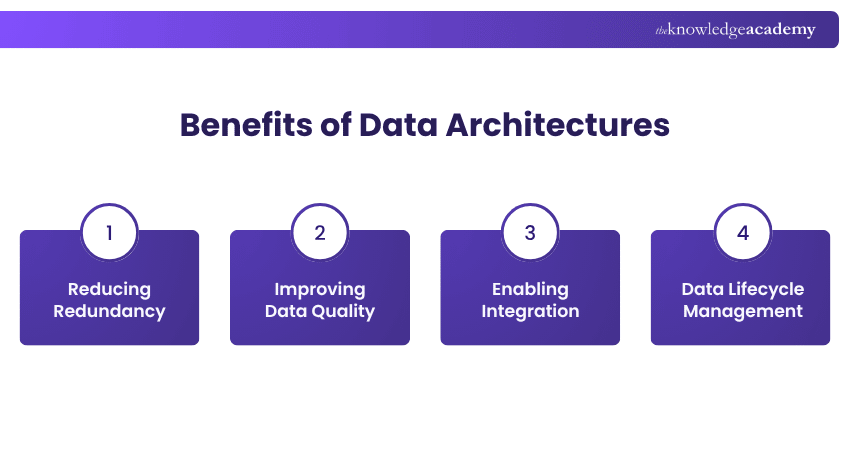
1) Reducing Redundancy
Data can often overlap across different sources, which can lead to inconsistency, errors, and missed opportunities. A strong data architecture helps you standardise data storage and minimise duplication, thereby improving data quality and encouraging accurate analysis.
2) Improving Data Quality
Data architectures can address problems in poorly managed data lakes (also called "data swamps"). This is done by ensuring proper standards and governance. This helps improve overall data quality and keeps data reliable and useful for future analysis.
3) Enabling Integration
Data is often isolated due to technical or organisational barriers. Modern data architectures help with integration across different domains. This helps provide a more consistent understanding of key metrics and offers a broader view of customers, products, and markets, improving data-driven decisions.
4) Data Lifecycle Management
Data architecture also helps manage data throughout its lifecycle. As data becomes less useful and is accessed less frequently, it can be moved to more affordable storage solutions. This allows businesses to retain data for reports and audits without incurring unnecessary storage costs.
From Data Chaos to Data Clarity
Before: Data Silos | Duplicate Data | Inconsistent Formats | Limited VisibilityAfter: Connected Data | Better Quality | Consistent Standards | Clearer Insights
Effective data architecture helps organisations create a more structured and connected data environment.
How is Data Architecture Implemented?
Here are the key phases involved in building a robust data architecture:
Step 1: Align With Business Goals
Begin by determining business goals like analytics, compliance, or automation. These objectives guide data priorities, source selection, and system integration.
Step 2: Define Data Requirements, Models and Governance
Identify important data requirements and develop appropriate conceptual, logical and physical data models. Establish governance policies and responsibilities for areas such as data ownership, quality, access, security and lifecycle management.
Step 3: Architecture Design
Choose storage, integration, and data consumption technologies. Define how data flows between systems and where it is stored.
Step 4: Build and Integrate
Deploy data pipelines, APIs, and access tools such as dashboards. Apply appropriate compliance and security controls during implementation.
Step 5: Observe, Develop, and Grow
Continuously monitor performance and update the architecture when required. Adapt the design to support business growth, new applications, and changing regulatory requirements.
Data Architecture Roadmap
Business Goals → Data Models → Governance → Architecture Design → Integration → Monitoring & Improvement
Data Architecture vs Data Modelling
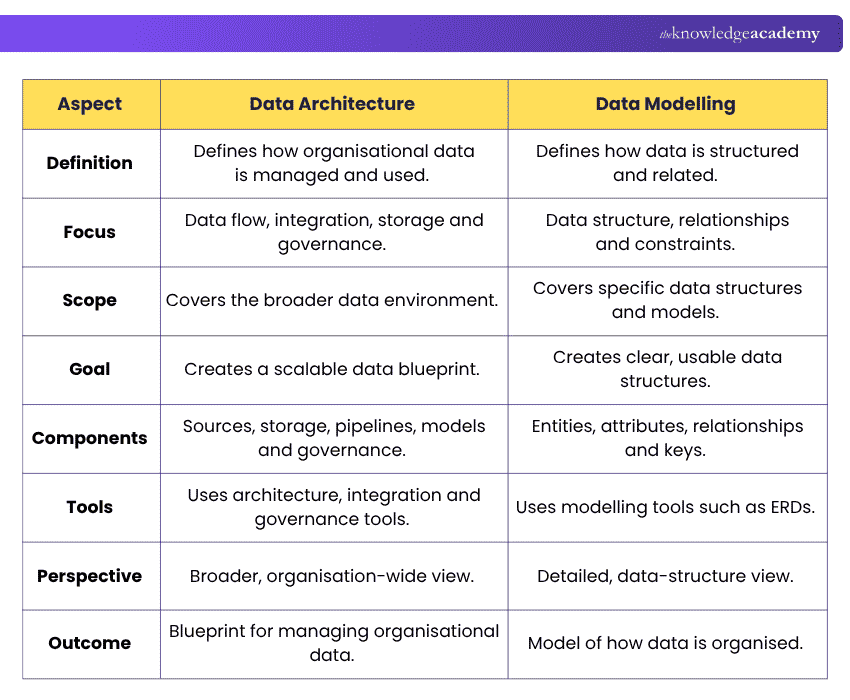
Data architecture takes a broader view by defining how data is stored, integrated, and used across systems. It includes data models within a comprehensive framework for controlling large amounts of data.
In contrast, data modelling lays out the data's structure, relationships, and format for particular use cases. It is concerned with arranging data elements according to business needs.
Data Architecture Best Practices
Effective data architecture helps organisations generate meaningful insights. Following best practices ensures reliable and scalable results. Let's look at them below:
a) Business Alignment: Ensure the architecture supports long-term business goals and strategic objectives.
b) Flexibility and Scalability: Design systems that adapt to change and scale with growing data volumes.
c) Integrated Governance and Security: Embed governance and security controls into the architecture from the start.
d) Unified Data Access: Enable multiple data workloads to operate on shared data securely and consistently.
e) Open Foundation: Reduce vendor dependency by using open standards and interoperable technologies where appropriate.
f) Data Democratisation: Provide appropriate data access to authorised users while maintaining clear governance, security, and access controls.
Advance your expertise in business, data, application, and technology architecture with the Enterprise Architecture Black Belt Training – Join now!

Akhil K is a Copywriter and Video Editor with experience in content creation, visual storytelling, advertising and brand communication. His background in journalism, research and audience-focused communication strengthens his ability to create clear and engaging Business Skills content.
View Detail

 If you wish to make any changes to your course, please


