




We may not have the course you’re looking for. If you enquire or give us a call on 01344203999 and speak to our training experts, we may still be able to help with your training requirements.
What is CTQ (Critical to Quality) Tree: An Ultimate Guide
ByThe Knowledge AcademyLast updated on: 22 September 2026
Critical to Quality (CTQ) refers to measurable product or service attributes customers see as essential for satisfaction and value, ensuring strong quality. They help teams prioritise what truly matters to customers and improve quality. Identifying CTQs early reduces defects and ensures consistent, high-value outcomes.

Ever looked forward to a product or service and felt let down by small but important details, bland food, slow service, or a phone that dies too fast? Those moments instantly change how we see a brand. We don’t think in technical terms; we simply think, “This didn’t meet my expectations.” That’s why businesses must understand what truly matters to customers, and knowing What is CTQ helps them get it right.
In this blog, you’ll learn What is CTQ, how a CTQ Tree works, and how to build one. We’ll also cover identifying CTQs, key tools, CTQ vs KPI, examples, and best practices to help businesses deliver better customer experiences.
What is Critical to Quality?
Critical to Quality (CTQ) refers to the key product or service features that customers value most. These measurable characteristics help identify what truly matters to customers and which steps in a process add real value. To define CTQs, organisations gather the Voice of the Customer (VOC) and prioritise customer needs to set clear quality requirements.
A CTQ Tree is often used to translate broad customer expectations into specific, measurable criteria. This tool helps teams remain focused on delivering high-quality outcomes that meet customer expectations, strengthen performance, and improve overall satisfaction.

Components of a CTQ Tree
Recognising the key factors that shape Customer Satisfaction is essential for any organisation striving to succeed. Below are the important elements to focus on:
a) Need: This is the customer’s main expectation or goal. It shows what the customer wants overall and what the business aims to deliver.
b) Driver: These are the key features or qualities that affect how customers judge the product or service. Drivers help show if the customer's main need is being met.
c) Requirements: These are clear, measurable standards used to check each driver. They tell the business how well it must perform to satisfy customers and maintain quality.
Steps to Develop a CTQ Tree
The CTQ process systematically translates customer preferences and needs into specific, measurable requirements for product and service development. Here is a step-by-step overview of the CTQ process:
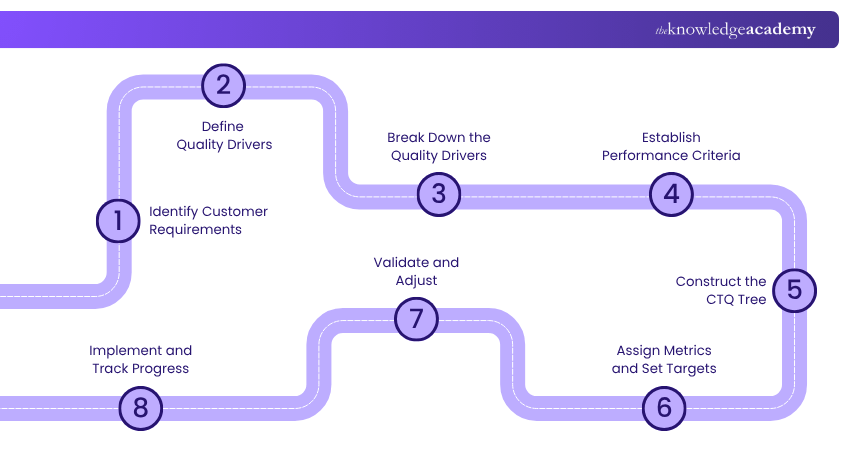
Step 1: Identify Customer Requirements
Start by gathering comprehensive data on customer expectations and needs. This can be achieved through several methods, such as interviews, surveys, Market Research, and feedback mechanisms.
Step 2: Define Quality Drivers
Once customer needs are identified, determine the quality drivers that will influence their satisfaction. Customers prioritise specific attributes and characteristics when evaluating products or services.
Step 3: Break Down the Quality Drivers
For each quality driver, break it into key components or subcomponents to better understand what factors contribute to overall quality. This helps identify the most critical elements that need to be addressed to meet client expectations.
Step 4: Establish Performance Criteria
Based on the identified quality drivers and components, set clear and measurable performance requirements. These standards must be met to achieve high-quality products or services.
Step 5: Construct the CTQ Tree
Organise performance requirements in a hierarchical tree structure. The CTQ Tree visually represents the relationship between quality drivers and performance requirements, providing a roadmap for quality improvement efforts.
Step 6: Assign Metrics and Set Targets
For every performance criterion listed in the CTQ Tree, assign metrics and targets for assessment and measurement. The selection of metrics relies on the relevance of every performance requirement and it’s ability to provide meaningful insights into product or service quality.
Step 7: Validate and Adjust
Validate your CTQ Tree by discussing it with experts and Stakeholders to ensure it meets their needs and expectations. Seek feedback on the completeness and feasibility of performance metrics and requirements and refine the CTQ Tree as necessary.
Step 8: Implement and Track Progress
Integrate the CTQ Tree into the organisation's Quality Management system and relevant processes and activities. Monitor and track performance against the metrics and targets, using the information gained to identify areas for improvement and take corrective action as needed.
Understand how to recognise the importance of the customer in Quality Assurance. Register for our Quality Assurance Training today!
How to Identify CTQs?
Finding Critical to Quality begins with knowing what customers value most. Industries differ, a restaurant may prioritise taste and service, while a car company may focus on safety and fuel efficiency.
To identify CTQs, follow these steps:
a) Voice of the Customer (VoC): Collect opinions through surveys, reviews, interviews, and conversations. This helps you understand what customers need, expect, and value most.
b) Use a CTQ Tree: Break down broad customer needs into clear and measurable quality factors. This helps turn general feedback like “good service” into specific points like “fast service within 5 minutes.”
c) Prioritise What Matters Most: Rank the CTQs based on how much they affect customer satisfaction and business results. Focus first on the ones with the highest impact.
A Practical Example of a CTQ Tree
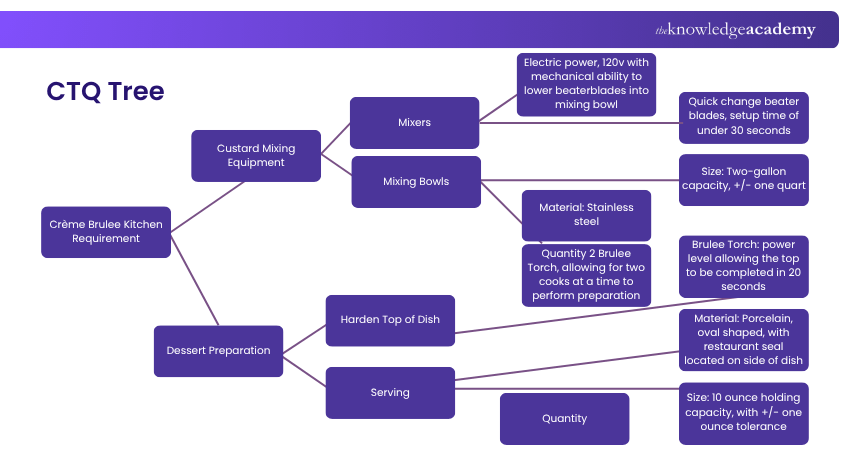
Consider CTQ in the context of a restaurant. The menu and the desired quality of the food will determine the necessary equipment. For instance, a fine dining establishment serving crème brûlée would require a brûlée torch to caramelise the top of the dish. However, in a burger joint, a brûlée torch would be useless.
The Kitchen Manager must understand the customer's needs before setting up a kitchen that can meet those needs. If they are producing hundreds of crème brûlées daily for delivery to local shops, a traditional brûlée torch would not be practical. Instead, an automatic machine capable of caramelising the tops of thousands of crème brûlées a day would be required.
Understanding all the characteristics of the customer is essential to determine what is Critical to Quality. A CTQ for making crème brûlée might look like the example below:
Advantages of Using CTQ
Focusing on Critical to Quality (CTQ) elements can significantly enhance various aspects of an organisation's operations. Let's explore some of its key benefits:
1) Better Understanding of Customer Needs
Knowing the CTQ information allows you to comprehend value, eliminate non-value-added activities, and meet your customers' needs effectively.
2) Reduced Effort
Without understanding the CTQ, you are likely to fail to meet your customer's requirements, leading to the need for rework. By establishing metrics using your CTQ Trees, you can identify quality errors earlier, thereby reducing the cost of rework.
3) Time Savings
Less rework also means less time spent on corrections and fewer instances of having to apologise to customers for errors.
Improves supplier quality assessment and enhancement skills. Join our Supplier Quality Management Training today!
CTQ Best Practices
Understanding and accurately capturing Critical to Quality (CTQ) elements is essential for meeting customer requirements and maintaining high standards. Here are some practical steps to ensure you gather and utilise CTQ information effectively:
1) Gather as much data on the CTQ as possible, as it's easy to overlook key customer requirements.
2) Ask the customer the same questions in different ways. Often, a rephrased question will elicit a slightly different response, revealing hidden requirements.
3) Use your CTQ Trees to develop your metrics. Quality is maintained through these metrics, which verify that customer demands are being met and identify errors promptly.
What's the Difference Between CTQ and KPI?
Critical to Quality (CTQ) shows what customers care about most. It tells you the key things a product or service must have to make customers satisfied, like fast delivery or good taste.
Key Performance Indicator (KPI) measures how well a business or team is doing. It tracks results, such as sales numbers, response time, or customer complaints.
What Tools Help Define CTQs?
To define CTQs, businesses use tools that help understand customer needs and turn them into clear goals:
a) Voice of the Customer (VoC): Collects customer feedback through surveys, reviews, or interviews.
b) CTQ Tree: Breaks customer needs into clear, measurable requirements.
c) SIPOC Diagram: Shows the full process; Suppliers, Inputs, Process, Outputs, and Customers, to help understand customer needs and how to meet them effectively.
d) Pareto Chart: Finds the most important factors that affect customer satisfaction.

The Knowledge Academy develops accessible learning content across Project Management, IT, Cybersecurity, Data Science, Business Analysis, HR, Accounting and Finance, Leadership and Health and Safety. Its resources combine subject research with clear explanations to help professionals build practical knowledge across a wide range of disciplines.
View Detail

 If you wish to make any changes to your course, please


