


 Top Rated Course

We may not have the course you’re looking for. If you enquire or give us a call on 01344203999 and speak to our training experts, we may still be able to help with your training requirements.
What is Cartography? Types, Elements and Tools
The Knowledge Academy 05 February 2026Cartography is the art and science of designing maps that represent data accurately, blending creativity, precision, and technology for clear communication. It transforms complex spatial information into visuals that are easy to understand. Modern cartography also integrates digital tools, GIS, and remote sensing for interactive mapping.

Training Outcomes Within Your Budget!
We ensure quality, budget-alignment, and timely delivery by our expert instructors.
Table of Contents

Maps influence our perception of the world. They have been integrating science, design, and technology to make complicated data more accessible and easier to understand through visuals. Knowing What is Cartography will let us have a greater appreciation of how geography is expressed through not only precise but also artistic map-making styles. In this blog, we will be looking into the area that links data with art and spatial comprehension.
Table of Contents
1) What is Cartography?
2) Different Types of Maps and Cartographic Representations
3) The Four Elements of Cartographic Design
4) Modern Cartography Tools
5) The Connection Between Geography and Cartography
6) Future of Cartography
7) Conclusion
What is Cartography?
Cartography is the practice of designing, creating, and interpreting maps. It merges geography, artistry, and technology to visually represent spatial information. While traditional Cartography centred on physical and printed maps, modern methods now use digital tools and interactive maps for more dynamic visualisation.
Maps have evolved from simple cave drawings to advanced digital renderings that provide real-time data on locations, weather, and traffic. Beyond just depicting geographic features, Cartography involves the careful arrangement of elements to effectively communicate spatial information.

Different Types of Maps and Cartographic Representations
Maps come in all shapes and sizes, each designed to tell a unique story about the world. Here’s a look at the different types of maps and cartographic representations and how they help us understand the world:
1) Political Maps
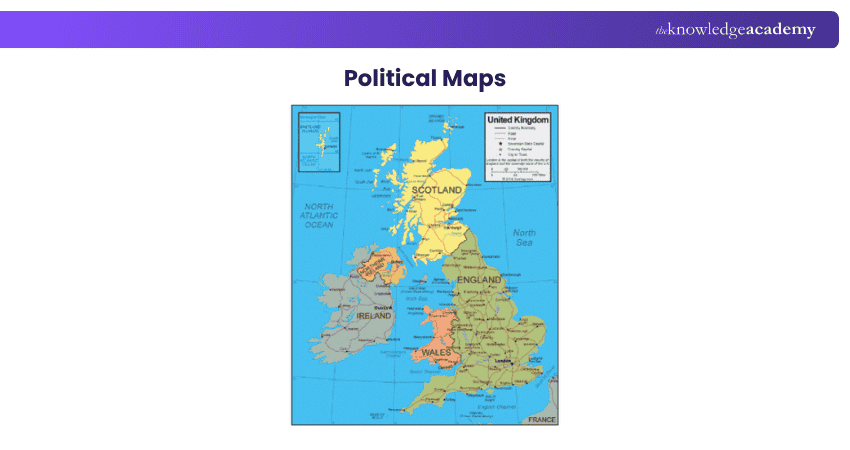
a) Display country borders, cities, and important political divisions
b) Commonly used to understand global political relationships and geography
c) Helpful for studying the boundaries between nations and regions
2) Physical Maps
a) Showcase natural features such as mountains, rivers, and deserts
b) Use colours and shading to represent different elevations and terrain types
c) Focus on the Earth’s physical landscape, which is ideal for geography studies
3) Topographic Maps
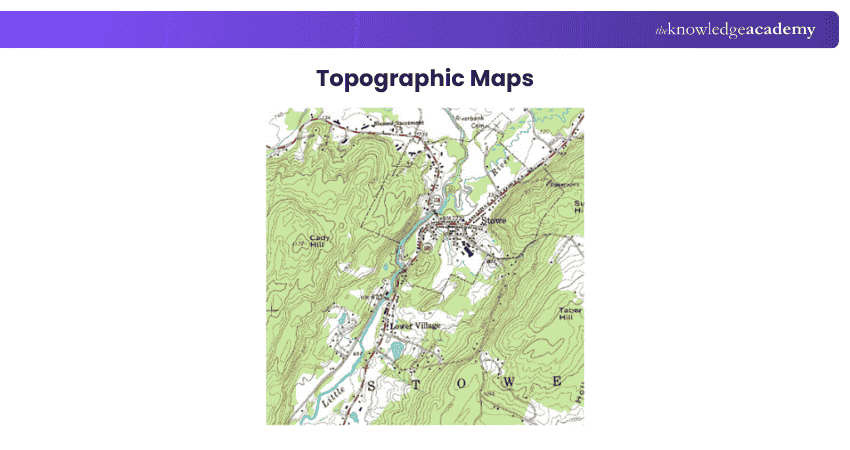
a) Depict terrain and landforms using contour lines to show elevation
b) Essential for activities like hiking, construction, and geological surveys
c) Offer a detailed, 3D-like view of landscapes
4) Thematic Maps

a) Focus on specific themes like population, climate, or economic activity
b) Used to display trends and patterns in various data sets
c) Great for comparing data across different regions
5) Nautical and Aeronautical Charts
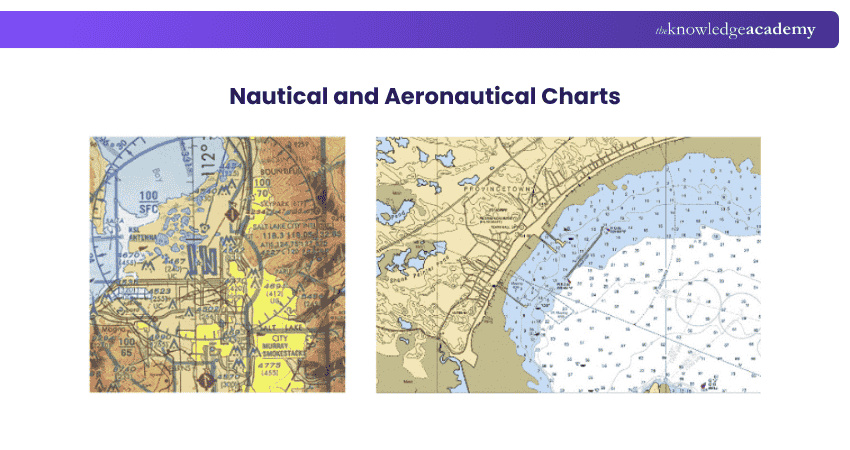
a) Provide navigation information for sailors and pilots
b) Show sea depths, coastal features, and navigational hazards for water routes
c) Aeronautical charts display airways, airports, and airspace data for pilots
6) Digital and Interactive Maps
a) Interactive tools that allow real-time navigation (e.g., Google Maps)
b) Provide features like Zoom, live traffic updates, and directions
c) Useful for everyday navigation and advanced Geographic Analysis
7) Geospatial Data Visualisation
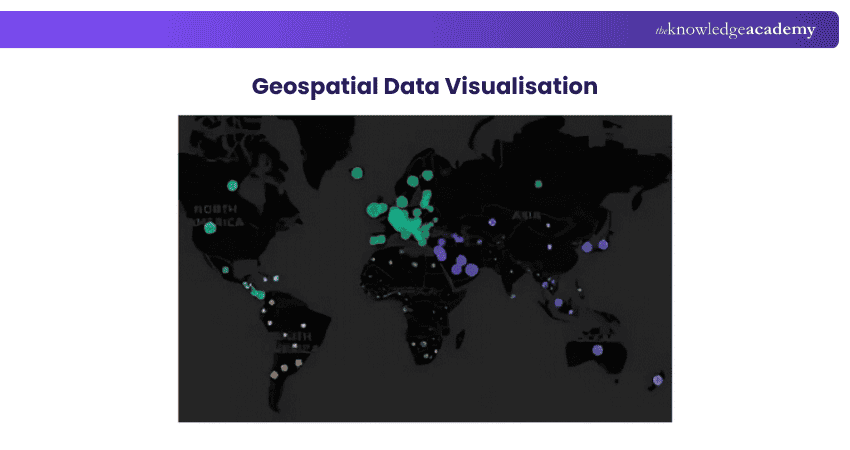
a) Combines large datasets with geography for dynamic Data Mapping
b) Used in urban planning, environmental monitoring, and disaster response
c) Helps in visualising complex spatial trends and relationships
8) Choropleth Maps
a) A type of thematic map that uses colour gradients to represent data
b) Often used to display demographic information, like population density or income
c) Provides an easy way to compare data visually across regions
Explore CorelDRAW tools and transform your ideas into eye-catching, professional-grade graphic designs with our CorelDRAW Training – Sign up now!
The Four Elements of Cartographic Design
The four main elements support the mapmakers in datamapping the geographic information to the audience by maintaining three important factors: the precision of the mapping, beauty, and clarity. The following shows how each component is essential.
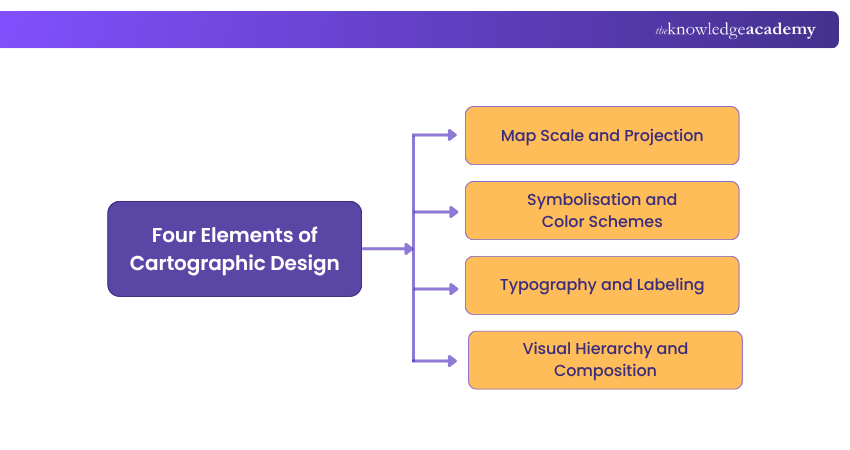
1) Map Scale and Projection
Map scale describes the relationship between distances on a map and real-world distances. Cartographers choose a scale that fits the map’s purpose; large-scale maps show more detail for smaller areas, while small-scale maps cover larger areas with less detail. Projection involves flattening the Earth’s curved surface onto a map, and each type (cylindrical, conic, azimuthal) has trade-offs in distortion that must be managed.
2) Symbolisation and Color Schemes
Symbolisation makes use of points, lines, and polygons to very clearly show geographic features. Different colours help to make the map more readable by identifying the various data types. Besides, cartographers look at the accessibility of the map and, at the same time, create harmony and contrast for a balanced map design.
3) Typography and Labeling
Typography is the study of text and its appearance on a map, as factors like font, size, and style not only influence readability but also contribute to the map's overall look. The location of the labels is very important to maximise their legibility and at the same time, not to overcrowd the design. Cartographers strive to make sure the map looks presentable, readable, and visually well-balanced.
4) Visual Hierarchy and Composition
The visual hierarchy, by means of size, colour, and contrast, directs the viewer's attention towards the important details. The composition guarantees a balanced and pleasant collaboration of all map elements. A good map design leads the viewer smoothly, thus making the interpretation both easy and efficient.
Modern Cartography Tools
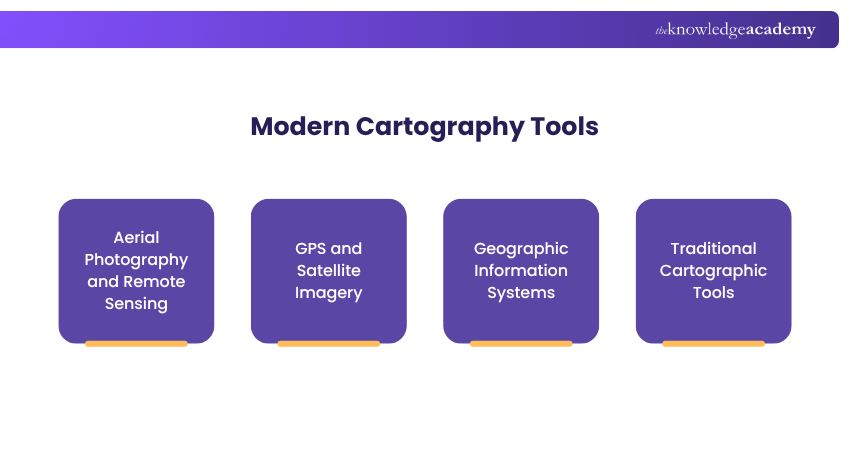
Currently available mapping services are using a huge variety of modern tools already, and most of them are not all related to traditional drafting at all. The use of aerial photos and interactive software, among other technologies, contributes to map-making by making it accurate, faster, and even more creative.
Aerial Photography and Remote Sensing
Cartographers now have the ability to create detailed maps of the Earth through high-altitude photography and drone-based images. Remote sensing transforms light, heat, and motion into digital data, which can subsequently be used to monitor changes in the terrain and land cover. All of these methods contribute to the faster and easier process of map updates in the wake of ongoing changes around the globe.
GPS and Satellite Imagery
The global positioning system (GPS) provides exact location tracking, while satellites record considerable geospatial images from space. The two powers combined allow cartographers to quickly obtain precise data and map out areas at a great scale and speed that has never been encountered before.
Geographic Information Systems
Unlike paper maps, GIS software can organise, visualise, and analyse geographic data in many different ways. It opens up a wide range of applications from planning to research by letting users stack data sets, do advanced spatial analyses, and generate maps that are dynamic and interactive.
Traditional Cartographic Tools
Though there have been digital improvements, traditional instruments such as compasses, protractors, and manual drafting still remain at the foundation of map-making. The use of these tools is an indication of the skill that went into designing maps, and they were primarily responsible for the accuracy of paper maps produced in earlier times.
Transform your imagination into stunning animations with our comprehensive 2D Animation Course – Join now!
The Connection Between Geography and Cartography
Cartography and geography are deeply intertwined. While geography is the study of places, spaces, and environments, Cartography provides the tools to represent these concepts visually.
Cartographers use geographic theories and data to create maps that reflect the Earth’s physical and cultural landscapes. The maps produced by Cartographers are essential tools for geographers, helping them analyse spatial relationships and explore patterns across different scales.
Turn your designs into powerful motion graphics with the Motion Graphics Course – join now!
Future of Cartography
Digital mapping is about to undergo a major transformation in the coming ten years, all due to the rapid technological and data advancements. These projections underscore the possible future of digital maps and the actual change in the way people interact with their environment.
a) Integration of Augmented Reality (AR): The incorporation of AR into maps will provide users with the ability to see interactive, real-world overlays through the live camera view. For instance, a user can aim his or her device at a certain structure and immediately get access to its past or commercial details.
b) Improved Real-time Data: As the number of connected gadgets and the IoT keeps increasing, maps will provide more detailed real-time updates regarding traffic, weather, and events. This will contribute to better knowledge of the situation and hence better decisions.
c) Autonomous Vehicles: Self-driving cars and other autonomous systems will heavily rely on high-precision, continuously updated maps. The maps will have to reflect the changes occurring in real-time and ensure perfect navigation.
d) Indoor Mapping: Detailed mapping of large indoor areas like malls, airports, and museums will be performed, and mobile devices or AR glasses will provide navigation throughout such places. This will allow users to effortlessly roam through intricate interiors.
e) 3D Mapping and Visualisation: The application of three-dimensional mapping for urban areas and natural landscapes will increase due to the use of drones and satellite images. These maps will not only support the planning of cities but also attract tourists and offer captivating digital experiences.
f) Personalisation and AI: The use of AI and machine learning technology will lead to customisation of map experiences, recommending routes and attractions, and forecasting future map situations like traffic congestion.
g) Environmental and Sustainability Planning: Digital maps will more and more help in the areas of environmental monitoring, tracking of climate change, and sustainability planning. They will also be useful in disaster response and resource management for the long term.
h) Blockchain for Data Integrity and Sharing: When different groups of people alter geographical map databases that are shared using blockchain technology, the origin and correctness of the geospatial data can be secured.
i) Greater Accessibility: Maps would indeed become more accessible, garnished with features for the disabled, voice navigation, haptic feedback and a broad demographic inclusion.
j) Enhanced Privacy Controls: Concern about privacy is powering new momentum, and such is reflected in increased requirements for permissions and new products for regulating location data in the out-of-home market.
k) Integration with Smart City Infrastructure: As essential elements in smart city systems, digital map guides induction and energy distribution, management of resources, emergency services and infrastructure.
l) Participatory and Community-based Mapping: Community-driven mapping activities will rise, allowing local voices to access map data and bring out the distinct local viewpoints that the global datasets may overlook.
Conclusion
Understanding What is Cartography reveals the connections between humans, locations, and knowledge by means of maps. Maps produced nowadays are very attractive and informative at the same time, as they are the result of very creative and data-driven approaches to complex information. As the earth and its population continue to change, the art and science of mapping will remain essential.
Transform your creative potential through our Animation and Design Training for professionals!
Frequently Asked Questions
What is Cartographic Generalisation?

Cartographic generalization is a process that makes geographic data simpler and more suitable to different map scales and purposes. It takes away the unimportant details, keeps the important features, and retains the overall accuracy thus ensuring that the maps are still clear, readable, and useful for either analysis or presentation.
What are Map Projections in Cartography?
Mapping projections are techniques that convert the Earth’s round surface into a flat map. Every projection changes the dimensions of shape, area, distance, or direction to serve particular purposes. The cartographers select the projections according to the objective of the map and the area shown on the map.
What are the Other Resources and Offers Provided by The Knowledge Academy?
The Knowledge Academy takes global learning to new heights, offering over 3,000+ online courses across 490+ locations in 190+ countries. This expansive reach ensures accessibility and convenience for learners worldwide.
Alongside our diverse Online Course Catalogue, encompassing 19 major categories, we go the extra mile by providing a plethora of free educational Online Resources like Blogs, eBooks, Interview Questions and Videos. Tailoring learning experiences further, professionals can unlock greater value through a wide range of special discounts, seasonal deals, and Exclusive Offers.
What is The Knowledge Pass, and How Does it Work?
The Knowledge Academy’s Knowledge Pass, a prepaid voucher, adds another layer of flexibility, allowing course bookings over a 12-month period. Join us on a journey where education knows no bounds.
What are the Related Courses and Blogs Provided by The Knowledge Academy?
The Knowledge Academy offers various Animation and Design Courses, including the Animation Course, Video Editing Training, and Logo Design Course. These courses cater to different skill levels, providing comprehensive insights into Types of Photo Retouching.
Our Office Applications Blogs cover a range of topics related to Cartography, offering valuable resources, best practices, and industry insights. Whether you are a beginner or looking to advance your Office Applications skills, The Knowledge Academy's diverse courses and informative blogs have got you covered.

The Knowledge Academy


Global Training Provider
The Knowledge Academy is a world-leading provider of professional training courses, offering globally recognised qualifications across a wide range of subjects. With expert trainers, up-to-date course material, and flexible learning options, we aim to empower professionals and organisations to achieve their goals through continuous learning.

Upcoming Office Applications Resources Batches & Dates
Date
 Motion Graphics Course
Motion Graphics Course
Fri 17th Apr 2026
Motion Graphics Course
Fri 17th Jul 2026
Motion Graphics Course
Fri 16th Oct 2026

 If you wish to make any changes to your course, please


