


 Top Rated Course


We may not have the course you’re looking for. If you enquire or give us a call on 01344203999 and speak to our training experts, we may still be able to help with your training requirements.
What is an Array? Types, Benefits and Operations
The Knowledge Academy 25 February 2026What is an Array? It’s a fundamental data structure that stores a group of similar elements in contiguous memory locations. Arrays allow efficient indexing and manipulation, making them essential for handling data in tasks like searching, sorting, and iteration across most programming languages. Let’s dive in!

Training Outcomes Within Your Budget!
We ensure quality, budget-alignment, and timely delivery by our expert instructors.
Table of Contents
Do you ever think about how program developers navigate large files without a hitch? The answer quite often concerns arrays—a basic concept in computer science when it comes to programming. If you’re thinking about What is an Array? It can be best understood as a systematically arranged bookshelf where every rack accommodates one item and can be altered conveniently.
To anyone who is a developer, it is important to understand that arrays are the pillars of efficient management of data.
In computer programming, an array is just a way of storing an object such as a number, words or even other object in a logical manner. Whether it is game design, data analysis, or creating software, if one does not know or grasp What is an Array? Then, they are going to have a tough time solving this problem. Okay, let’s go through this crucial concept and its uses!
Table of Contents
1) What is an Array?
2) Different Types Of Arrays
3) Common Array Operations
4) Usage of Arrays in Programming Languages
5) When to Use Arrays?
6) Advantages and Disadvantages of Arrays
7) Common Mistakes using Arrays
8) Additional Types of Arrays
9) Conclusion
What is an Array?
Let’s have in-depth understanding of What is an Array. An Array is a fundamental data structure used in computer programming and computer science. It is a collection of elements, often of the same data type, stored at contiguous memory locations. Arrays provide a way to store and manage multiple values or data items under a single variable name, making it easier to work with a large set of related data.

Different Types Of Arrays
Arrays are fundamental data structures in programming, and they can be classified based on their structure and behaviour. The most common classifications are based on dimensions and size.
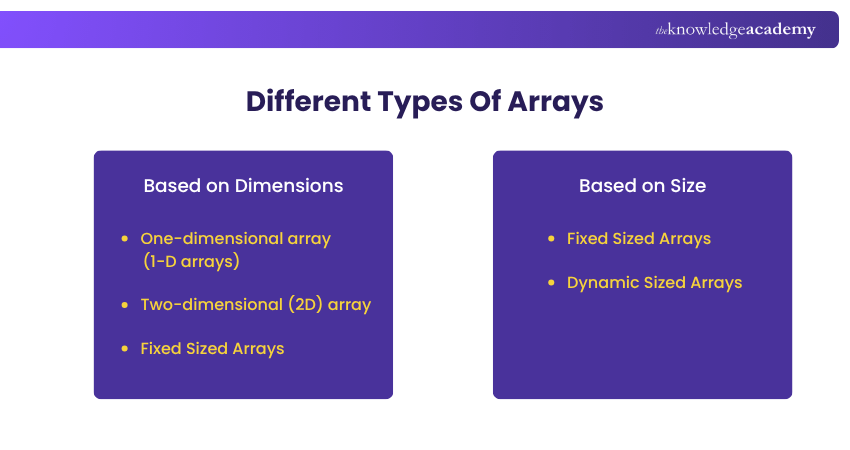
Based on Dimensions:
Arrays can be grouped by the number of indices required to access their elements. These range from simple lists to complex multi-layered structures.
One-dimensional array (1-D arrays)
A one-dimensional array stores elements in a single linear sequence. Each element is accessed using a single index. These arrays are ideal for simple data structures, such as storing a list of numbers, names, or scores. They are easy to manage and are often the starting point for learning array concepts.
Two-dimensional (2D) array
A two-dimensional array stores data in a grid-like structure, consisting of rows and columns. Each element is accessed using two indices, one for the row and another for the column. These arrays are commonly used for tabular data, such as matrices, spreadsheets, and simple image representations. They provide a structured way to handle data that naturally fits into a table format.
Three-dimensional array
A three-dimensional array adds an extra layer of complexity by storing data in multiple 2D arrays. It is typically used to represent structures like 3D models, volumetric data, or time-series grids. These arrays require three indices to locate a specific value, making them suitable for advanced applications involving depth, height, and width.
Based on Size:
Arrays can also be classified by whether their size is static or adaptable during runtime.
Fixed Sized Arrays
Fixed size arrays have a pre-defined length set during declaration. Once created, their size cannot be changed during the program’s execution. They offer high performance and are memory efficient because the system allocates a specific block of memory in advance. However, they are not flexible, especially when the number of elements is not known beforehand.
Dynamic Sized Arrays
Dynamic arrays are flexible in nature and can grow or shrink during runtime. They are useful when the size of the data set cannot be determined in advance. Languages such as Python and JavaScript use dynamic arrays as default structures, while languages like C++ provide vectors and other dynamic containers. These arrays are powerful, though they may involve additional overhead for memory management.
Common Array Operations
Arrays allow various operations that help manage and manipulate data efficiently. Here are the most common ones used in programming:

Removing Elements
Deleting an element from an array involves shifting the remaining elements to maintain continuity. In static arrays, this can be time-consuming, especially when removing from the middle or start, as all subsequent elements must shift left.
Insertion
Inserting a new element requires specifying the position. In dynamic arrays, it’s straightforward, but in fixed-size arrays, elements must be shifted to create space. Insertion at the end is generally more efficient than at the beginning or the middle.
Searching in an Array
Searching involves locating a specific value within the array. Linear search checks each element one by one, while binary search is more efficient but requires a sorted array.
Sorting an Array
Sorting arranges the array of elements in a specific order, such as ascending or descending. Common algorithms include Bubble Sort, Insertion Sort, and Quick Sort. Sorting improves efficiency in operations like searching and reporting.
Traversal
Traversal means accessing each element of the array, usually through a loop. It is the most basic operation and is necessary for performing other actions such as printing or modifying data.
Take your coding skills to the next level with our Python Course -join us now and tackle real-world projects!
Usage of Arrays in Programming Languages
Arrays are a core part of many programming languages, although their syntax and behaviour can differ slightly depending on the language.
C/C++
In C and C++, arrays are fixed in size and require type declaration. They are stored in contiguous memory locations.

Java
Java arrays are objects, and their size is defined at the time of creation. They can hold both primitive data types and objects.

Python
Python uses lists as dynamic arrays. They can hold elements of different types and grow or shrink in size.

JavaScript
In JavaScript, arrays are flexible and can store mixed data types. They are commonly used for manipulating data in web applications.

When to Use Arrays?
Arrays are a valuable data structure in programming, but they are not always the best choice for every situation. Knowing when to use arrays depends on the specific needs and characteristics of your programming task. Here are some scenarios in which using arrays is particularly advantageous:
1) Ordered Data: When you need to work with data that has a specific order or sequence, arrays are an excellent choice. This could include lists, time series data, or any situation where element order matters.
2) Fast Element Access: If your application requires frequent and efficient access to individual elements, arrays are ideal because they provide constant-time access based on the index.
3) Memory efficiency: When you want to minimise memory usage and avoid the overhead of complex data structures, arrays are a suitable choice because they allocate memory in a contiguous block.
4) Sequential Data Processing: For tasks involving sequential data processing, such as mathematical calculations, filtering, or transformations, arrays simplify the process by providing a convenient way to iterate through elements.
5) Situations with Fixed Data Size: When the size of your dataset is known and remains constant, using an Array with a fixed size is an efficient way to store and manage that data.
6) Ordered Collections of Homogeneous Data: Arrays are designed to store elements of the same data type. If you have a collection of similar data elements, like a list of integers or names, arrays are a natural fit.
7) Compatibility with Libraries and Algorithms: Many programming libraries and algorithms are optimised for Array data structures, making arrays the right choice when working with established code or libraries.
Empower your career with R Programming Course - Register now!
Advantages and Disadvantages of Arrays
Arrays are versatile data structures used in programming, but they come with their own set of advantages and disadvantages. Understanding these can help you make informed decisions about when to use arrays and when to consider alternative data structures. If you're preparing for a technical interview, reviewing Data Structure Interview Questions can help you deepen your knowledge of arrays and other data structures, ensuring you're well-prepared for coding challenges.
Advantages of Arrays:
Here are some of the advantages of an Arrays:
1) Efficient Access: Arrays offer constant-time access to elements, meaning you can retrieve an element by its index quickly. This makes them ideal for tasks that require frequent element access.
2) Memory Efficiency: Arrays allocate memory in a contiguous block, which minimises memory overhead and reduces the need for additional data structures to store data.
3) Ordered Collection: Arrays maintain the order of elements, which is crucial when dealing with sequences, lists, or datasets where element order is meaningful.
4) Simplicity: Arrays are straightforward to use and implement in most programming languages, making them a fundamental tool for organising data.
5) Compatibility: Arrays are widely supported in programming languages, allowing code to be easily transferred and used across different platforms and environments.
Disadvantages of Arrays:
Here are some of the disadvantages of an Arrays:
1) Fixed Size: In many programming languages, arrays have a fixed size that must be specified during declaration. This limitation can be problematic when the size of data is dynamic or unknown.
2) Inefficient Insertions and Deletions: Adding or removing elements from the middle or beginning of an Array can be inefficient, as it often requires shifting other elements to accommodate the change.
3) Homogeneous Data: Arrays typically store elements of the same data type. If you need to store mixed data types or complex structures, other data structures like lists, dictionaries, or objects may be more suitable.
4) Memory Allocation: Arrays pre-allocate memory based on their declared size. This can lead to wasted memory if the Array is larger than needed or insufficient memory if it's smaller than required.
5) Limited Flexibility: Arrays are rigid and may not adapt well to complex data structures or scenarios where elements need to be grouped differently.
6) Lack of Built-in Methods: Basic arrays may lack built-in methods for common operations like searching or sorting, which can necessitate custom implementations or the use of library functions.
Common Mistakes Using Arrays
Arrays are powerful, but even experienced developers can fall into traps when working with them. Here are some common mistakes to watch out for and how to avoid them.

Accessing Out-of-Bounds Index
Imagine walking into a room that doesn’t exist, that’s what happens when you try to access an index beyond an array’s length. This mistake can crash your program or return unpredictable results. Always check array bounds before accessing elements, especially when using loops.
Not Initialising Array Elements
Using array elements without initialising them is like reading from a blank page. In languages like C or C++, uninitialised arrays can contain garbage values that cause logic errors. To avoid this, always set a default value when creating arrays.
Misunderstanding Object References
In languages like Java and Python, arrays of objects store references, not actual objects. Assigning one array to another does not copy the contents, it creates a new reference to the same data. Modifying one affects the other. Use cloning methods or deep copies when needed.
Inefficient Deletion Methods
Manually shifting elements after deleting an item can slow down performance, especially in large arrays. For dynamic arrays or lists, use built-in functions like splice in JavaScript or remove() in Python. They’re optimised for such tasks and help maintain clean, efficient code.
Avoiding these pitfalls can make your array-based programming cleaner, faster, and more reliable.
Additional Types of Arrays
In addition to basic arrays, several specialised types are used for specific needs across programming tasks.
Jagged Arrays: These arrays are arrays of arrays where each inner array can have a different length. They are memory-efficient for handling uneven data structures.
Sparse Arrays: This stores only non-zero elements along with their indices. They are ideal for large data sets with many empty values, especially in scientific and data applications.
Associative Arrays: It’s also known as key-value pairs, associative arrays allow indexing using custom keys rather than numbers. Common Python (dict), PHP, and JavaScript objects.
Multidimensional Arrays: These go beyond three dimensions and are useful in fields like scientific computing, image processing, and simulations. Libraries like NumPy make handling them easier.
Be confident in the world of coding and programming with our Object Oriented Programming (OOPs) Course Sign up today!
Conclusion
We hope now to have understood about What is an Array. Arrays are a fundamental and versatile data structure in programming, offering a range of benefits that make them a valuable tool for managing and processing data efficiently. They excel in scenarios where ordered collections, efficient element access, and memory optimisation are crucial.
Empower your journey of programming with our Python Django Training - Register now!
Frequently Asked Questions
What is the Difference Between an Array and a List in Python?

Array and list in Python are both used to hold the related data set but one important thing about array is that it holds only similar data type while a list can contain different data types. When it comes to numerical computations arrays occupy less memory than lists, though lists are more versatile structures.
What is an array of arrays called?
An array of arrays is called a jagged array. Unlike a standard two-dimensional array, each inner array in a jagged array can have a different length, making it ideal for storing uneven or hierarchical data structures.
What are the Other Resources and Offers Provided by The Knowledge Academy?
The Knowledge Academy takes global learning to new heights, offering over 3,000 online courses across 490+ locations in 190+ countries. This expansive reach ensures accessibility and convenience for learners worldwide.
Alongside our diverse Online Course Catalogue, encompassing 17 major categories, we go the extra mile by providing a plethora of free educational Online Resources like News updates, Blogs, videos, webinars, and interview questions. Tailoring learning experiences further, professionals can maximise value with customisable Course Bundles of TKA.
What is The Knowledge Pass, and How Does it Work?
The Knowledge Academy’s Knowledge Pass, a prepaid voucher, adds another layer of flexibility, allowing course bookings over a 12-month period. Join us on a journey where education knows no bounds.
What are the Related Courses and Blogs Provided by The Knowledge Academy?
The Knowledge Academy offers various Programming Training, including the Swift Training, Python Course and the Object-oriented Programming (OOPs) Course. These courses cater to different skill levels, providing comprehensive insights into Inline Function in C++.
Our Programming and DevOps cover a range of topics related to Arrays and Functions, offering valuable resources, best practices, and industry insights. Whether you are a beginner or looking to advance your Programming skills, The Knowledge Academy's diverse courses and informative blogs have got you covered.

The Knowledge Academy


Global Training Provider
The Knowledge Academy is a world-leading provider of professional training courses, offering globally recognised qualifications across a wide range of subjects. With expert trainers, up-to-date course material, and flexible learning options, we aim to empower professionals and organisations to achieve their goals through continuous learning.


 If you wish to make any changes to your course, please


