




We may not have the course you’re looking for. If you enquire or give us a call on 01344203999 and speak to our training experts, we may still be able to help with your training requirements.
What is a Bibliography, and How to Create it?
ByAishwarya UnniLast updated on: 02 October 2026
A bibliography lists sources consulted or used during research, giving credit to authors, helping prevent plagiarism, and allowing readers to verify and explore the topic further. Creating a bibliography involves collecting accurate details of each source and formatting them according to the required referencing style.
Overview
1. A bibliography provides an organised record of the sources consulted during research.2. It can include books, articles, websites, reports, and other relevant materials.3. Different types of bibliographies are used for different research purposes.4. Entries are organised and formatted according to the required referencing style.5. Complete and consistent source details make research easier to document and verify.
Have you ever finished writing an assignment or blog and wondered how to properly show where your information came from? That is where understanding what a bibliography is can make this final stage of writing much easier, especially when you have consulted multiple books, articles, websites, or other materials during your research.
A well-prepared bibliography brings structure and consistency to your research and makes your work look more organised and professional. In this blog, you will learn about what is a bibliography, its purpose, its different types, and more. Let's begin to learn more!
What is a Bibliography?
A bibliography refers to a comprehensive list of all the sources a writer consulted while researching and writing a work, such as an article, book or academic paper. It includes details like the author's name, title, and publication date. Bibliographies not only credit authors and prevent plagiarism but also provide references for readers and showcase the depth of research. They can be either annotated, with summaries or evaluations, or simply a list of sources.
In simple terms, a bibliography records all the sources you've referred to while writing a paper. It allows readers to verify your information and understand the basis of your research. A bibliography isn't exclusive to academic papers but can be found on websites, in interviews, and in articles.

Purpose of a Bibliography
A bibliography serves several important purposes in any research work:
1) Keep a Record of the Sources Used During Research: It keeps track of all the books, articles, websites, and other sources you used, which helps you stay organised and track where you got your information.
2) Acknowledge the Original Authors and Creators: By acknowledging your sources, you give proper credit to the people whose work you used. This helps you avoid plagiarism and respects intellectual property.
3) Help Readers Access More Details on the Topic: A good bibliography guides readers to the original sources if they want to explore the topic further or verify the information you presented.
4) Show That Your Research is Based on Credible Sources: Listing trusted, high-quality references adds weight to your work and shows that your research draws on relevant and credible sources.
Trainer's Insight
A bibliography and a reference list are not always the same. A reference list generally contains sources directly cited in a piece of work, while a bibliography may also include sources consulted during research. However, terminology and requirements can vary between referencing styles and institutions, so always follow the guidelines provided for your work.
What are the Different Kinds of Bibliographies?
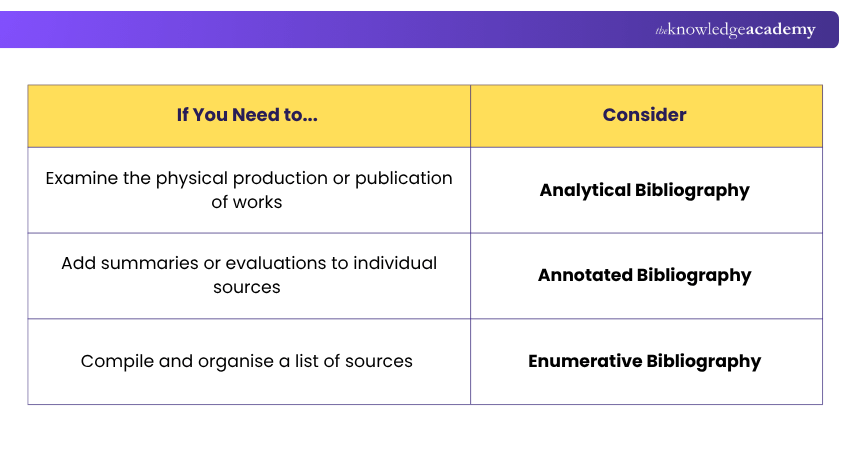
Different types of bibliographies are used for various academic projects. For instance, your computer science professor might ask for an annotated bibliography explaining why you chose each source you used. Here are the main types:
1) Analytical Bibliography
This type examines the physical features and production of books or other published works. It may consider details such as paper, printing, binding, typography, illustrations, and different editions to understand how a work was produced and transmitted.
2) Annotated Bibliography
An annotated bibliography includes brief notes that summarise, describe or evaluate individual sources. These notes summarise or reflect on the source, usually a few sentences long. Unlike a literature review, which synthesises information and ideas across multiple sources, an annotated bibliography presents individual sources with brief descriptions, summaries, evaluations, or comments on their relevance.
3) Enumerative Bibliography
This type lists and organises sources according to a defined scope or purpose. It can be arranged alphabetically by the author's last name or categorised by topic or language. This structure makes it easier for readers to quickly locate and review the reference materials. There are four main categories of enumerative bibliographies used for research works. They are:
a) National Bibliography
This type lists publications associated with a particular country, usually within a defined period. Entries may be organised by author, subject, publication date, or another established system.
b) Personal Bibliography
A personal bibliography collects works by, and in some cases works about, a specific author or individual. It may include rare or unpublished works that are not easily accessible elsewhere.
3) Corporate Bibliography
In a corporate bibliography, sources are grouped based on their connection to a particular organisation. These sources might be published by, about, or owned by that organisation.
4) Subject Bibliography
This type organises works based on their subject matter. It may include both primary and secondary sources related to a particular field or topic.
Other Types of Bibliographies
Sometimes, you might need to use a different type of bibliography. Here are two common ones:
1) Single-author Bibliography
This type lists works by one author. For example, if your research focuses on the works of one author, your bibliography may bring those works together in one organised list. You can arrange them by publication date or alphabetically by title.
2) Selected Bibliography
A selected bibliography only includes some of the sources you used, typically the most important ones. You might use this format when you want to present only the most relevant or important sources from a much larger body of material. It can also be annotated to explain why each source was chosen.
Perfect your writing with precision with the Proofreading Course – Join now!
How to Write a Bibliography?
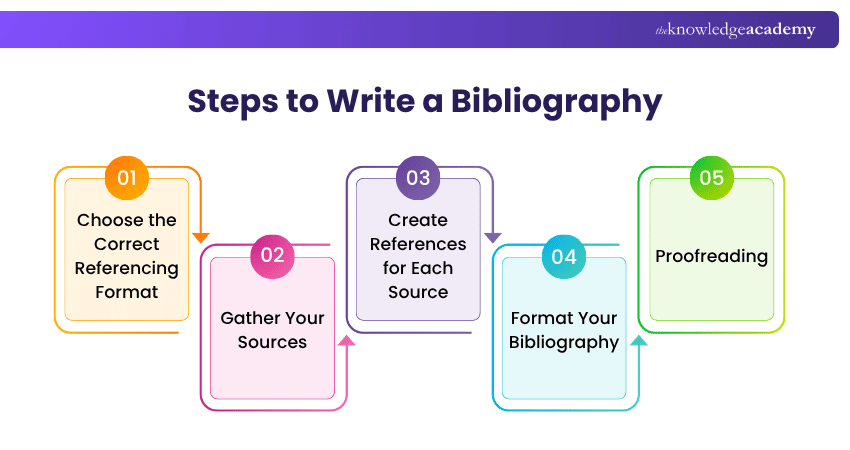
Writing a bibliography properly requires you to follow a few simple steps to make the process clear and manageable. Let's look at the steps below to help you create an accurate bibliography and understand what is a bibliography effectively:
1) Choose the Correct Referencing Format
Identify the referencing style required for your work, such as American Psychological Association (APA), Modern Language Association (MLA), or Harvard. Each style has its own rules for formatting sources. So, understanding these guidelines ensures consistency throughout your bibliography.
2) Gather Your Sources
As you research, keep a record of every source you use, including books, articles, and websites. Also, note key details, such as author names, titles, publication dates, and page numbers, to avoid any missing information later.
Bonus Tip
Record source details as you research rather than waiting until your work is complete. Keeping author names, titles, publication details, page numbers, URLs, or DOIs together can make your bibliography easier to compile and reduce missing information.
3) Create References for Each Source
After using your chosen referencing style, write a complete reference for every source you collected. Ensure that every essential detail is included and presented in the correct order, as required by the format.
4) Format Your Bibliography
Arrange all entries alphabetically by the author's surname or as specified by your referencing style. It is crucial to maintain consistent formatting, including the use of italics, punctuation, and spacing, to keep your bibliography clear and professional.
5) Proofreading
Finally, carefully proofread your bibliography to check for errors or inconsistencies. Verify spellings, formatting, and details for each reference to ensure accuracy and alignment with the chosen style.
Bibliography Checklist
Before finalising your bibliography, check that you have:
□ Included all the required sources.□ Used the required referencing style.□ Added the necessary details for each source type.□ Followed the correct order and formatting.□ Checked names, dates, titles, URLs, and other source details.□ Proofread all entries for accuracy and consistency.
Craft reports that inform, persuade, and deliver! Learn how to do it in the Report Writing Course - Sign up now!
Common Mistakes When Creating Your Bibliography
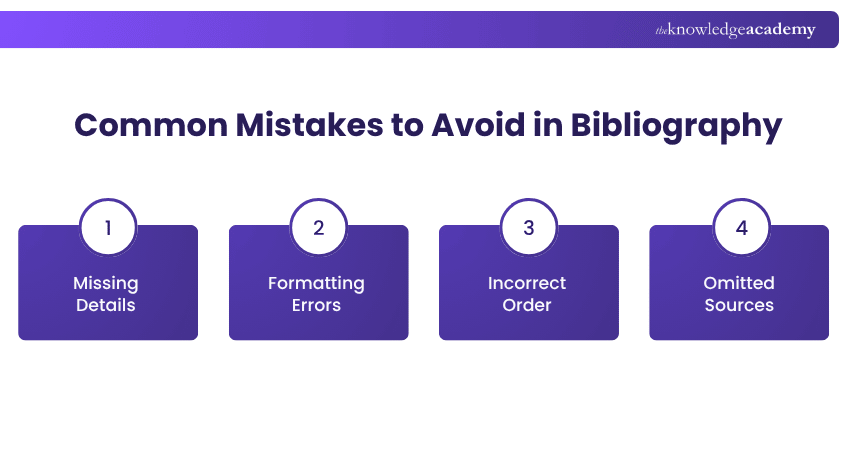
Making a bibliography is important for any academic or research project because it shows the sources that support your work. Yet, many students and even experienced researchers often struggle to put it together correctly. Here are some common mistakes to avoid:
1) Missing Details
Make sure each reference includes the information required for that source type and referencing style. This may include details such as the author's name, title of the work, publication date, publisher, DOI, or URL. Missing any of these details can confuse readers and undermine the credibility of your research.
2) Formatting Errors
Consistency is key when formatting your bibliography. Stick to one citation style, such as APA, MLA, or Chicago. Mixing formats can seem unprofessional and make your references difficult to follow.
3) Incorrect Order
Organise your entries according to the rules of your chosen referencing style, which commonly involves arranging them alphabetically by the author's surname.
4) Omitted Sources
Double-check that all sources required by your chosen referencing style or assignment guidelines are included in the final source list. Overlooking even one source can lead to incomplete documentation and may raise questions about the accuracy of your research.
What are the Different Bibliography Styles?
When creating a bibliography, it is important to use the correct referencing style based on your academic or professional requirements. Let's look at them below to better understand what is a bibliography:
1) MLA Reference Order
Modern Language Association (MLA) style is commonly used in humanities subjects like literature and the arts. It focuses on presenting source details in a clear and simple format for easy reading.
Reference Structure for a Basic Book:
a) Author's name (surname first)
b) Title of the source
c) Publisher name
d) Publication date
2) APA Reference Order
American Psychological Association (APA) style is widely used in social sciences and emphasises clarity and consistency in referencing. It includes specific formatting for dates and author names.
Reference Structure for a Basic Book:
a) Author's last name
b) Author's initial(s)
c) Publication date (in brackets)
d) Title of the source
e) Publisher name
f) DOI or URL, where applicable
3) MHRA Reference Order
The Modern Humanities Research Association (MHRA) style is used in humanities subjects and presents information in a slightly different order compared to other styles.
Reference Structure for a Basic Book:
a) Author's name
b) Title of the source
c) Place of publication
d) Publisher name
e) Publication date
Referencing Styles at a Glance
|
Style
|
Commonly Associated With
|
|
MLA
|
Humanities, especially language and literature
|
|
APA
|
Social and behavioural sciences and other academic disciplines
|
|
Harvard
|
Academic writing across a range of disciplines, depending on institutional requirements
|
|
MHRA
|
Humanities, particularly arts and humanities research
|
Grow skills that shape your future with Personal Development Courses – Sign up now!

Aishwarya Unni is a Copywriter with 2+ years of experience in reporting, web content, blogs, email marketing, and case studies. Her journalism background, combined with her research and writing experience across Business Skills and Human Resources, helps her create clear, engaging content for different audiences.
View Detail

 If you wish to make any changes to your course, please


