


 Top Rated Course

We may not have the course you’re looking for. If you enquire or give us a call on 01344203999 and speak to our training experts, we may still be able to help with your training requirements.
Volume of a Cylinder: A Complete Guide
The Knowledge Academy 15 July 2026The Volume of Cylinder is the space occupied by it in three-dimensional space or the total capacity of the cylinder measured in cubic units like cm³, mm³, m³ or ft3. This blog thoroughly explores the steps to calculate the Volume of a Cylinder with easy-to-follow examples and explanations. Continue reading to learn more!

Training Outcomes Within Your Budget!
We ensure quality, budget-alignment, and timely delivery by our expert instructors.
Table of Contents
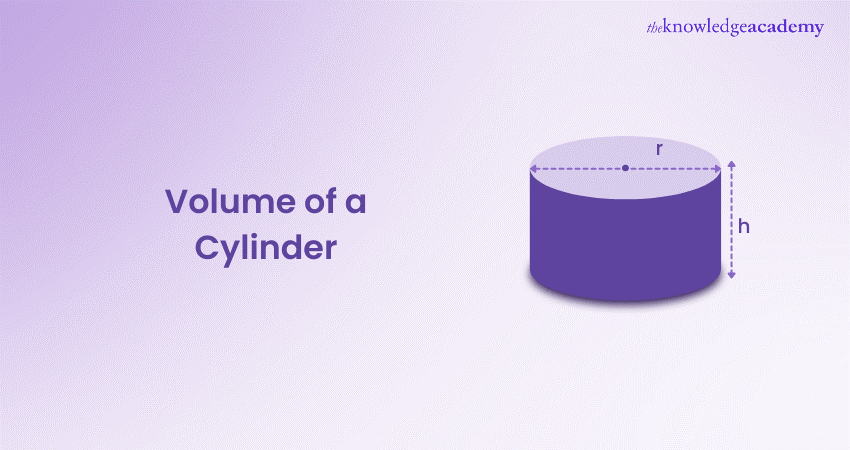
Have you ever stared into a tall glass, wondering exactly how much juice (or cocktail) it could hold? Or maybe you're designing a gift box and need to calculate the perfect size. The answer to these questions lies in unlocking the calculations of Volume of a Cylinder.
This seemingly complex concept can be mastered with a simple formula and a few practical examples. In this blog, we'll break down everything you need to know about calculating the Volume of a Cylinder, transforming you from a geometry novice to a volume-measuring pro!
Table of Contents
1) What is the Volume of a Cylinder?
2) How to Calculate the Volume of a Cylinder?
3) Volume of Cylinder Examples
4) What is the Area of the cylinder?
5) How to Calculate the Volume of Gas in a Cylinder?
6) Conclusion
What is the Volume of a Cylinder?
The volume of a cylinder refers to its capacity that determines the amount of material it can hold. A specific formula is used to calculate the cylinder’s volume, helping to measure how much of a substance, whether liquid or solid, can be uniformly contained within it. Basically, a cylinder is a three-dimensional shape with two identical, parallel bases. Similarly, the volume of a Cone is determined by its base area and height, providing an interesting contrast in shape.

How to Calculate the Volume of a Cylinder?
The basic steps to calculate the Volume of a Cylinder are:
1) Find the radius of the circular base.
2) Calculate the circular base area using the formula A = πr2.
3) Find the height of the cylinder.
4) Multiply the base area by the height to get the cylinder's volume.
Cylinders are fundamental shapes in geometry and various practical applications. Calculating their volume is crucial in fields like Engineering, Manufacturing, and Architecture. Let us look at the different types of cylinders and their respective volume calculation formulas.
Volume of a Right Circular Cylinder
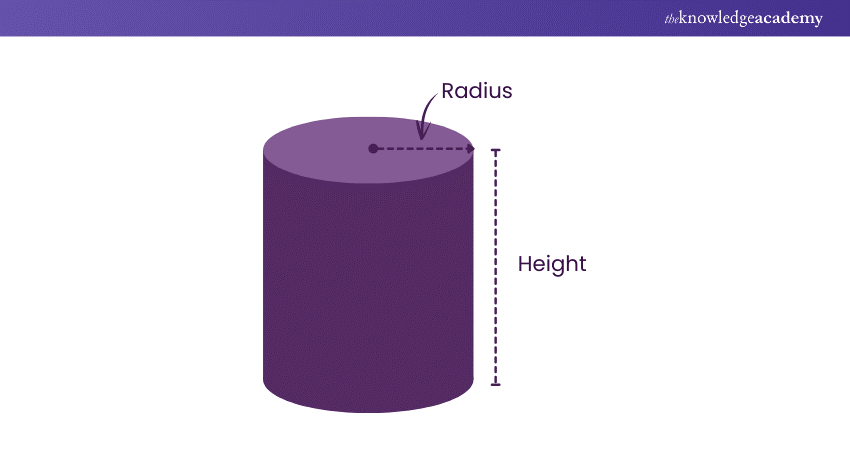
The right circular cylinder is the most common type. It has two parallel circular bases and a perpendicular height connecting them. The formula for calculating the volume (V) of a right circular cylinder is:

where:
a) r is the radius of the base
b) h is the height of the cylinder
c) π (pi) is approximately 3.14159
Unlock the secrets of geometry, refer to our blog on Volume of a Cuboid.
Volume Determination Formula for an Oblique Cylinder
An oblique cylinder is a cylinder where the sides are not perpendicular to the bases, making it appear slanted. Despite its tilted appearance, the volume formula remains the same as for a right circular cylinder, because volume is a measure of the space occupied and doesn’t depend on the slant.
The volume formula for an oblique cylinder is:

This is because the Area of a Cylinder, specifically its base area, along with the height, determines the volume. The height (h) in this formula is the perpendicular distance between the bases, not the length of the slanted side.

Volume Calculation Formula for an Elliptic Cylinder
An elliptic cylinder has elliptical bases instead of circular ones. The formula for calculating the volume of an elliptic cylinder involves the semi-major axis (a) and the semi-minor axis (b) of the ellipse, along with the height (h).
The volume formula for an elliptic cylinder is:

where:
a) a is the semi-major axis
b) b is the semi-minor axis
c) h is the height

Volume Formula for a Right Circular Hollow Cylinder
A right circular hollow cylinder, also known as a cylindrical shell, is a cylinder with a hollow center. It’s defined by two radii: the outer radius (R) and the inner radius (r), and the height (h).
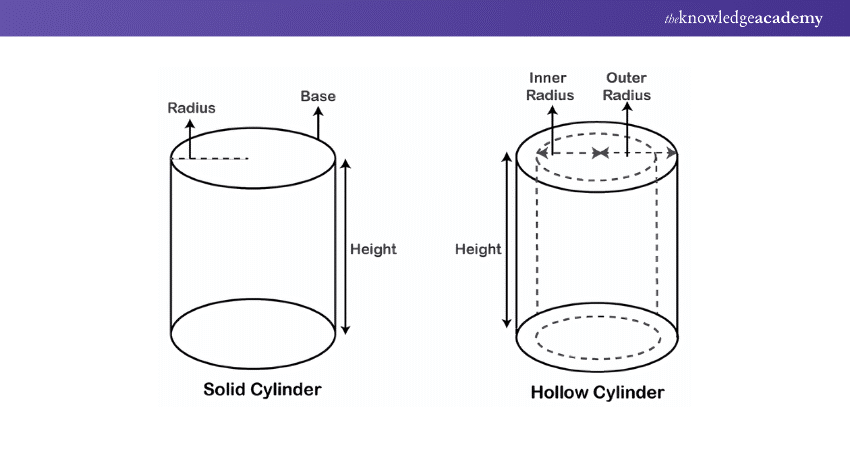
The volume formula for a right circular hollow cylinder is:

This formula accounts for the volume of the material making up the cylinder by subtracting the inner cylinder's volume from the volume of the outer cylinder.

Unlock your potential! Register for our Personal Development Courses today to enhance your skills, boost your confidence, and realise your goals.
Volume of a Cylinder in Litres
To convert the volume of a cylinder from cubic centimetres (cm³) to litres, use the conversion:
1 litre = 1000 cm³.
For example: if a cylinder has a height of 100 cm and radius of 120 cm,
Then Volume will be: V=22/7×120×120×100
V= 4,525,714.28 cm2
To convert litres to US gallons: Divide by 3.785 , To convert Litres to UK Gallons: Divide by 4.546
Volume of Cylinder Examples
These examples are a step-by-step demonstration on how to calculate the area of a cylinder. Let’s dive in
Example 1
Let's calculate the volume of a right circular cylinder with 4 units of radius and height of 10 units.
Step-by-step Calculation:
a) Identify the Radius and Height:
Radius (r) = 4 units
Height (h) = 10 units
b) Use the Volume Formula

c) Calculate the Base Area

d) Multiply by π: 16π
e) Multiply by the Height

The volume of the cylinder is 160π cubic units, which is approximately 502.65 cubic units
Example 2
Let's calculate the Volume of a Cylinder with a diameter of 6 units and a height of 15 units.
Step-by-step Calculation:
a) Convert Diameter to Radius
Diameter (d) = 6 units

b) Identify the Height
Height (h) = 15 units
c) Use the Volume Formula

d) Calculate the Base Area

e) Multiply by π: 9π
f) Multiply by the Height

The volume of the cylinder is 135π cubic units, which is approximately 424.12 cubic units.
Sharpen Your Skills. Train to Become a Top Engineer. Join our Engineering Skills Training now!
What is the Area of the Cylinder?
The surface area of a cylinder is the total space it occupies in three dimensions. It is determined by summing the areas of its two circular bases and its curved surface area.
How to Calculate Volume of Gas in a Cylinder?
To determine the volume of gas in a cylinder, use the Ideal Gas Law (PV=nRT). In a high-pressure cylinder, the volume is influenced by the compressibility factor (Z), modifying the equation to PV=ZnRT, where:
1) P is pressure
2) V is volume
3) n is the number of moles
4) R is the gas constant
5) T is the absolute temperature
Conclusion
The Volume of a Cylinder can be quantified through various formulas depending on its type. The right circular cylinder’s volume is straightforward using radius and height. For an oblique cylinder, the same formula applies. An elliptic cylinder requires knowledge of the semi-major and semi-minor axes. When calculating the Volume of Hemisphere, similar principles of geometry come into play, especially for spherical or hemispherical shapes. Finally, a right circular hollow cylinder uses both inner and outer radii. The Base Area of Cylinder plays a crucial role in these calculations, as understanding these formulas allows for accurate volume calculation across different cylindrical shapes, which is crucial in many practical and theoretical applications.
Take charge of your future! Join our Career Development Course today and unlock the skills and strategies to advance your professional journey.
Frequently Asked Questions
What is the Total Surface Area of a Cylinder?

The total surface area of a cylinder is the summation of the lateral surface area and area of the cylinder's two circular bases. The formula for TSA is:
Total Surface Area = Lateral Surface Area + 2πr², where r is the radius of the cylinder's base.
Do Three Cones Equal a Cylinder?
No, three cones won't necessarily equal a cylinder. It depends on their sizes and shapes. They could hold more or less volume than the cylinder.

The Knowledge Academy


Global Training Provider
The Knowledge Academy is a world-leading provider of professional training courses, offering globally recognised qualifications across a wide range of subjects. With expert trainers, up-to-date course material, and flexible learning options, we aim to empower professionals and organisations to achieve their goals through continuous learning.


 If you wish to make any changes to your course, please


