




We may not have the course you’re looking for. If you enquire or give us a call on 01344203999 and speak to our training experts, we may still be able to help with your training requirements.
What is Verbal Communication: A Complete Guide
ByAkhil KLast updated on: 18 September 2026
Verbal communication involves using spoken words to exchange ideas, information, and feelings through conversations, calls, meetings, presentations, and similar interactions. Effective verbal communication supports clearer understanding, stronger relationships, and better collaboration.
Quick Snapshot
1. Verbal Communication uses spoken words to exchange information, ideas, thoughts, and feelings.2. It includes forms such as face-to-face conversations, meetings, presentations, phone calls, and video calls.3. Effective verbal communication depends on clarity, tone, vocabulary, listening, and appropriate delivery.4. It helps improve understanding, collaboration, decision-making, and relationship-building.5. Common barriers include unclear language, poor listening, differences in tone, distractions, and misunderstandings.
Ever said something and wished you could take it back? Or struggled to find the right words in a tough moment? We have all been there, and that is where verbal communication makes the difference. It helps you express yourself clearly, build trust, share ideas, and connect better with people who matter most.
In this blog, we will explore what is verbal communication and why it is important in daily life. You will learn its types and styles, how it differs from non-verbal communication, and simple ways to improve your speaking and listening for more confident, engaging conversations. So, read on!
What is Verbal Communication?
Verbal communication is the use of spoken language to exchange ideas, information, thoughts, and feelings. It can take place through face-to-face conversations, phone or video calls, meetings, presentations, speeches, and other spoken interactions.
Effective verbal communication involves more than choosing the right words. Tone, pace, volume, pronunciation, clarity, and listening can all influence how a message is understood.
Why is Verbal Communication Important?
Verbal communication plays an essential role in how people share ideas, express feelings, and exchange information in everyday life. It enables one to express ideas in an understandable manner, listen to people, and react positively in a conversation. Good verbal communication in personal and professional settings aids in teamwork and enables individuals to build deeper relationships.
Here are the reasons why it matters:
1) Expression of Ideas: It allows people to convey ideas, opinions, and information in a clear and ordered manner allowing other people to grasp the message easily.
2) Improved Understanding: Conversations and discussions enable people to ask questions, seek clarification and also develop a clearer understanding of different viewpoints.
3) Stronger Relationships: Effective verbal communication helps build trust and understanding, making it easier for people to connect and maintain positive relationships.
4) Professional Communication: Verbal communication in the workplace encourages collaboration, teamwork, and allows professionals to exchange ideas, receive feedback, and support organisational objectives.
Types of Verbal Communication
Verbal communication may take various forms based on the situation and number of people. Each type plays a unique role in how individuals share ideas, exchange information, and interact with others. Some of the typical verbal communication types are as follows:
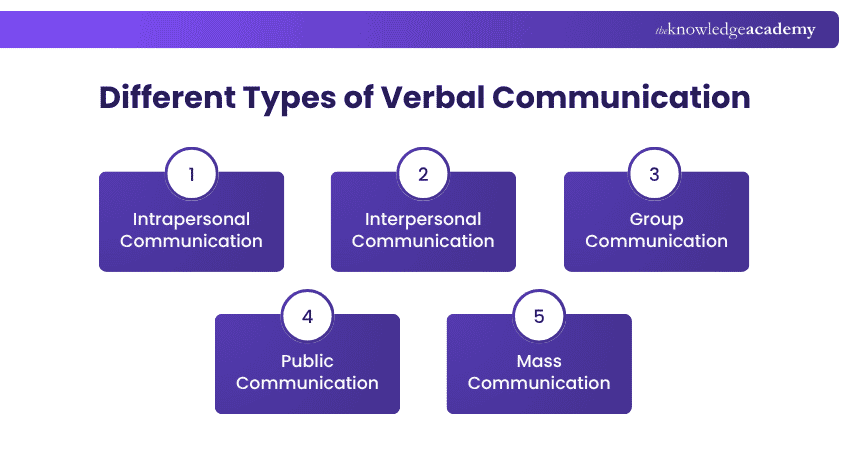
a) Intrapersonal Communication: Intrapersonal communication involves internal dialogue or self-talk. It may occur silently as thought or through spoken self-talk and helps individuals organise ideas, reflect on experiences, and make decisions. This kind of self-discussion assists individuals in structuring their thoughts, analysing alternatives, and planning for various events.
b) Interpersonal Communication: Interpersonal communication is the process that occurs between two or more individuals. It is often observed in our daily conversations, when we talk to colleagues, or even when communicating with friends and family. Good interpersonal communication means speaking clearly, listening, and responding accordingly to facilitate understanding.
c) Group Communication: Group communication takes place when multiple individuals are communicating in a team meeting, classroom discussion, or collaborative project. Here, the participants share ideas, comments, and collaborate towards a common goal. Effective communication also aids in making sure that each person knows their roles and responsibilities.
d) Public Communication: Public communication refers to addressing a wider audience like in presentations, speeches, or seminars. It involves clear communication, framed messages and confidence in order to inform or persuade listeners effectively.
Good oratory skills are useful in making presenters articulate their ideas in a way that attracts their audience. Moreover, public speaking skills can help inspire, persuade, and influence others, making it an essential skill in various professional and social settings.
e) Mass Communication: Mass verbal communication employs the means of television, radio, podcasts, or online broadcasts and reaches a vast number of people. It is widely employed to deliver information, news, or messages to a large group of people, and, in this case, well-crafted material and effective delivery are needed to convey the message.
Develop the ability to engage and inspire any audience through our Public Speaking Course – Register today!
Four Styles of Verbal Communication
People communicate in different ways depending on their personality, situation, and relationship with others. The four common styles of verbal communication reflect different approaches to expressing thoughts, needs, and opinions. Let's explore them below:
Style 1: Assertive Communication
Assertive communication involves the clear and respectful expression of one's thoughts, feelings, and needs. It values the rights and opinions of both oneself and others. Being assertive means expressing yourself honestly and respectfully, without being passive or aggressive.
An assertive communicator strives to communicate honestly and directly while also actively listening to others. This style fosters healthy communication, promotes understanding, and helps resolve conflicts constructively. It is considered one of the most effective forms of communication for building positive relationships and achieving mutual goals.
Style 2: Aggressive Communication
An aggressive style of communication is characterised by the use of forceful and confrontational language. Individuals employing this style often dominate conversations, disregard others' opinions, and may resort to shouting or verbal attacks. This approach can lead to hostility and conflict in communication, making it less effective for productive dialogue.
Style 3: Passive Communication
A passive style of communication involves a reluctance to express one's own opinions or needs. Individuals using this style often avoid confrontation, but this can lead to poor self-advocacy and misunderstandings. While it may prevent immediate conflict, it can result in unmet personal needs and desires.
Style 4: Passive-aggressive Communication
The passive-aggressive communication style combines indirect expression with underlying frustration or hostility. In this approach, individuals may use sarcasm, backhanded compliments, or subtle sabotage to express their displeasure or frustration. It often creates confusion and can damage relationships due to hidden resentment, as true feelings are not openly communicated.
Message Makeover
Which response is clearer and more constructive?
A) “This doesn’t make sense.”B) “Could you clarify this point with an example?”Answer: B) It communicates the concern directly while encouraging clarification.
How to Improve Your Verbal Communication Skills?
Improving verbal communication takes consistent practice, active listening, and greater awareness of how your message is delivered. The following techniques can help you communicate more clearly and confidently:
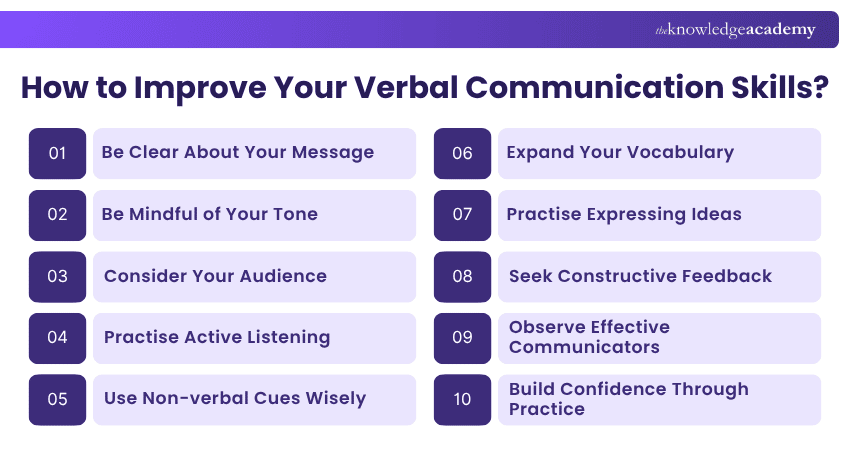
1) Be Clear About Your Message: Organise your thoughts and use simple, direct language.
2) Be Mindful of Your Tone: Adjust your tone, pace, and volume to suit the situation.
3) Consider Your Audience: Adapt your words and level of detail to the listener.
4) Practise Active Listening: Pay attention, avoid interrupting, and ask questions when needed.
5) Use Non-verbal Cues Wisely: Support your words with appropriate eye contact, posture, and gestures.
6) Expand Your Vocabulary: Learn new words while keeping your language clear and relevant.
7) Practise Expressing Ideas: Use conversations and presentations to improve clarity and fluency.
8) Seek Constructive Feedback: Ask trusted people where your communication could improve.
9) Observe Effective Communicators: Notice how skilled speakers structure ideas and engage listeners.
10) Build Confidence Through Practice: Practise speaking in different situations to reduce nervousness and improve confidence.
Pro Tip: Record a short practice conversation or presentation. Listening back can reveal unclear wording, rushed delivery, filler words, or tone issues that are difficult to notice while speaking.
What are the Differences Between Verbal and Non-verbal Communication?
Let’s discuss some of the key differences between verbal and non-verbal communication:
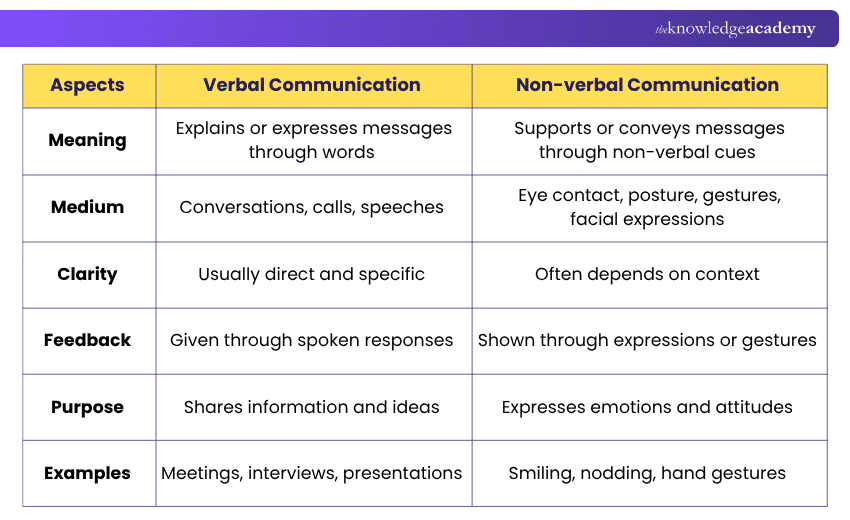
Verbal communication uses spoken words to share ideas, information, and feelings. It is commonly used in conversations, meetings, interviews, presentations, and phone calls, making it suitable for explaining detailed or specific information clearly.
Non-verbal communication conveys messages without spoken words through facial expressions, gestures, posture, eye contact, and other visual cues. It often supports verbal communication by showing emotions, attitudes, and reactions, although its meaning can depend heavily on the context.
Learn how nonverbal cues influence communication with our Nonverbal Communication Training – Sign up soon!
Five Basic Elements of Verbal Communication
Verbal communication has five basic elements that make talking clear and easy to understand. Those elements include:
a) Sender: The person who starts the conversation and shares an idea or message.
b) Message: The information or thought that the sender wants to share.
c) Medium: The channel used to deliver the spoken message, such as face-to-face conversation, a phone call, or a video meeting.
d) Receiver: The person who listens to and interprets the spoken message.
e) Feedback: The receiver’s response that shows understanding, like nodding or replying
These five parts help people communicate clearly and understand each other better.
Examples of Verbal Communication in the Workplace
Verbal communication is used across the workplace to share information, coordinate tasks, give feedback, and support decision-making. Common examples include:
1) Team Meetings: Sharing updates, discussing tasks, and coordinating responsibilities.
2) One-to-one Conversations: Discussing performance, expectations, concerns, or development.
3) Presentations: Explaining ideas, proposals, findings, or project updates.
4) Phone Calls: Exchanging information quickly with colleagues, clients, or suppliers.
5) Video Conferences: Collaborating with remote teams and discussing work in real time.
6) Interviews: Asking and answering questions to assess suitability or gather information.
7) Briefings: Providing concise instructions, updates, or important information.
8) Customer Discussions: Understanding needs, explaining solutions, and addressing queries.
Strengthen workplace communication with our Business Communication Course and communicate ideas clearly, professionally, and confidently.

Akhil K is a Copywriter and Video Editor with experience in content creation, visual storytelling, advertising and brand communication. His background in journalism, research and audience-focused communication strengthens his ability to create clear and engaging Business Skills content.
View Detail

 If you wish to make any changes to your course, please


