


 Top Rated Course


We may not have the course you’re looking for. If you enquire or give us a call on 01344203999 and speak to our training experts, we may still be able to help with your training requirements.
Different Types of Engineering and What They Do
The Knowledge Academy 16 July 2026Types of Engineering include chemical, civil, electrical and mechanical, as well as modern areas like aerospace, biomedical and Environmental Engineering. Engineering refers to the practical application of scientific and mathematical principles to design, build and optimise structures, machines, systems, and processes.

Training Outcomes Within Your Budget!
We ensure quality, budget-alignment, and timely delivery by our expert instructors.
Table of Contents

More than equations and blueprints, Engineering is the innovative force that shapes the world around us. From designing skyscrapers to producing life‑saving medical devices, the different Types of Engineering bring unique flavours to innovation. So, behind every mind-blowing technology, stands a specialised Engineer solving unique challenges.
Whether it’s the quiet precision of electrical circuits or the bold ambition of aerospace exploration, each field solves problems in uniquely brilliant ways. In this blog, we’ll unravel the diverse Types of Engineering and discover what each one does to keep our world moving forward. So read on!
Table of Contents
1) What is an Engineer?
2) Major Branches of Engineering
3) What Other Types of Engineering are There?
4) How to Choose the Right Engineering Discipline?
5) Future of Engineering
6) Conclusion
Who is an Engineer?
An Engineer is a professional who applies scientific principles, and Mathematics to design, develop and improve systems, structures, machines and processes. They can solve real-world problems by creating practical solutions that boost efficiency and innovation across industries such as technology, healthcare, construction, energy, and transportation. Their work often involves research, testing, analysis and collaboration to transform ideas into functional products that benefit society.

Major Branches of Engineering
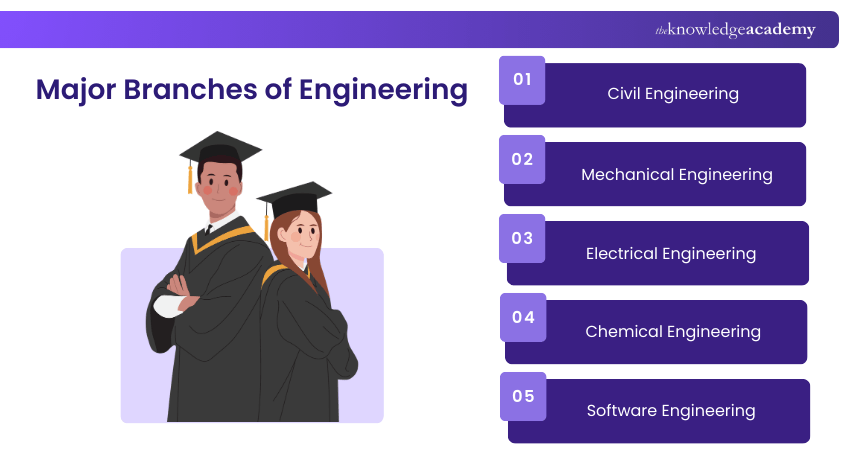
Many sources acknowledge five to six main Types of Engineering, with the rest often categorised as subdivisions or closely linked to one of these types. Firstly, let's comprehend the primary ones.
1) Civil Engineering
Civil Engineers deal with the issues related to infrastructure. As mentioned by BLS, the range of projects they create, construct, and care for covers a variety of public and private sectors like bridges, roads, tunnels, dams, and water and sewer systems.
Civil Engineers were responsible for enabling the construction of infrastructure like the Brooklyn Bridge, the Erie Canal, and the Thames Tunnel in London. These three are only a few among many Civil Engineering landmarks listed. A Civil Engineer can earn an average yearly salary of £43K in the UK, $95k in the USA and ₹382K in India
Develop stronger self-awareness and better relationship skills with Emotional Intelligence Training – Begin now!
2) Mechanical Engineering
The majority of individuals typically envision a mechanical Engineer when thinking about an Engineer. They are liable for creating, constructing, and repairing mechanical systems like machines, tools, or engines. To attain that, you must entail and implement the fundamentals of Physics, Materials Science, and Mathematics.
Mechanical Engineering is the most versatile field of Engineering, providing several career opportunities to explore later. As a Mechanical Engineer, you have the opportunity to design a variety of things such as automobiles, aircraft, robots, medical devices, heating and cooling systems, power generation equipment, and more. A Mechanical Engineer in the UK can earn an average yearly salary of £42K, while those in the USA and India can earn $102K and ₹507K Respectively.
3) Electrical Engineering
The study of electricity, electronics and electromagnetism is known as Electrical Engineering. It includes understanding the workings of electricity to apply the information to Engineering tasks. Electrical Engineers shaped the 20th century by creating technologies that transform society.

Universal electric power, telecommunications, radio and television were provided to us by them. Today, we can utilise electronic monitoring, medical scanning, computers and the internet. An Electrical Engineer can earn an average yearly salary of £43K in the UK, $108K in the USA and ₹500K in India
4) Chemical Engineering
Chemical Engineering entails discovering methods to transform basic materials into final products using chemical processes. Therefore, Chemical Engineers must attain knowledge in Mathematics and Physics just like other Engineers, in addition to Chemistry and Biology.
A Chemical Engineer's duties involve refining petroleum to make fuels or plastics, producing pharma drugs, and developing renewable energy sources. A Chemical Engineer can earn an annual average salary of £37K in the UK, $87K in the USA and ₹469K in India.
5) Software Engineering
Software Engineering is viewed as a division of Computer Science in which Engineering principles are applied to create, construct, and upkeep computer software. A Software Engineer's role does not involve dealing with computer hardware, and they are not the same as a programmer, who focuses mainly on coding.
Software Engineers contribute to all stages of the Software Development process, from analysing requirements to designing system architecture, coding, and testing for functionality and quality. Consequently, a Software Engineer can earn an average yearly salary of £50K in the UK, $130K in the USA and ₹809K in India.
Strengthen Customer Relationships and boost loyalty with expert Customer Relation Management Training – Join now!
What Other Types of Engineering are There?
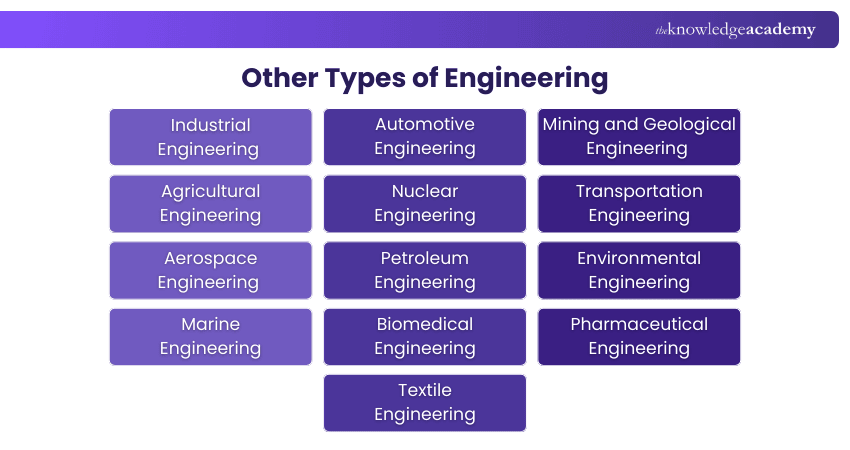
There is almost an equal number of Engineers as there are industries in general. Below is a summary of thirteen distinct categories in the field of engineering.
1) Industrial Engineering
Industrial Engineering concentrates on enhancing intricate systems and procedures across different sectors. This can be relevant to sectors such as manufacturing, services, transportation, healthcare, commerce, and more. The industrial Engineer works to enhance these systems or procedures by cutting costs, pinpointing bottlenecks, and minimising waste to increase efficiency.
2) Agricultural Engineering
Agricultural Engineering utilises Engineering concepts to enhance and create effective systems and machinery for agricultural production, focusing on aspects like designing machinery, irrigation systems, and managing crops.
3) Aerospace Engineering
Aerospace Engineering is a field of Engineering that deals with matters concerning travel within the atmosphere and outer space. In the field of Aerospace Engineering, you would be responsible for creating, advancing, and producing airplanes, spacecraft, satellites, and other technologies related to flight. There are two main divisions in this field: Aeronautical and Astronautical Engineering.
4) Marine Engineering
Marine Engineering manages the creation and building of marine crafts and constructions, like submarines, ships, and boats. Marine Engineers are immersed in several projects related to ships and other maritime amenities. Commonly, Marine Engineers perform various functions on ships, so being ready to work at sea for extended periods is an essential angle to think about if you're interested in following this field of study.
5) Automotive Engineering
The field of Automotive Engineering revolves around creating and maintaining vehicles: it encompasses the processes of designing, advancing, and maintaining. It’s a particular field of Engineering that involves principles from Mechanical Engineering as well as Electrical, Software and Safety Engineering.
6) Nuclear Engineering
The field of Nuclear Engineering involves researching and utilising nuclear processes and technologies for power generation, radiation detection and nuclear medicine, with an emphasis on safety, Waste Management, and efficient use of resources.
Learn how to practice good gestures, expressions, and posture with our Understanding Body Language Training – Sign up soon!
7) Petroleum Engineering
Petroleum Engineering includes the process of searching for, extracting, and producing oil and gas reserves, necessitating knowledge in reservoir assessment, drilling methods and production enhancement to guarantee effective and environmentally friendly petroleum activities.
8) Biomedical Engineering
Biomedical Engineering applies Engineering principles and technologies to create and enhance medical devices, equipment, and healthcare systems to improve patient care and outcomes.
9) Mining and Geological Engineering
The field of Mining and Geological Engineering focuses on extracting and processing minerals and other geological resources. It involves expertise in mine planning, Geotechnical Engineering and Environmental Management to ensure safety and efficiency.
10) Transportation Engineering
Transportation Engineering focuses on creating, building, and managing transportation networks for both passengers and cargo. It consists of air, rail, highway, road and pipeline transportation. Engineers are accountable for improving the efficiency of traffic flow and ensuring safety.
It is important for them to take into account the environment, as well as national and local laws, and the use of energy and its effect on climate change when it comes to transportation.
11) Environmental Engineering
Environmental Engineering uses Engineering concepts to address environmental problems such as pollution, creating renewable energy sources, and managing waste. Your knowledge base should encompass Soil Science, Chemistry, and Biology as well.
12) Pharmaceutical Engineering
Pharmaceutical Engineering combines Chemical Engineering principles with Biotechnology and Industrial Engineering to create new medicines and balance the secure production and delivery of these medications. Pharmaceutical Engineers plan thorough research on current drugs and their effect before starting the development of new medication.
13) Textile Engineering
Textile Engineering focuses on producing and upgrading textile goods. People working in this field use fibres, threads, textiles, and other elements to create various products, including materials for medical equipment, fireproof fabrics for fire fighters, and biomedical materials for medical purposes. The procedure involves choosing raw materials, perfecting manufacturing methods, and producing textile goods.
How to Choose the Right Engineering Discipline?
Selecting the right Engineering field begins with understanding both your interests and the opportunities available around you. Now that you have a better grasp on the various Types of Engineering, here are some things to consider:
1) Assess Your Interests: If you enjoy solving environmental challenges, environmental or Civil Engineering may suit you. Those fascinated by healthcare and Biology can explore biomedical or Biotechnology Engineering. If innovation in vehicles excites you, automotive or Aeronautical Engineering could be ideal.
2) Recognise Your Strengths: Detail-oriented individuals may thrive in systems or computer engineering. Those who enjoy building and experimenting might prefer mechanical, materials or Manufacturing Engineering.
3) Learn From Professionals: Speaking with experienced Engineers can provide valuable insights into daily work, career progression, and real-world industry expectations.
4) Explore Industry Demand: Fields such as software and Biotechnology continue to grow and often provide strong long-term career prospects.
5) Consider Interdisciplinary Roles: Modern Engineering frequently blends multiple domains. Areas like mechatronics or green energy combine technical expertise with skills such as Project Management.
Future of Engineering
Here are some promising trends in Engineering ready to shape the future:
1) Rapid Adoption of AI and Automation: Engineering industries are increasingly integrating artificial intelligence, robotics, and automation to improve productivity.
2) Rise of Digital Workers and AI Collaboration: AI-powered digital assistants are becoming part of the workforce. They help Engineers manage tasks across operations, finance, supply chains and Risk Management.
3) Greater Use of Data for Smarter Decisions: Companies are investing heavily in consolidating and analysing data to support intelligent decision-making and improve project planning.
4) Strong Global Growth in Engineering Projects: Infrastructure expansion, housing demand, renewable energy development and data-centre construction are driving industry growth worldwide.
Conclusion
Selecting a suitable Engineering specialisation is an essential step that influences your future professional journey. If you are dedicated to creating reliable solutions, designing cutting-edge technology, enhancing infrastructure, or diving into Requirements Engineering writing to define system specifications, there is a field that’ll suits your interests and skills. So, make the right choice among the various Types of Engineering and unlock the power to shape the future!
Elevate your personal and professional skills today with Personal Development Courses. Register Now!
Frequently Asked Questions
What is the Highest Paid Engineer?

The highest-paid engineers typically work in specialised fields such as petroleum, software or Aerospace Engineering. The salaries are heavily influenced by location, experience and industry demand.
What is the Hardest Engineering Degree?
Chemical Engineering is often cited as one of the most challenging Engineering degrees due to its multidisciplinary nature. It integrates Advanced Chemistry, Physics and Mathematics with core Engineering concepts. It requires students to understand topics such as Thermodynamics, Fluid Dynamics and Chemical Kinetics.

The Knowledge Academy


Global Training Provider
The Knowledge Academy is a world-leading provider of professional training courses, offering globally recognised qualifications across a wide range of subjects. With expert trainers, up-to-date course material, and flexible learning options, we aim to empower professionals and organisations to achieve their goals through continuous learning.


 If you wish to make any changes to your course, please


