




We may not have the course you’re looking for. If you enquire or give us a call on 01344203999 and speak to our training experts, we may still be able to help with your training requirements.
Theories of Entrepreneurship: Major Theories Explained
ByNaveena VenkatesanLast updated on: 02 October 2026
Explore the major theories of entrepreneurship that shape how entrepreneurs identify opportunities, innovate and build ventures.

Understanding what drives individuals to start businesses and how they achieve success has led to the development of multiple theories of entrepreneurship. They offer varying perspectives on what propels entrepreneurial success. The notion of creativity under this massive rock addresses the multifaceted nature of entrepreneurship.
Furthermore, these theories of entrepreneurship provide diverse perspectives on the motivations, behaviours, and characteristics of entrepreneurs. Read further to gain all necessary insights!
What is Entrepreneurship?
Entrepreneurship is the process of identifying, developing and pursuing opportunities to create economic or social value, often through new ventures, products, or services. It commonly involves organising resources and making decisions under risk or uncertainty.
Entrepreneurial ventures are often driven by innovation and the ability to identify market opportunities. Entrepreneurship involves developing, organising, and running a business amid uncertainty, with the aim of creating long-term growth and profitability.

Significance of Theories in Understanding Entrepreneurship
Theories of entrepreneurship offer a framework for understanding the complex nature of entrepreneurial activities. This framework helps explain why certain individuals become entrepreneurs while others do not. They also examine factors that may contribute to the success or failure of new organisational ventures.
By studying these theories, one gains insights into the motivations, behaviours, and environmental conditions that influence entrepreneurial results. This understanding is crucial for policymakers, educators, and practitioners who aim to foster entrepreneurial ecosystems and support aspiring entrepreneurs.
Theories of Entrepreneurship
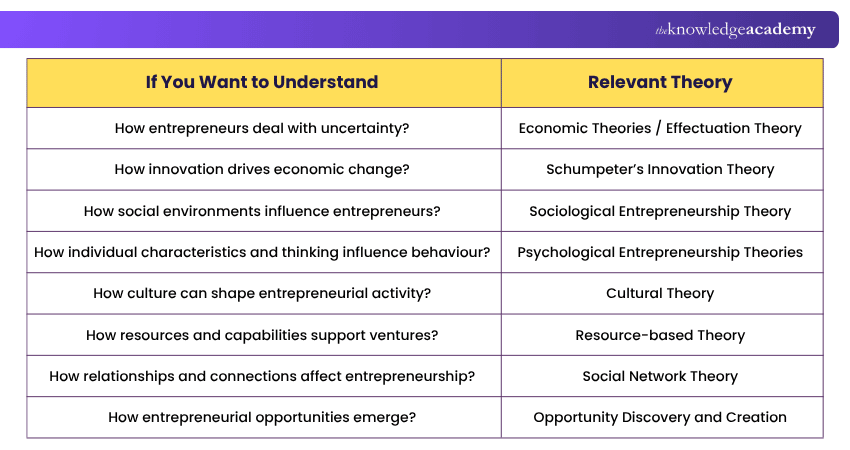
Each theory offers different insights and strategies associated with entrepreneurship. By applying these different views, one can develop a more detailed understanding of the entrepreneurial process. This creates a supportive environment that ensures innovation and economic growth. Below are some of the common theories:
1) Economic Theories of Entrepreneurship
Economic theories of entrepreneurship examine the economic roles of entrepreneurs. Richard Cantillon associated entrepreneurship with operating under uncertainty, while Frank Knight distinguished measurable risk from uncertainty and linked entrepreneurial profit to bearing uncertainty.
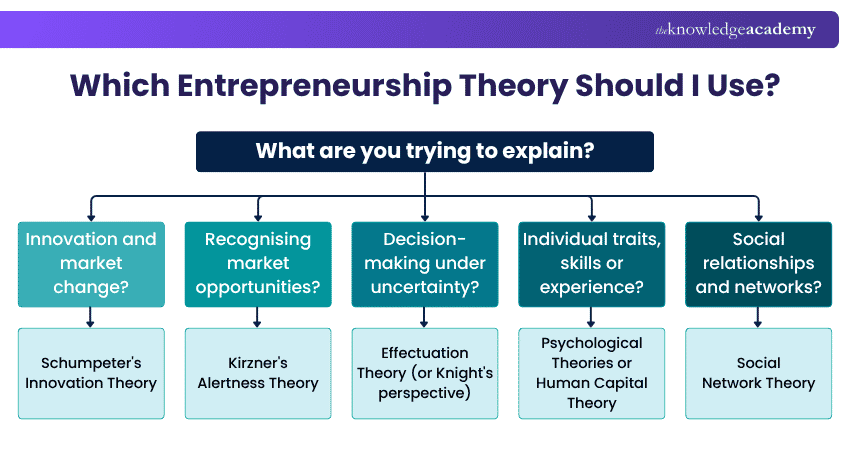
Other economic approaches focus on functions such as innovation and the recognition of market opportunities. These perspectives were developed more specifically by thinkers such as Joseph Schumpeter, who emphasised innovation, and Israel Kirzner, who focused on entrepreneurial alertness to market opportunities.
Trainer's Insight
In Frank Knight's perspective, risk involves outcomes whose probabilities can be estimated, while uncertainty involves outcomes that cannot be reliably predicted. This distinction matters because entrepreneurs make important business decisions under uncertainty, requiring judgement.
2) Sociological Entrepreneurship Theory
The sociological theories examine how social structures, community networks, and cultures influence entrepreneurial behaviour. This point of view suggests that entrepreneurship is not only an individual endeavour. It is shaped or rather influenced by the social environment.
Factors like family background, social status, and community support can impact an individual's likelihood of becoming an entrepreneur. Sociologists also study the role of social movements and collective action in fostering entrepreneurial activities within specific cultural or demographic groups.
3) Schumpeter's Entrepreneurship Innovation Theory
The innovation theory is primarily associated with Joseph Schumpeter. It says that entrepreneurship is fundamentally based on innovation. Entrepreneurs drive economic development by creating new products and processes. This can also include new markets and new forms of organisation.
Schumpeter viewed the entrepreneur primarily as an innovator who introduces new combinations into economic activity. Entrepreneurial innovation can disrupt existing technologies, products or ways of doing business. An economic process closely associated with Schumpeter's concept of creative destruction.
Trainer's Insights
Innovation does not have to mean inventing something completely new. From a Schumpeterian perspective, entrepreneurial innovation can also involve new combinations of existing resources, methods, markets or forms of organisation.
4) Psychological Entrepreneurship Theories
The psychological theories focus on the individual characteristics and mental processes that may influence entrepreneurial behaviour. Researchers have examined factors such as need for achievement, locus of control, risk propensity, self-efficacy and resilience in relation to entrepreneurial intentions and behaviour.
Cognitive approaches examine how entrepreneurs perceive and interpret information, recognise and evaluate potential opportunities, solve problems and make decisions. These psychological factors may influence entrepreneurial behaviour, but no single personality profile reliably determines whether an individual will become or succeed as an entrepreneur.
5) Cultural Theory
The cultural theories of entrepreneurship examine how cultural values, beliefs, and practices build entrepreneurial activities. Different cultures foster varying levels of entrepreneurial spirit based on their attitudes toward risk, innovation, and individualism.
Hofstede's cultural dimensions have often been used in research examining how cultural differences may relate to entrepreneurial behaviour across societies. However, the relationship between culture and entrepreneurship is complex, and no single cultural characteristic automatically produces successful entrepreneurs.
6) Resource-based Theory
The resource-based theory emphasises the importance of access to resources in the success of entrepreneurial ventures. This theory suggests that entrepreneurs with unique resources or capabilities, such as financial capital, human talent, or proprietary technology, have a competitive advantage in the marketplace.
The ability to acquire, manage, and leverage these resources effectively is crucial for creating and sustaining a successful business. Resource-based theory highlights the strategic role of resource allocation and management in entrepreneurship.
Enhance your managerial expertise with our Business Management Training – Register today!
7) Effectuation Theory
The effectuation theory, developed by Saras Sarasvathy, focuses on how entrepreneurs make decisions under uncertainty. Instead of starting with a fixed goal and predicting how to achieve it, entrepreneurs begin with the means available to them: who they are, what they know and whom they know.
Effectuation emphasises affordable loss, stakeholder commitments, adapting to unexpected events and focusing on what entrepreneurs can influence. It highlights adaptability, experimentation and the effective use of existing resources throughout the entrepreneurial process.
Pro Tip
Instead of asking only, "What resources do I need to achieve my goal?", an effectual entrepreneur can also ask:"Given who I am, what I know and whom I know, what can I create with the means currently available to me?"
8) Social Network Theory
The social network theory examines the role of social relationships and networks in entrepreneurial activities. Entrepreneurs rely on their networks. These networks are used for accessing information, resources, and support. Strong social ties can provide valuable mentorship, funding opportunities, and business partnerships.
Weak ties, on the other hand, can offer new perspectives and connections to diverse networks. In digital entrepreneurship, understanding the structure and dynamics of social networks helps entrepreneurs build and leverage their connections to enhance their chances of success.
9) Human Capital Theory
The human capital theory focuses on the importance of individual skills, knowledge, and experience in entrepreneurship. Entrepreneurs with higher levels of education, industry experience, and specific competencies are more likely to identify and exploit business opportunities successfully.
Investing in human capital, through education and training, enhances an entrepreneur's ability to innovate, adapt, and grow their business. This theory underscores the critical role of continuous learning and skill development in entrepreneurial success.
10) Institutional Theory
Institutional theory examines how formal and informal institutions, such as laws, regulations, norms and values, influence entrepreneurial activities. Effective legal frameworks and secure property rights can support entrepreneurship, while corruption, restrictive policies and bureaucratic barriers can hinder it.
Understanding the institutional context helps explain how the wider environment can enable or constrain different types of entrepreneurship. Supportive institutions can provide greater stability and confidence for entrepreneurs, while weak or restrictive institutional conditions can make it more difficult to establish, operate and grow a business.
Pro Tip
When evaluating an entrepreneurial environment, look beyond market demand. Ask: What rules, regulations, property rights and informal norms could enable or constrain this venture?
11) The Knowledge Spillover Theory
The knowledge spillover theory of entrepreneurship suggests that new knowledge and innovations often spill over from established firms, research institutions, or other sources, creating opportunities for new ventures. Entrepreneurs capitalise on these spillovers by commercialising new ideas and technologies.
This theory focuses on the importance of knowledge transfer, collaboration, and proximity to innovation hubs in driving entrepreneurial activity. It underscores the role of research and development, education, and knowledge networks in fostering a vibrant entrepreneurial ecosystem.
Develop the skills to turn innovative ideas into sustainable social impact with our Social Innovation Course – Join now!
12) Opportunity Discovery and Creation
Opportunity-based approaches examine how entrepreneurial opportunities emerge and how entrepreneurs act on them. Israel Kirzner's perspective focuses on entrepreneurial alertness, where entrepreneurs recognise unmet needs, information or market gaps that others may have overlooked.
Another perspective suggests that opportunities can emerge through entrepreneurial action, experimentation and interaction with stakeholders. Together, these perspectives show that entrepreneurship can involve both discovering existing opportunities and creating new ones.
13) Property Rights Perspective on Entrepreneurship
The property rights perspective examines how ownership rights and legal protections influence entrepreneurial activity. Clear and enforceable property rights can give entrepreneurs greater confidence to control assets and benefit from their investments.
This security can encourage entrepreneurs to invest, innovate and develop ventures. Rather than a distinct theory of entrepreneurship, the property rights perspective is better understood as a broader economic and institutional approach applied to entrepreneurial activity.
The 4Ps of Creativity Theory in Entrepreneurship
The 4Ps of creativity theory, developed by Mel Rhodes, provides a comprehensive framework for understanding creativity in entrepreneurship. The four dimensions are as follows:
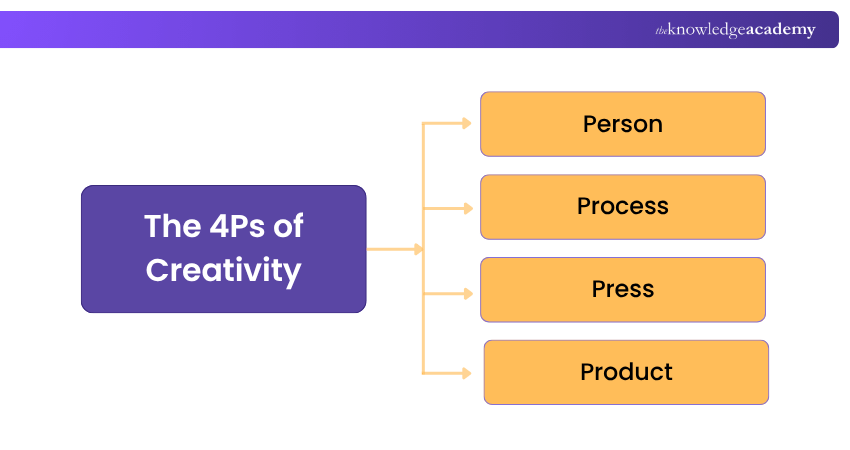
1) Person: The individual characteristics and traits that foster creativity.
2) Process: The methods and techniques used to generate and implement creative ideas.
3) Press: The environmental factors that influence creativity, such as organisational culture and external pressures.
4) Product: The tangible outcomes of the creative process, such as new products, services, or business models.
In an entrepreneurial context, the framework can help explain how individuals, creative processes, environmental conditions and creative outcomes interact when developing new ideas, products, services or business models.
Unlock your potential and build a better you by joining the Personal Development Courses today!

Naveena Venkatesan is a Content Editor with 2+ years of experience in content writing, editing and linguistic quality assurance. Her research, fact-checking and editorial experience enable her to develop accurate, accessible resources across Business Skills, Human Resources, and Accounting and Finance.
View Detail

 If you wish to make any changes to your course, please


