


 Top Rated Course

We may not have the course you’re looking for. If you enquire or give us a call on 01344203999 and speak to our training experts, we may still be able to help with your training requirements.
What is a t-Test? The Ultimate Guide to Group Comparison
William Brown 16 July 2026A t-Test is a statistical method used to compare group means, test hypotheses, and determine whether differences in data are statistically significant. It helps researchers analyse small sample sizes and make data-driven decisions. This test is widely used in academic research, business analytics, and scientific studies.

Training Outcomes Within Your Budget!
We ensure quality, budget-alignment, and timely delivery by our expert instructors.
Table of Contents

A t-Test is a powerful statistical method used to compare the means of two groups and determine whether the difference between them is statistically significant. It helps researchers and analysts understand whether observed variations are likely due to a real effect or simply random chance.Understanding when and how to use a t-Test correctly is essential for making accurate, data-driven decisions. From selecting the right type of t-Test to interpreting p-values and assumptions, clarity is key to meaningful group comparison. In this blog, we will explore what a t-Test is, how it works, its different types, and when to apply it effectively.
Table of Contents
1) What is a t-Test?
2) How Does a t-Test Work?
3) When Should You Use a t-Test?
4) Types of t-Tests
5) Choosing the Test Direction
6) t-Test Assumptions
7) How to Perform a t-Test?
8) Interpreting Test Results
9) Presenting the Results of a t-Test
10) Conclusion
What is a t-Test?
t-Test is a basic statistical methodology to measure the difference between the average (mean) of the numeric variable of up to two samples (dataset). It helps to answer the following question: Do the differences in group mean occur by chance, or does it represent a real effect?
t-Tests are particularly applicable in experiments or studies with limited data collection, unlike tests which need large sample sizes, t-Tests are most applicable when the sample sizes are relatively small (usually less than 30), which is not the case with tests. They assess the extent to which the observed difference is unexpected by contrasting it with the variability of the data.
t-Tests involve the t-distribution, which is a probability distribution, which resembles the normal distribution, yet wider in the tails, to compute a t-statistic and find statistical significance. This method was historically evolving with the aim of assisting the researcher to make inferences regarding a greater population as found on a few observations.

How Does a T-test Work?
A T-test works by comparing the means of two groups to see if they’re statistically different. To perform a T-test, we assume that our data follows a distribution and that the variances (the degree of spread in our data) are reasonably similar.
At its core, the T-test calculates a T-value, which is the ratio of the difference between the group means to the variability within the data. A high T-value suggests that the difference between groups is significant. In contrast, a low T-value indicates that any observed difference may be due to chance rather than a real effect.
When Should You Use a T-test?
Using a T-test is appropriate in specific scenarios. Here’s when to consider it:
1) Comparing Two Groups: T-tests are perfect when you need to compare the means of two groups, such as a control group and a treatment group.
2) Small Sample Sizes: If the size of your sample is relatively small (typically under 30 per group), a T-test is ideal as it accounts for more variability than other tests suited for larger datasets.
3) Normal Distribution: T-tests assume the data in each group follows a roughly normal distribution. If this assumption doesn’t hold, consider using a non-parametric test.
4) Equal Variance: For certain types of T-tests (like the equal variance T-test), the two groups should have similar variances. If not, an unequal variance (Welch’s) T-test may be more suitable.
If these conditions align with your data, a T-test can be a powerful tool. It helps decide whether the observed differences between your groups are likely meaningful or simply due to random chance.
Enhance your career with Mathematical Optimisation for Business Problems Training - Register today and start crunching numbers like a pro!
Types of T-tests
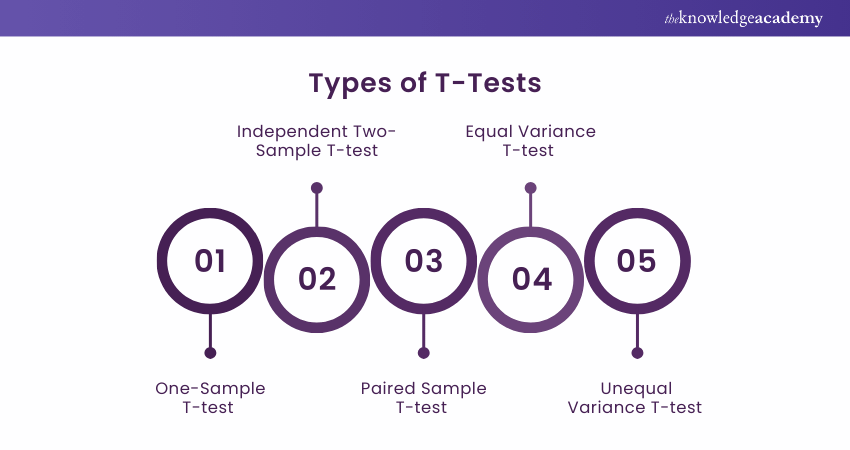
There are several types of T-tests, each tailored to different scenarios. Let’s explore the most common ones:
1) One-sample t-Test
The one-sample T-test compares the meaning of a single sample to a known value or population mean. For example, if you want to see if the average score of a class matches the national average, a one-sample T-test would work.
2) Independent Two-sample t-Test
It involves the comparison of the means of two independent groups using an unpaired T-test. A typical application can be given using the example, which may illustrate that an independent two-sample T-test can be used for two different classes which need to have their test scores compared.
3) Paired Sample T-test
A paired sample T-test, or dependent T-test, is ideal for comparing means within the same group at different times. This could be useful in a before-and-after scenario, like testing students’ performance on a pre-test and post-test to see if an intervention made a difference.
Choosing the Test Direction
The following are the two main types of test directions used in a t-Test, depending on your research hypothesis and expected outcome:
1) One-tailed Test
A one-tailed t-Test is used to verify a difference in a particular direction, used to test whether the means of one group are either higher or lower than those of the other depending on your hypothesis. Select this when you have a definite anticipation of the direction of the effect.
2) Two-tailed Test
A two-tailed t-Test looks for any difference between group means regardless of direction, testing whether they are simply different. It will work well when you do not have a clear forecast as to what group will be higher or lower.
t-Test Assumptions
To obtain appropriate and meaningful outcomes using a t-Test, specific statistical assumptions should be fulfilled. These guarantee the accuracy and reliability of the comparison of group means.
1) Normal distribution of Data: The values within any group must be normally distributed, especially when the groups are small. Although t-Tests are quite resistant to small deviations, heavily skewed data may influence accuracy.
2) Independence of Observations: Data points have to be independent. This implies that measurement of one subject or sample should not affect or correlate with another either within or between groups.
3) Equal Variances (some t-Tests): In an unpaired t-Test with equal variability, similar variability should be observed in both groups. If variances differ substantially, an alternative such as Welch’s t-Test is recommended.
The validation of these assumptions increases the validity of the conclusions based on a t-Test and helps interpret the statistics properly.
How to Perform a t-Test?
A t-Test is a scientific procedure whereby the differences between group means is tested to identify whether the difference is statistically significant or not. First, state your null hypothesis and your alternative hypothesis. The second step involves selecting the type of t-Test that would be suitable according to your study design; whether it is independent samples, paired samples, or one-sample test.
Once you have chosen the right test, compute the t-statistic with your sample data, and find the degrees of freedom, and compare the value with the critical value or p-value. Finally, interpret the outcome to decide whether to reject or fail to reject the null hypothesis.
T test Formula
The general formula for an independent samples t-Test is:

M₁ and M₂ represent the means of the two groups.
SE is used to indicate the standard error of the difference between the means.
The t-value is used to assess the distance between the difference observed and the zero variance. The greater the absolute t-value, the more the evidence that is against the null hypothesis.
Become a quality control expert! Learn SPC with our Statistical Process Control Training and set the standard for flawless processes - Join us today!
Interpreting Test Results
Here the following are the interpreting test results:
1) P-value:
a) Indicates the probability that the observed results are due to chance.
b) A p-value less than 0.05 typically suggests statistical significance (i.e., the result is unlikely to be due to random chance).
2) T-statistic:
a) Measures the difference between the group means relative to the variation in the data.
b) A larger absolute t-statistic indicates a more significant difference.
3) Degrees of Freedom:
a) Reflect the sample size and influence the shape of the t-distribution
b) The larger the Degrees of Freedom, the more reliable the result
4) Effect Size:
a) Measures the magnitude of the difference between groups, offering insight into the practical significance of the result.
b) Common effect size measures include Cohen's d.
5) Confidence Interval:
a) Provides a range of values within which the true mean difference is likely to fall
b) A confidence interval that does not cross zero suggests a significant difference
6) Contextual Interpretation:
a) Consider the practical significance of the findings.
b) Results should be interpreted in the context of the research question and broader implications.
Presenting the Results of a t-Test
When presenting t-Test results, it's crucial to include the t-statistic, degrees of freedom, and p-value. The t-statistic measures the magnitude of the difference between the groups, while the degrees of freedom reflect the sample size used in the analysis.
The p-value indicates whether the observed difference is statistically significant, with values below 0.05 typically signifying significance. Clear and concise reporting ensures the results are easily interpretable.
Beyond statistical values, it's important to provide context for the findings, such as the direction of the difference (e.g., one group is higher than the other) and the effect of size. The effect of size quantifies the strength of the difference, helping to understand its practical significance. Including visual aids, like graphs, can further illustrate the comparison. This comprehensive approach ensures that the results are accessible.
Conclusion
t-Tests are versatile and fundamental tools in statistics, enabling researchers across disciplines to make informed conclusions about their data. They work best with small samples but require assumptions for accuracy. While powerful, larger datasets may need alternative methods. From medicine to education, T Tests remain vital for informed decision-making.
Get organised and creative with Mind Mapping Training to help you bring ideas to life - Join us today!
Frequently Asked Questions
What is the Purpose of a T-test?

T-test tests whether the means of the two groups are significantly different. It essentially determines whether any observed difference could be due to random chance or if the effect is significant in the data.
What is the Maximum Sample Size for a T-test?
There is no strict maximum, but T-tests are most effective for small to moderate sample sizes (typically fewer than 30 per group). For larger samples, other statistical tests, such as ANOVA or Z-tests, may be more appropriate due to reduced variability effects.

William Brown


Senior Business Analyst and Strategic Advisor
William Brown is a senior business analyst with over 15 years of experience driving process improvement and strategic transformation in complex business environments. He specialises in analysing operations, gathering requirements and delivering insights that support effective decision making. William’s practical approach helps bridge the gap between business goals and technical solutions.
View Detail

 If you wish to make any changes to your course, please


