




We may not have the course you’re looking for. If you enquire or give us a call on 01344203999 and speak to our training experts, we may still be able to help with your training requirements.
Smart Contracts in Blockchain: A Complete Guide
ByGaurav KalitaLast updated on: 18 September 2026
Smart Contracts in Blockchain automate agreements using code, enabling secure, transparent, and fast transactions without intermediaries or any delays. They improve transparency, security and efficiency while reducing costs and delays. Understanding how they work helps streamline transactions and build trust in decentralised applications.

In 1994, visionary Cryptographer and legal scholar Nick Szabo envisioned a future where contracts weren’t just written on paper; they were encoded in digital form. Fast forward to today, and the Smart Contracts market is projected to soar to £12 billion by 2034, highlighting their increasing influence and significance.
Unlike traditional agreements, Smart Contracts are embedded in Blockchain Technology, executing actions automatically once specific conditions are met, often within a set timeframe. Ready to dive deeper? Let’s explore how Smart Contracts in Blockchain operate and unlock their full potential!
What are Smart Contracts in Blockchain?
Smart Contracts in Blockchain are self-executing digital agreements that automatically perform specific actions when predefined terms and conditions are met. Instead of relying on intermediaries such as banks, lawyers, or brokers, these contracts use computer code stored on a blockchain to verify, execute, and record transactions securely and transparently.
Much like a traditional contract is backed and enforced by legal systems, a Smart Contract is enforced by code. It performs exactly as it has been programmed, ensuring that the agreed-upon rules are followed consistently and transparently. They are widely used in industries such as finance, supply chain, healthcare, insurance, and real estate to automate processes, reduce costs, improve efficiency, and minimise the risk of human error.

How do Smart Contracts Work?
The workings of Smart Contracts on Blockchain can be understood through a few key principles:
a) Coded Logic and Agreement Terms: Smart Contracts contain coded logic that dictates the terms of an agreement. They activate when specific conditions are met, automatically executing the agreed-upon actions without manual intervention.
b) Time Constraints: Smart Contracts can include time constraints, triggering actions if conditions aren’t met within a set timeframe. This feature ensures agreements are honoured promptly and reliably.
c) Unique Address Assignment: Each Smart Contract is assigned a unique address on the Blockchain, allowing it to be accessed and linked by other users or contracts. This address is essential for seamless interaction within the Blockchain ecosystem.
d) Illustrative Example: For example, "If you send object X, you receive a set amount of Cryptocurrency." While the logic is simple, implementing Smart Contracts often requires technical expertise to ensure they function securely and correctly within the Blockchain.
Seize your dream opportunity with Investment Banking Training – Join Today!
Benefits of Smart Contracts
Smart Contracts offer a faster, more secure, and efficient way to execute agreements without relying on intermediaries. Here are the key benefits of Smart Contracts in Blockchain:
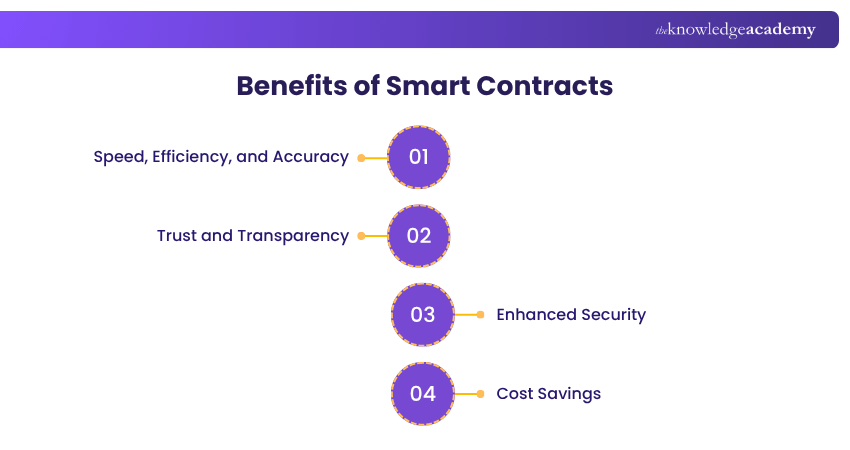
1) Speed, Efficiency, and Accuracy
Smart Contracts execute automatically as soon as the predefined conditions are met. Since the entire process is digital and automated, there is no need for paperwork, manual processing, or lengthy verification steps. This not only speeds up transactions but also minimises the risk of human errors that can occur when handling documents manually.
2) Trust and Transparency
Smart Contracts operate on Blockchain networks, where transaction records are securely shared among participants. Because there is no intermediary controlling the process and all transactions are transparently recorded, participants can trust that the agreed terms are being executed fairly and that the information has not been altered.
3) Enhanced Security
Blockchain technology uses advanced cryptographic techniques to secure transaction records, making them highly resistant to tampering and cyberattacks. Additionally, each transaction is linked to previous records on the Blockchain, ensuring data integrity and making unauthorised changes extremely difficult.
4) Cost Savings
By eliminating the need for intermediaries such as brokers, agents, or other third-party service providers, Smart Contracts help reduce transaction costs. They also save time by automating processes, resulting in faster execution and lower administrative expenses.
Limitations of Smart Contracts
Blockchain contracts have certain limitations that make it challenging for the parties involved. These limitations are described below:
a) Third-party Involvement: These Smart Contracts do not eliminate the involvement of third parties. They remain involved with Blockchain contracts in some other capacity. For instance, lawyers will not be required to prepare individual contracts. However, they will become associated with such contracts as developers will consult them to understand the contract's terms better to create better and more effective codes.
b) Handling Ambiguity: Another major limitation highlighted in the Blockchain Career Guide is the inability of Blockchain-based contracts to effectively handle terms and conditions. These contracts need to be more specific and clearly defined. However, it is not always possible for all parties to fully understand every term and condition. As a result, Blockchain contracts have often fallen short of being highly effective or useful.
Advance your financial knowledge with our comprehensive Bitcoin and Cryptocurrency Course- Explore now!
Use Cases of Smart Contracts
Smart Contracts are now being executed autonomously, without intermediaries. This development is bringing the framework into reality. The following are a few examples of Smart Contracts in Blockchain.
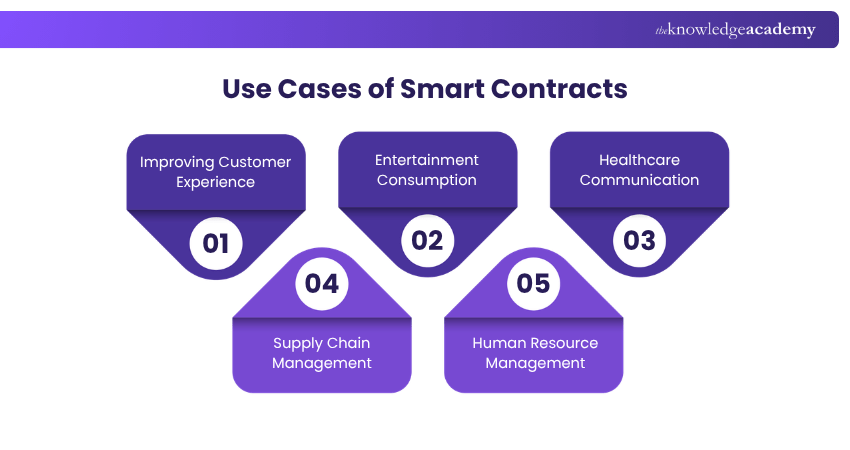
1) Improving Customer Experience
Smart Contracts can enhance business-to-customer relationships effectively. For example, a fitness clothing brand is partnered with an online music streaming app, where the person works out while listening to music. Based on their activity, the person will be receiving offers for new clothes and subscriptions to music.
2) Entertainment Consumption
In the entertainment sector, Blockchain can enhance the consumer connection in entertainment consumption with the chosen sections. For example, Non-fungible Tokens (NFTs), royalty payments and digital licensing are validated with virtual asset possession. The buying, selling or transferring of the NFTs (non-fungible tokens) can be integrated by a Smart Contract.
3) Healthcare Communication
Proper communication is required among the patients and insurance providers. Storing the patients’ data on the Blockchain will reduce the paperwork and healthcare providers will be able to send data directly to the providers. For example, if the patient requires medical interventions, requests through Smart Contracts will check the insurance coverage and release payment instantly.
4) Supply Chain Management
Blockchain vs Data Science plays a crucial role in optimising various industries, including Supply Chain Management. Enterprising Blockchain in Supply Chain Management enhances functions in several key areas. Smart Contracts enable seamless tracking of goods and materials, ensuring transparency. For instance, while navigating the international supply chain and calculating product taxes, most Blockchain software can efficiently trace a product’s origin.
5) Human Resource Management
With the distributed ledger technology, the functions of the Human Resource Manager can be automated. For example, while onboarding new Employees to the organisation, Smart Contracts in Blockchain can easily authenticate the employees’ details and impose duties and responsibilities.
Accelerate your career growth in the Crypto world with our Cryptocurrency Trading Training- sign up today!
What is an Example of a Smart Contract?
A simple example of a Smart Contract is an online sale between a customer and a business. Instead of relying on manual processing, the agreement is programmed into a Blockchain-based Smart Contract. When the customer completes the payment, the Smart Contract automatically verifies the transaction and triggers the next step, such as notifying the warehouse to prepare and ship the order.

Gaurav Kalita is a Content Writer with 2+ years of experience in content development, research and storytelling. His background in English literature and teaching, combined with his growing interest in AI and Machine Learning, supports his writing across Business Skills and IT and Tech.
View Detail

 If you wish to make any changes to your course, please


