




We may not have the course you’re looking for. If you enquire or give us a call on +65 6929 8747 and speak to our training experts, we may still be able to help with your training requirements.
What is Revenue Generation: Strategies, Factors, and Insights
ByThe Knowledge AcademyLast updated on: 22 September 2026
Revenue Generation is the strategic process of using marketing, sales, and product initiatives to generate income, support growth, and sustain operations. It focuses on identifying opportunities, optimising revenue streams, improving customer value, and ensuring long-term profitability in competitive markets.

Driving consistent income is not just about selling more, it’s about building the right strategies that fuel long-term success. Understanding What is Revenue Generation helps businesses move beyond short-term gains towards sustainable growth.
In this blog, we will explore proven revenue generation strategies, key influencing factors, and practical insights. And learn how your businesses can identify opportunities, optimise income streams, and strengthen profitability in competitive markets.
What is Revenue Generation?
Revenue Generation is the process through which a business earns income by selling its products, services, or other offerings. It involves developing strategies, marketing efforts, and operational activities for attracting customers and increasing sales.
Beyond just selling, it also focuses on maintaining customer relationships and creating long-term value. Additionally, businesses explore new income streams to enhance profitability and ensure sustainable growth in a competitive market.

Effective Revenue Generation Strategies
Altering an extensive Revenue Generation Strategy is crucial for businesses seeking to optimise their Revenue potential. Here are some key steps to consider:
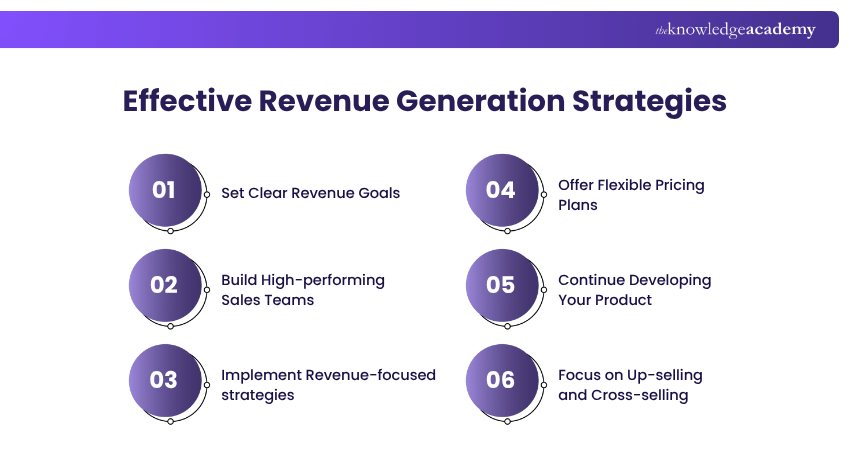
1) Set Clear Goals
To measure progress is the initial step of setting a goal to increase revenue. You can set a deadline for achieving the goal in a timeframe and determine the amount of revenue you want to generate. This helps to assess the strategy effectiveness, whether it is working or new ones must be applied.
2) Build a High-performing Outbound Sales Team
A high-performing outbound sales team helps in Generating Revenue by finding and closing deals with customers. If the business doesn't have a sales team, think about hiring one or externalising this task to a company proficient in sales. The organisation can also go with software such as Customer Relationship Management (CRM), which will help to find and close deals.
3) Implement Revenue-focused Marketing Strategies
A good marketing team is essential for creating strategies which will fascinate customers and entice them to buy services and your products. There are various marketing methods, such as social media and online advertising. To find the most suitable approach for your business, check various marketing methods.
The Three Main Types Include:
1) Content Marketing
2) Performance Marketing
3) Campaign Marketing
4) Offer Flexible Pricing Plans
Choosing the right pricing strategy matters a lot in the Generation of Revenue, as it will impact how much customers can pay for the service or your product. While determining your profit margins, the price is also a key factor in that. The various types of pricing strategies that can be used to Generate Revenue for the company are:
1) Subscription Based
2) Usage Based
3) Pay-as-you-go
5) Continuously Evolve Your Product
As the company grows, it’s essential to update and develop the service and your products so to meet the customer’s needs and satisfy them with your products. Always think about how to develop new services, expand your product line and add your new features. It shows the use of different strategies in your business to satisfy your customers.
6) Focus on Upselling and Cross-selling
Cross-selling services or products to your existing customers is much easier than selling them to new ones. When we sell multiple products to the same customers, this will help in generating more Revenue. Upselling is the process in which the company offer higher-priced products to the customers, which will help in generating more Revenue.
Factors to Consider for Revenue Generation
There are some important factors to consider when focusing on Revenue Generation which includes:
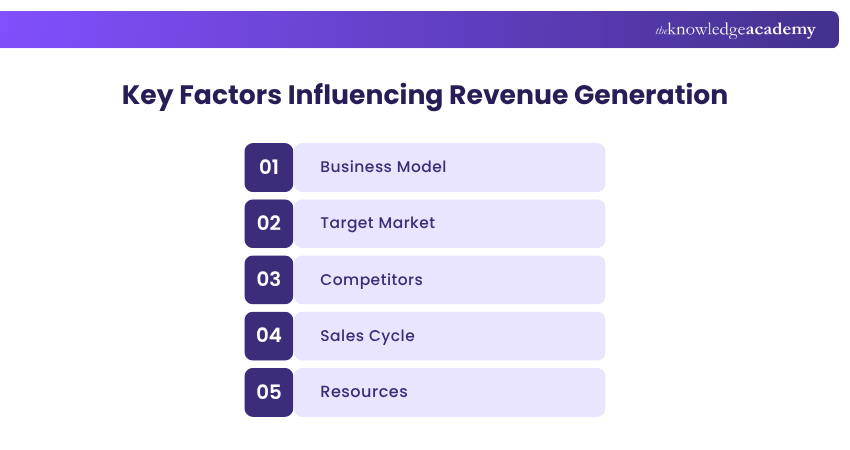
1) Business Model
This type of business model determines how to Generate Revenue. Let’s take an example of a B2B business in which the Revenue is generated by subscription fees, product sales and enterprise contracts. In B2C business, the revenue can be generated by e-commerce sales or from advertising offline or online.
2) Target Market
The Target Market stats of your company will help to tell us what type of service or product can sell to your customers and how to sell them. Deliver the products or services according to the needs of the targeted businesses and customers.
3) Competitors
By considering the strategies of the competitors we can plan accordingly what we can offer to the customers and how to price it for them. It’s as if the competitors are offering a lower price for the product, just matching their price or offering high quality product for the same price. Take advantage of your competitor's weaknesses.
4) Sales Cycle
The Sales Cycle of your business or the company determines the time taken to Generate Revenue from the customers. By understanding the Sales Cycle, the company can predict future Revenue. Take the example, when selling products the factors to keep in mind are the time to manufacture, shipment and the time to deliver them.
5) Resources
Your Resources are an essential thing in business to determine what type of activities the organisation can deal with. Like take an example that having a low budget, just target to generate instant Revenue from selling products and having a high budget can afford to Generate Revenue from time taking activities, such as brand familiarity and marketing.
Learn how to be a confident Portfolio Manager with Investment and Portfolio Management Course – Join today!
When to Focus on Revenue Generation?
Knowing What is Revenue Generation is not enough. Many times, in business or in companies there are situations when they must focus on Revenue Generation to maintain the cash flow and smooth working of all activities. Here are some key times that need to focus on Revenue Generation:
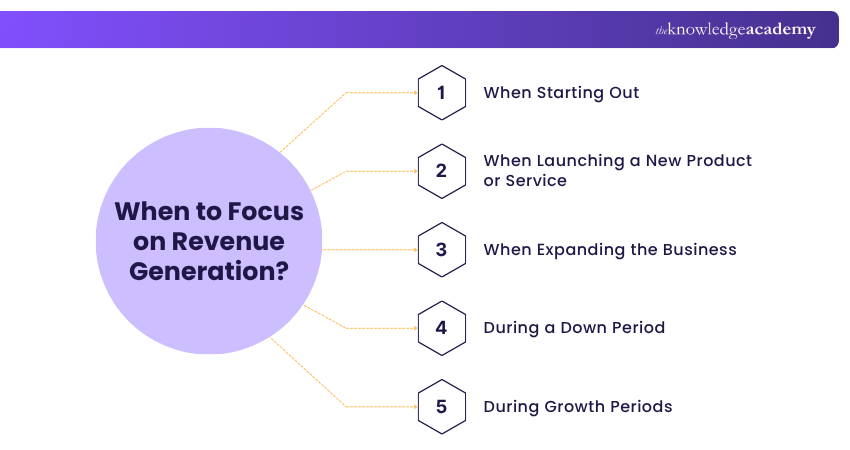
1) When Starting Out
It’s important to prioritise Revenue Generation when starting a new business to sustain it and attract customers and investors to grow the business. This will also help in getting funds for the business that can help to scale the business.
2) When Launching a New Product or Service
It’s essential to focus on Revenue Generation when the company is launching a New Product or Service because to out the cost of marketing and development. This can help to grow your product faster and make good profit margins from it.
3) When Expanding the Business
When focusing on the growth of the business, it is a necessary to increase your financial resources for expansion. So, focus on Revenue Generation, which will help in expanding into new markets and reaching new customers.
4) During a Down Period
The key aspect is to ensure a steady Cash Flow vs Profit to keep the business afloat, making it essential to focus on Revenue Generation during a Down Period. This approach also aids in effective expense management and helps prevent redundancies.
5) During Growth Periods
The key aspect is to ensure a steady Cash Flow vs Profit to keep the business afloat, making it essential to focus on Revenue Generation during a Down Period. This approach also aids in effective expense management and helps prevent redundancies.
Learn about revenue and investments by registering for Investment and Trading Training now!
Revenue Generation Models
Understanding What is Revenue Generation begins with knowing how businesses take profit from their products or services. Revenue generation models differ according to the industry, scale of business, type of offering, and many organisations combine multiple models to diversify revenue streams and reduce financial risk. The Key Revenue Generation models are:
1) Transactions-based Revenue Model
A transactions-based revenue model generates income whenever a customer makes a purchase. It is commonly used within B2B and B2C, in the case of one-time product sales, software licences and professional services. The revenue growth will rely on the constant demand and encouraging new buyers into the sales and marketing process.
Pros:
1) Complete authority of pricing and terms of transaction
2) Basic model applied in the majority of industries
Cons:
1) Needs to acquire customers on a regular basis
2) Revenue changes as the volume of sales changes
2) Subscription Revenue Model
The subscription revenue model involves imposing customers with recurring subject fees that often involve monthly or annual payments as a result of having unlimited access to some product or service. It is a well-liked practise in SaaS networks, digital media providers, as well as cloud-based platforms.
Pros:
1) Regular and consistent flow of revenue
2) Simpler growth planning and forecasting
Cons:
1) Expensive customer acquisition rates
2) Loss of revenue through the churning of customers
3) Pay-Per-Use Revenue Model
In a pay-per-use service, the customers are charged according to the quantity they consume or utilise the service. It is usually used in cloud computing, telecommunications and utilities, where the level of use displays various different usage. This strategy matches the pricing with the customer demands and with real consumption.
Pros:
1) Cost-efficient for customers
2) Revenue potential from high-usage users
Cons:
1) Unpredictable income patterns
2) Requires advanced usage tracking systems
4) Freemium / Hybrid Revenue Model
The freemium or hybrid revenue model provides essential features of its product without charge, but charges for the higher functionality or premium services. Mobile apps, online platforms, and digital tools have a wide application with the aim of gaining a huge user base and monetising it at a later stage.
Pros:
1) Low entry barrier increases user adoption
2) Supports upselling and long-term conversion
Cons:
1) High cost of maintaining free users
2) Low conversion rates to paid plans
5) Advertisement-based Revenue Model
This model makes money selling advertising space to businesses and brands. This is profitable in sites that have a large amount of traffic, like websites, social media networks, and mobile applications. Income will be determined by the number of viewers, the engagement levels, and the advertiser demands.
Pros:
1) Monetisation of high-traffic platforms in a short period
2) High demand for targeted advertising
Cons:
1) May have negative implications on user experience
2) Great dependency on the growth of traffic
6) Commission-based Revenue Model
Another key revenue model is the one based on commissions, which makes money by imposing a fee on transactions between buyers and sellers. Marketplaces, ride-sharing platforms, booking sites and service aggregators are widely utilising this model for Revenue Generation.
Pros:
1) The amount of revenue can be predicted per transaction
2) Platform activity scales
Cons:
1) Transaction-dependent revenue
2) Low ability to control supplier prices
7) Markup Revenue Model
Markup revenue model is a model associated with buying at a lower price and selling items at a higher price. It is typically employed in the retail, wholesale and service businesses where the profit margins are added to the base costs.
Pros:
1) Easy margin calculation and pricing control
2) Flexible pricing adjustments
Cons:
1) Possibility of overpricing or underpricing
2) Needs constant market research
7) Affiliate Revenue Model
The affiliate revenue model provides a business or other individuals with a chance to earn commissions by advertising third-party products. The customers are redirected to the platform of the provider, and a sale/ registration is made, which will bring the revenue.
Pros:
1) Minimal upfront investment
2) No inventory and fulfilment liability
Cons:
1) Low commission percentages
2) Needs high volumes of traffic
8. Interest Revenue Model
This model creates revenue from the interests of loans, investments or deposits. Banks, lending platforms and other financial institutions that handle high volumes of capital mainly utilise it.
Pros:
1) Consistency of returns at regularly determined intervals
2) Clear revenue structure
Cons:
1) Affected by the state of the economy
2) Regulatory and default risks
9. Donation-based or Pay-what-you-want Revenue Model
In this type of model, the user is not forced to pay anything, yet they can access free services or products. Open-source platforms, educational resources, and community-driven projects generally utilise it.
Pros:
1) Fosters much-needed adoption
2) Makes people have a high level of trust and loyalty
Cons:
1) Revenue is unpredictable
2) Rarely sustainable as a primary model
10) Arbitrage Revenue Model
The arbitrage revenue model makes profit by exploiting price differences across markets. It involves purchasing assets at a lower price and selling them at a higher price, often requiring fast execution and market awareness.
Pros:
1) High profit potential with low capital
2) Can scale quickly with expertise
Cons:
1) Requires constant monitoring
2) Sensitive to market volatility
Is a Profit Centre Responsible for Generating Revenue?
Yes, a profit centre is responsible for Revenue Generation. It has control over pricing and operations, allowing organisations to track performance and identify profitable business units.
Can a Company Have Profit but No Revenue?
A business cannot earn profit without revenue. Revenue is total income, while profit is what remains after expenses, such as rent or taxes. Without Revenue Generation, companies face losses, except when earning non-operational income, such as asset sales.
Analyse markets, manage portfolios, and maximise returns with our Investment Management Course – Join now!

The Knowledge Academy develops accessible learning content across Project Management, IT, Cybersecurity, Data Science, Business Analysis, HR, Accounting and Finance, Leadership and Health and Safety. Its resources combine subject research with clear explanations to help professionals build practical knowledge across a wide range of disciplines.
View Detail

 If you wish to make any changes to your course, please


