




We may not have the course you’re looking for. If you enquire or give us a call on 01344203999 and speak to our training experts, we may still be able to help with your training requirements.
RAG Status in Project Management: Definition and How to Choose
ByDavid EvansLast updated on: 14 August 2026
RAG Status in Project Management uses red, amber, and green colours to indicate project health: green (on track), amber (at risk), and red (off track). It's a visual reporting method that enables stakeholders to grasp project status at a glance, thus supporting timely decision-making and effective Risk Management.
In Project Management, clarity is everything and that’s where RAG Status steps in. Short for Red, Amber, Green, this simple framework transforms project data of any complexity level into clear, actionable insights. It helps teams instantly understand progress, risks and priorities without getting lost in details.
But choosing the right status isn’t always straightforward. In this blog, we’ll explore what RAG Status means, why it matters, and how to apply it effectively for more confident decision-making. So read on and transform the way your team tracks success!
Table of Contents
1) What is RAG Status in Project Management?
2) What do RAG Colours Represent?
3) How to Choose RAG Status in Project Reporting?
4) How to Implement RAG Status Reporting?
5) Benefits of Using RAG Status in Project Management
6) Limitations of RAG Status Reports
7) Conclusion
What is RAG Status in Project Management?
RAG Status in Project Management is a simple colour coded tool to address the health of a project. The acronym of RAG stands for Red, Amber, and Green. In some cases, other colours are added such as blue to indicate completed tasks or grey when the status cannot be determined. This visual method simplifies project performance assessment for Managers to stakeholders and responds accordingly.

What do RAG Colours Represent?
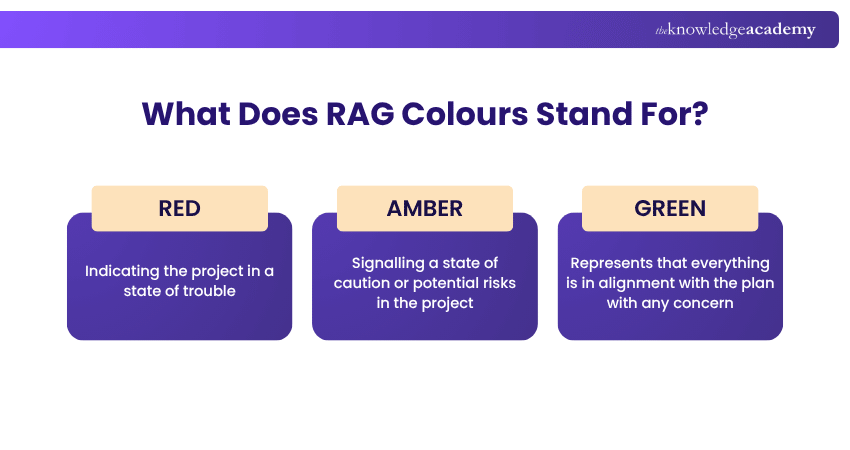
The appeal of the RAF system lies in its simplicity, with each colour representing the project state. By being able to interpret the colours, teams, Managers and stakeholders can understand progress, identify risk, and prioritise actions. Here’s a detailed look at what the colours signify:
1) Meaning of RED RAG Status
A Red RAG Status indicates a project is in a state of serious trouble. It could mean various problems, such as over-budget, staying behind schedule or facing major risks. It is addressing the need for urgent measures, like quick action, communicate clearly regarding the issues and recovery plan to keep the project on track.
2) Meaning of AMBER RAG Status
An Amber RAG Status stands for signalling caution in the project state. The reasons for caution can include reasons, such as delay, budgeting concerns, or potential risks. These types of issues are not majorly critical yet; they required monitoring and corrective action to mitigate problems early.
3) Meaning of GREEN RAG Status
A Green RAG Status represents that everything is in alignment with the plan. It means projects are on track in terms of schedule, budget, quality and scope. This means there are not risks involved to hinder the project. It provides team the signal of keeping momentum, monitor for changes, and ensure warning or issues are avoided.
Step into project leadership with the power of our Praxis Framework™ Practitioner Course - Register now!
How to Choose RAG Status in Project Reporting?
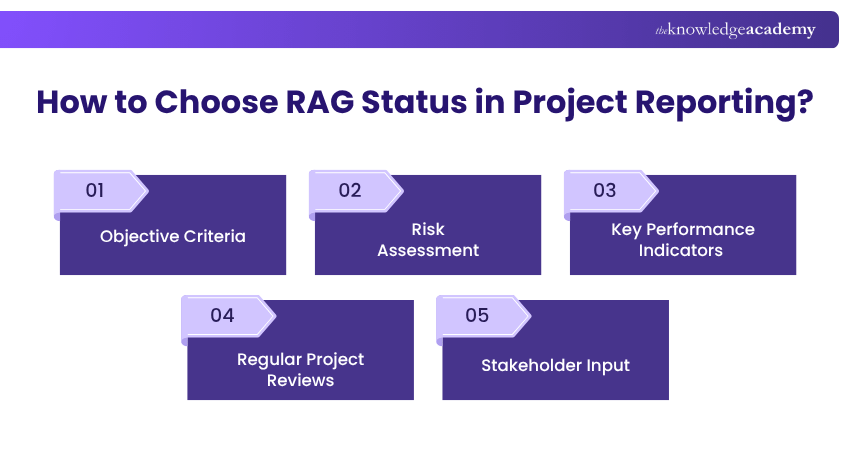
For selecting the suitable RAG Status, you must approach with a structured approach, combine objective criteria, risk assessment, and input of the stakeholders. By consistently applying clear benchmarks, Project Managers can ensure accuracy in project reporting. Below, we have mentioned the ways to choose RAG Status:
1) Objective Criteria
It involves defining measurable benchmarks for key project areas, such as schedule, budget, scope, quality, and risks. For instance, a project can be considered “Green” if it has met every objective or “Amber” could mean minor delays or budgeting constraints. These criteria should be customised to the project’s context and agreed upon by the stakeholders to keep clarity in reporting.
2) Risk Assessment
It is critical in determining the appropriate RAG Status for a project. By evaluating potential risk, Project Managers can assign the relevant status. For example, “Red” can be market for projects with high probability of risk, indicating need for immediate attention. This is to ensure RAG Status is not only mentioning current performance but helping to manage future risks proactively.
3) Key Performance Indicators
These are quantifiable metrics, such as resource utilisations, budget adherence etc., to provide objective data to address RAG assessment. For instance, a project with a 25-day delay will be marked “Amber.” By establishing and monitoring Key Performance Indicators, Project Managers can keep consistency and transparent RAG reporting.
4) Regular Project Reviews
Regularly conducting project reviews are essential for providing status. These reviews give a structure for assessing project performance against outlined benchmarks. By consistently carrying out evaluations, Project Managers can make certain the RAG Status is reflected with accuracy enabling informed decision-making.
5) Stakeholder Input
It is important to maintain accurate reporting. By engaging with key stakeholders, like sponsors or clients, it provides a diverse perspective and insight to enhance project assessment process. This feedback facilitates in identifying issues in advance, understand project context in detail.
How to Implement RAG Status Reporting?
The right way of implementing RAG Status reporting ensures projects are thoroughly monitored, risks are identified and addresses, and stakeholders are kept informed. This makes the RAG Status actionable and consistent across teams. Here we lay out the important implementation approaches for deeper understanding:
1) Define RAG Criteria:
It is crucial to specify what each colour (Red, Amber and Green) mean for your project. It can be used against measurable benchmarks, such as budget, schedule, scope, risks, and quality levels.
2) Integrate RAG Status into Reporting Tools:
It is essential to apply RAG Status definitions to dashboards, reports, statuses, and Project Management tools to keep tracking consistent and transparent for everyone.
3) Regular Reviews:
It is important to update the RAG Status frequently based on the performance of a particular project to maintain consistency in providing accuracy and relevance of the reviews.
4) Respond to Insights:
By utilising the RAG Status, it can help to indicate people across teams to prioritise certain areas, address issues, and keep the project aligned with budgets, schedule, quality, and scope.
Praxis equips you with integrated, practical, end‑to‑end capability in Project Management. Sign up for our Praxis Framework™ Foundation and Practitioner Course now!
Benefits of Using RAG Status in Project Management
By implementing RAG Status in Project Management, you can provide several advantages for teams in Project Management. Below, we have listed out some of the primary benefits of utilising RAG Status:
1) Clear Visual Communication:
RAG Status provides a color-coded overview of overall health of the project. This enables Project Managers and stakeholders to assess project at a simple glance.
2) Better Attention Targets:
By allocating RAG Statuses, it helps people across teams to spot areas that require immediate attention, allowing Project Managers to communicate potential risks proactively. At the same, this provides guidance where to allocate resources for efficiency.
3) Improves Communication with Stakeholder:
The utility of RAG Status helps to simplify complex project data. This facilitates communication smoothly with stakeholders, like investors, clients etc., Who may not be involved in the day-to-day operations of the project.
4) Efficient Decision-making:
With the highlighting of areas needing immediate focus, RAG Status helps to prioritise actions for mitigating risks in advance as well as to make informed decisions to keep projects in alignment with the set benchmarks.
5) Ensures Consistency:
By applying RAG Status, it maintains uniformity in the assessment across a project or multiple projects, assisting in managing portfolios and benchmarking criteria.
Limitations of RAG Status Reports
While RAG Status reporting is a simple and powerful tool in the arena of Project Management, it is also important to recognise its limitations. Below, a list of limitations is provided for your insight:
1) Over-simplification:
RAG Status can reduce complicated project scenarios to a single colour. This might seem valuable but it potential overlooks nuanced issues.
2) Delay in Identifying Issues:
The phase between conducting of reviews and reporting cycles can potentially delay the detection of problems that can emerge in the future.
3) Lack of Context:
RAG Status gives a bit of information regarding the status. It does not provide a comprehensive information about the underlying issues, requiring supplementary data for a thorough understanding.
4) Inability to Predict Future Issues:
RAG Status is meant for reflecting the present status of a project. It does not give the details of any challenges, most likely to occur in the future.
5) Overemphasis on Negative Aspects:
By focusing on the Red or Amber status might overshadow areas where the project is progressing in its performance. This can potentially lead to inaccurate understanding of the project.
Conclusion
RAG Status in Project Management is a simple and powerful tool for assessing project health, identifying risks, and making informed decisions. With the understanding of each colour, and combining it with stakeholder inputs, Project Managers can improve accuracy, select priority actions, and keep projects in alignment with set benchmarks.
Unify your project skills under one powerful framework. Step into the Praxis way of working in our Praxis Framework™ Training - Sign up now!

David Evans creates accessible resources that help professionals understand different approaches to planning and delivering projects. His content addresses changing requirements, collaborative working and the practical demands of contemporary project environments.
View Detail

 If you wish to make any changes to your course, please


