


 Top Rated Course

We may not have the course you’re looking for. If you enquire or give us a call on 01344203999 and speak to our training experts, we may still be able to help with your training requirements.
NLP Dissociation Techniques: A Quick Guide
Charlotte Wilson 05 March 2026Explore the transformative power of NLP Dissociation Techniques in our blog. Learn how NLP Dissociation Techniques can help you disconnect from negative emotions and rewire your mindset for personal growth and empowerment. Discover practical tips and insights to master this powerful tool for self-improvement and emotional well-being.

Training Outcomes Within Your Budget!
We ensure quality, budget-alignment, and timely delivery by our expert instructors.
Table of Contents
NLP (Neuro-Linguistic Programming) Dissociation techniques are powerful tools used to help individuals separate themselves from negative emotions, traumatic memories, or limiting beliefs. By dissociating from these unwanted states, individuals can gain a new perspective and take control of their emotional well-being. In this blog, we will explore NLP Dissociation Techniques and provide a quick guide on how to apply these techniques effectively.
Table of Contents
1) Understanding Dissociation in NLP
2) Benefits of NLP Dissociation Techniques
3) Step-by-step guide to NLP Dissociation Techniques
4) Practical applications of NLP Dissociation Techniques
5) Tips for effective implementation of NLP Dissociation Techniques
6) Potential limitations and precautions
7) Conclusion
Understanding Dissociation in NLP
Dissociation, in the context of NLP, refers to the ability to mentally separate oneself from an experience or state of mind. It involves detaching from the associated emotions, thoughts, and sensations, creating a sense of distance and objectivity. Dissociation allows individuals to observe their experiences from a different perspective, enabling them to break free from negative patterns and unhelpful behaviour patterns.
Benefits of NLP Dissociation Techniques
NLP Techniques offer several benefits for personal growth and development. Some of the key benefits that NLP Dissociation Techniques offer include:
1) Emotional freedom: Dissociating from negative emotions allows individuals to gain emotional freedom and regain control over their reactions and responses. This aligns with the Importance of Negotiation Skills in managing emotional responses during negotiations.
2) Trauma resolution: Dissociation techniques can help individuals process traumatic memories in a safe and empowering way, facilitating healing and resolution.
3) Enhanced decision making: By detaching from limiting beliefs and emotional biases, Dissociation techniques enable clearer and more rational decision-making processes.
4) Stress and anxiety reduction: Dissociation can provide relief from stress and anxiety by creating a mental space that is separate from the triggers and sources of distress.
Step-by-step guide to NLP Dissociation Techniques
This section of the blog will expand on a step-by-step guide to applying NLP Dissociation Techniques.
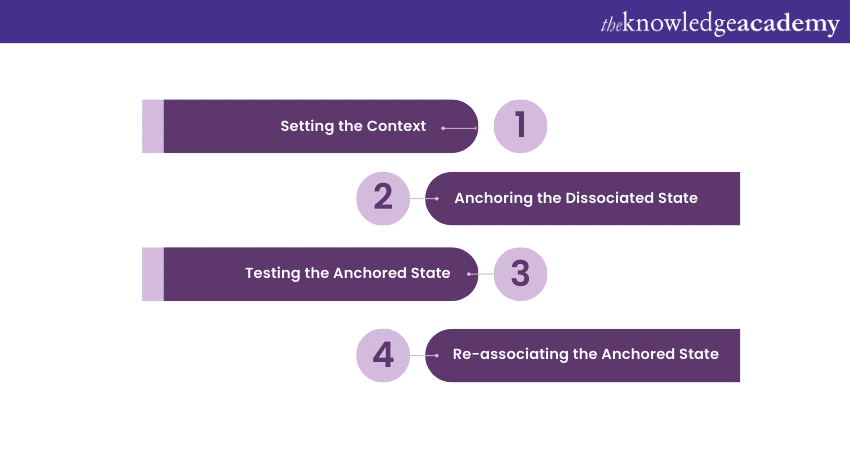
Step 1: Setting the context
Begin by creating a calm and relaxed environment where you can focus on the dissociation process. Find a quiet space where you won't be disturbed and ensure you are in a comfortable position.
Step 2: Anchoring the dissociated state
Close your eyes and bring to mind the unwanted emotion, memory, or belief that you wish to dissociate from. As you immerse yourself in that experience, imagine stepping outside of yourself, observing it from a distance. Visualise yourself as a detached observer, watching the situation unfold without any emotional attachment, this technique can be further refined with NLP Calibration.
Step 3: Testing the anchored state
Once you feel sufficiently dissociated, test the effectiveness of the technique by briefly re-associating with the emotion or memory. Step back into the experience for a moment, notice any changes in your perception, and then quickly dissociate again.
Step 4: Re-associating the anchored state
After testing, fully re-associate with your present surroundings, leaving the dissociated state behind. Open your eyes, take a few deep breaths, and consciously shift your focus to the present moment.
Ready to dive deeper into NLP? Take the next step and explore our NLP Introduction Course to expand your knowledge and skills in Neuro-Linguistic Programming!
Practical applications of NLP Dissociation Techniques
NLP Dissociation Techniques have practical applications that can benefit people in various aspects of their lives. Here are some specific practical applications:
1) Overcoming phobias and fears: NLP Dissociation Techniques an approach as part of broader NLP Strategy can help individuals overcome phobias and fears by creating distance from the associated emotions and thoughts, allowing for a new perspective and reduced intensity.
2) Managing stress and anxiety: Dissociation techniques provide a tool for managing stress and anxiety by creating a mental space that offers relief and promotes a calmer state of mind.
3) Enhancing performance: In sports, public speaking, and other performance-based activities, Dissociation techniques can enhance performance by dissociating from performance-related anxiety and self-doubt. This can be further understood through studying NLP Learning Styles.
4) Breaking free from limiting beliefs and negative thoughts: Dissociation techniques help individuals break free from limiting beliefs and negative thought patterns, creating space for more empowering beliefs and personal growth.
5) Enhancing creativity and problem-solving: By dissociating from preconceived notions and mental blocks, Dissociation techniques enhance creativity and problem-solving abilities, leading to innovative thinking and unique solutions.
Tips for effective implementation of NLP Dissociation Techniques
To maximise the effectiveness of Dissociation NLP techniques, keep the following tips in mind:
1) Practice regularly: Like any skill, dissociation techniques improve with practice. Set aside dedicated time for regular practice sessions to reinforce the neural pathways associated with dissociation.
2) Start with small steps: If you're new to NLP dissociation, begin with less intense emotions or memories. Gradually work your way up to more challenging experiences as you become comfortable with the process.
3) Seek professional guidance: If you're dealing with complex trauma or intense emotional challenges, consider seeking guidance from a qualified NLP practitioner or therapist. They can provide personalised support and ensure the techniques are applied safely.
Potential limitations and precautions
While NLP Dissociation Techniques can be highly effective, it's essential to acknowledge Cause and Effect in NLP and understand their limitations and exercise caution:
1) Individual variations: The effectiveness of Dissociation techniques may vary from person to person. What works for one individual may not have the same impact on another.
2) Emotional processing: Dissociation should not replace the process of emotional processing and healing. It is important to address underlying emotions and seek appropriate support when necessary.
3) Self-awareness: Engage in dissociation techniques responsibly and ensure you are in a stable emotional state before attempting the process.
Unleash your full potential with our Neuro-Linguistic Programming Course– join now and embark on a transformative journey!
Conclusion
Frequently Asked Questions

Charlotte Wilson


Soft Skills and Business Training Manager
Charlotte Wilson is an expert in soft skills development, with over 14 years of experience helping individuals and teams improve communication, productivity and emotional intelligence in the workplace. Her training content is focused on enhancing interpersonal effectiveness and fostering positive, collaborative environments across all levels of an organisation.
View Detail
Upcoming Business Skills Resources Batches & Dates
Date
 Neuro Linguistic Programming
Neuro Linguistic Programming
Fri 27th Mar 2026
Neuro Linguistic Programming
Fri 19th Jun 2026
Neuro Linguistic Programming
Fri 18th Sep 2026
Neuro Linguistic Programming
Fri 11th Dec 2026

 If you wish to make any changes to your course, please


