




We may not have the course you’re looking for. If you enquire or give us a call on 01344203999 and speak to our training experts, we may still be able to help with your training requirements.
Leadership vs Management: A Detailed Comparison
ByVidhya NairLast updated on: 10 October 2026
This blog explores the difference between Leadership and Management, and how both skills can be developed to help organisations get the best of both.

A team is preparing to launch an important project. The deadline is approaching, tasks are falling behind and team members are beginning to lose confidence. What does the situation need?
One response is to manage the problem by reorganising tasks, allocating resources and tracking deadlines. But it may also call for leadership, rebuilding confidence, clarifying the bigger purpose and motivating people towards the goal.
So, is one approach better than the other?
Not necessarily. Understanding the Leadership vs Management differences is about knowing where they overlap and when each approach is most valuable. This blog explores that in detail.
KEY INSIGHT
The key difference has been eloquently summed up by Peter Drucker, who's regarded as the father of modern Management: “Management is doing things right; leadership is doing the right things”
What is Leadership?
Leadership is the process of influencing, guiding and motivating people towards shared goals or a desired direction. It is not limited to formal job titles. Individuals can demonstrate leadership by building trust, providing direction and helping others work towards common objectives.
Key Responsibilities of Leaders
Leaders carry numerous responsibilities depending on the organisation. Yet, there are a few responsibilities that remain constant for every business. Here are some of those key responsibilities:
a) Setting Direction: Leaders establish and communicate a clear direction that helps people understand where the team or organisation is heading.
b) Motivating People: They encourage people to contribute towards shared objectives and maintain commitment during challenges.
c) Empowering Others: Leaders delegate responsibility, encourage ownership and create opportunities for people to contribute ideas.
d) Communicating: They communicate purpose, expectations and direction while listening to the perspectives of others.
e) Decision-making: Leaders make decisions that help move teams or organisations towards their objectives.

KEY INSIGHT
Noted Author and Pastor John Calvin Maxwell sums up the essence of Leadership beautifully with his quote, “A leader is one who knows the way, goes the way, and shows the way”
Traits of Effective Leaders
Some useful leadership qualities include:
a) Communication: Clearly expressing ideas, expectations and direction.
b) Emotional Intelligence: Recognising and managing emotions while understanding others.
c) Integrity: Acting consistently with appropriate ethical principles and building trust.
d) Adaptability: Adjusting to changing circumstances and challenges.
e) Courage: Making difficult decisions and addressing uncertainty.
f) Collaboration: Building relationships and encouraging people to work together.
g) Innovation: Encouraging new ideas and approaches where appropriate.
What is Management?
Management is about achieving goals by coordinating and controlling various responsibilities. Managers work strategically to determine the company’s direction and manage employee actions to ensure goals are met by maximising available resources.
Becoming an effective Manager requires developing planning, communication, organisation, and leadership skills. It also requires a thorough understanding of the organisation's goals and the activities required to achieve them, such as workforce management and sales.
Key Responsibilities of Managers
Like leaders, Managers also carry significant responsibilities, which might vary across organisations. Below, we have described some of their typical responsibilities:
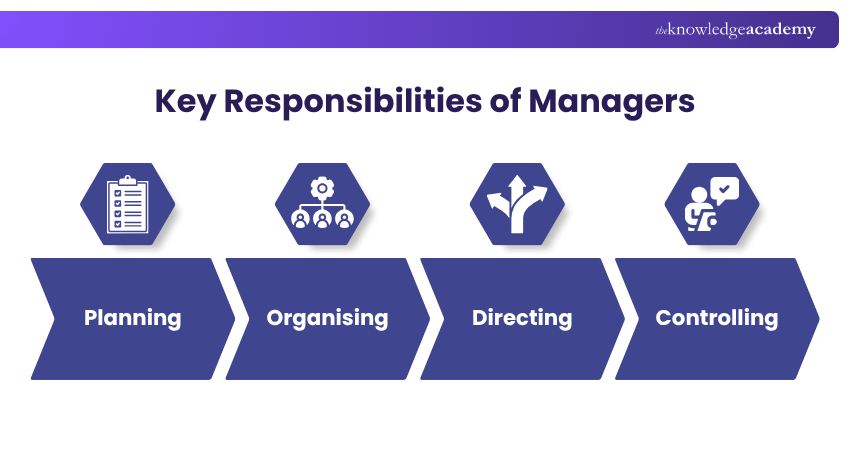
a) Planning: Managers engage in strategic and operational planning, establishing a path to achieving both long- and short-term goals. This involves outlining tasks, allocating resources, and establishing timelines.
b) Organising: Efficient organisation involves structuring tasks, roles, and responsibilities to optimise productivity. To achieve this, Managers strategise to assign roles, delegate responsibilities, and establish a unified workflow.
c) Directing: Managers provide guidance, instructions, and direction to their teams. They ensure their team members understand their roles and responsibilities and that their work is aligned with the organisation's objectives.
d) Controlling: They track progress, evaluate performance, set milestones, and measure outcomes. Following this, they take corrective action when necessary to ensure goals are met.
Give your management skills the boost it needs with our range of Management Courses – Sign up today!
Traits of Effective Managers
Common qualities that can support effective management include:
a) Organisational Skills: Structuring priorities, resources and responsibilities effectively.
b) Problem-solving: Identifying problems and developing practical solutions.
c) Decision-making: Evaluating information and selecting appropriate courses of action.
d) Communication: Clearly explaining responsibilities, expectations and feedback.
e) Adaptability: Responding effectively to changing priorities and circumstances.
f) Empathy: Understanding the perspectives and needs of team members.
g) Conflict Resolution: Addressing disagreements constructively and helping teams maintain progress.
Leadership vs Management: What’s the Difference?
The primary distinction between leadership and management is their focus: Leaders inspire and guide with a clear vision for the future. In contrast, Managers focus on executing tasks and maintaining organisational stability. Let's explore the other differences between Leadership vs Management in detail below:
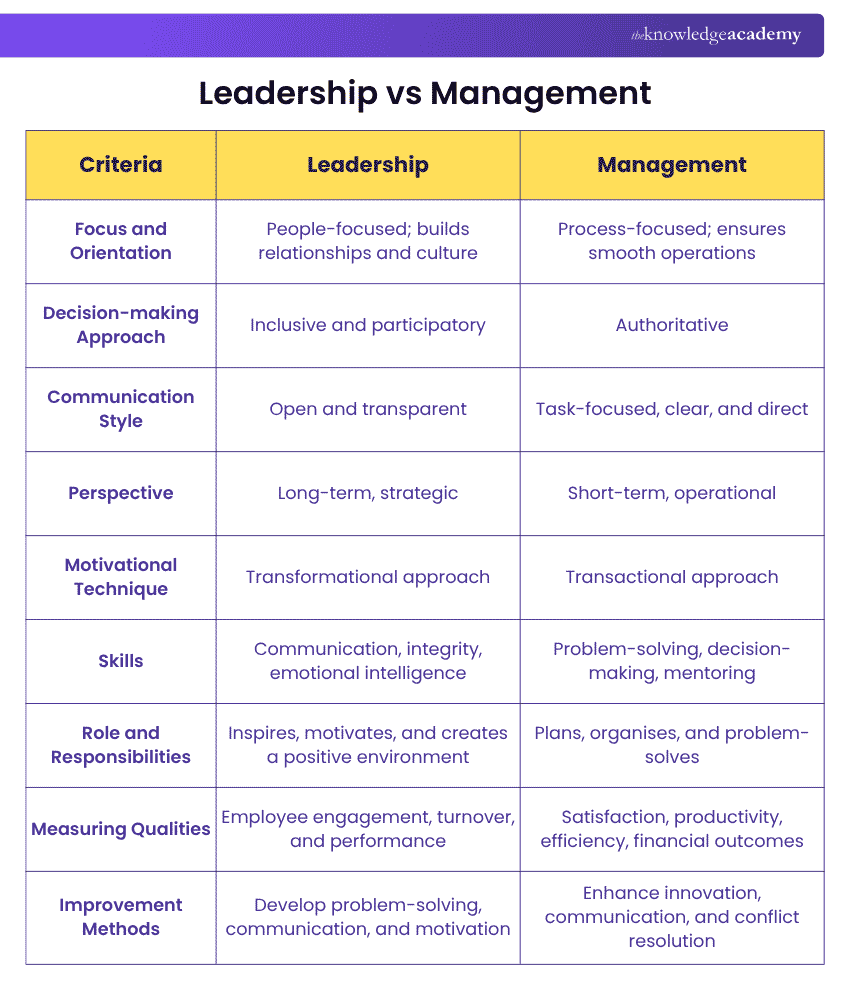
1) Focus and Orientation
Leadership is people-focused, placing greater emphasis on building relationships and organisational culture. In contrast, management is process-focused, concentrating on coordinating activities and supporting smooth operations.
2) Decision-making Approach
Leadership is presented as taking a more inclusive and participatory approach, involving others in decisions. On the other hand, management is presented as more authoritative, with Managers making decisions based on their responsibilities and organisational requirements.
3) Communication Style
Leadership uses open and transparent communication to engage and influence people. Management tends to use clear, direct and task-focused communication to communicate responsibilities, expectations and progress.
4) Perspective
Leadership typically takes a long-term, strategic perspective, focusing on future direction and broader goals. Management takes a more short-term, operational perspective, concentrating on implementation and immediate objectives.
5) Motivational Technique
Leadership is associated with a transformational approach, encouraging and inspiring people towards shared goals. Management is associated with a transactional approach, using expectations, rewards and performance measures to support results.
Build the mindset to inspire lasting team excellence with our range of Leadership Courses – Sign up now!
6) Skills
Leadership emphasises skills such as communication, integrity and emotional intelligence, which help influence and engage people. Management emphasises problem-solving, decision-making and mentoring to coordinate work and address operational needs.
7) Roles and Responsibilities
Leadership is about inspiring and motivating people while creating a positive environment. Management focuses on planning, organising and solving problems to ensure activities are completed effectively.
8) Measuring Qualities
Leadership effectiveness can be considered through areas such as employee engagement, turnover and performance. Management can be considered through measures such as satisfaction, productivity, efficiency and financial outcomes.
9) Improvement Methods
Leadership development can focus on strengthening problem-solving, communication and motivation. Management development can involve improving innovation, communication and conflict resolution.
Trainer Insight:
Strong results do not automatically prove effective leadership or management. Use multiple indicators and consider external factors before attributing organisational performance to a particular Leader or Manager.
How to Develop Leadership and Management Skills?
Leadership and management are two different but complementary skills essential for any organisation. Both skills are important and can collaborate to produce beneficial results. Here are some tips for developing these skills:
1) Identify Your Strengths and Weaknesses: Use self-assessments, feedback and professional guidance to identify your strengths and areas for improvement.
2) Learn From Different Sources: Explore books, articles, blogs, podcasts and videos, or develop your knowledge through courses and certifications.
3) Seek Out Mentors and Coaches: Connect with experienced Leaders or Managers for advice, guidance and support. You can also join relevant professional communities.
4) Practise Your Skills: Take on additional responsibilities, lead projects or teams, initiate improvements or volunteer with organisations to gain practical experience.
5) Seek Feedback and Improve: Ask for constructive feedback and use self-reflection tools such as journals or logs to monitor progress and identify areas for development.
30-Day Leadership and Management Challenge
Week 1 – AssessIdentify one leadership strength and one management skill you want to improve.↓Week 2 – PractiseApply those skills during meetings, projects or everyday team activities.↓Week 3 – Seek FeedbackAsk colleagues or mentors for specific feedback on your approach.↓Week 4 – ReviewEvaluate your progress and identify your next development goal.
Lead your team through consistent success with our Successful People Management and Team Leadership Training – Sign up today!
Leadership vs Management: Which is More Important?
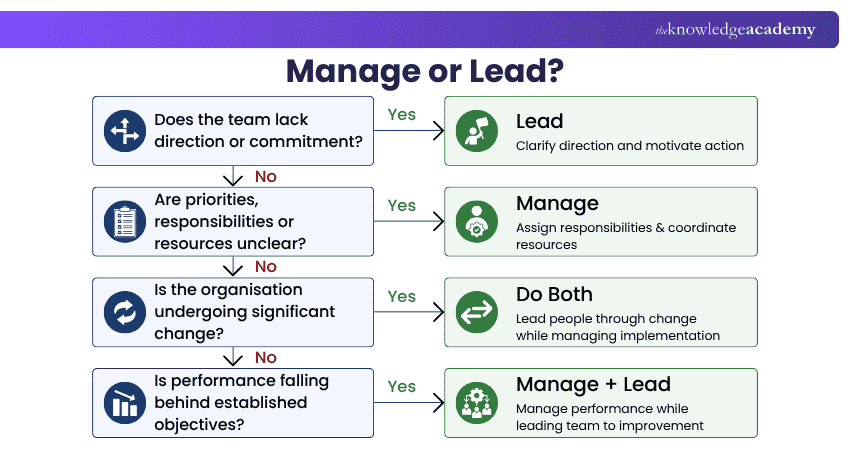
Neither Leadership nor Management is universally more important. Their relative importance depends on the organisation, role and situation. Leadership can be particularly valuable when an organisation needs direction, commitment or change.
Management becomes critical when plans need to be organised, resources coordinated and performance monitored. In practice, organisations often need both. Vision without effective execution may fail to produce results, while efficient execution without clear direction may lead teams towards the wrong priorities.
Before deciding between Leadership vs Management, consider this:
Lay the foundation for effective team leadership through our Introduction to Supervising a Team Course - Join now!

Vidhya Nair is a Senior Copywriter with 7+ years of experience across copywriting, content writing and communication. Her extensive research and editorial experience supports her ability to present topics across Business Skills and Human Resources with clarity and purpose.
View Detail

 If you wish to make any changes to your course, please


