


 Top Rated Course

We may not have the course you’re looking for. If you enquire or give us a call on 01344203999 and speak to our training experts, we may still be able to help with your training requirements.
Kanban vs Agile: Key Differences Explained
The Knowledge Academy 30 December 2025Learn the key differences between Kanban vs Agile, including workflows and methodologies, to choose the best Project Management approach for your team. Agile focuses on flexibility, collaboration, customer feedback, and continuous improvement. Kanban is a visual workflow helping teams to manage and optimise workflow.

Training Outcomes Within Your Budget!
We ensure quality, budget-alignment, and timely delivery by our expert instructors.
Table of Contents
Teams are always searching for smarter ways to deliver value quickly while staying adaptable in a changing environment. This is where the comparison between Kanban vs Agile becomes especially relevant. Although both approaches aim to boost efficiency and improve outcomes, they take distinctly different paths. Agile emphasises iteration and collaboration, while Kanban uses visual workflows to optimise task flow.
According to the 17th Yearly State of Agile Report, 71% of organisations report using Agile methodologies in their Software Development Lifecycle (SDLC). With such widespread adoption, exploring how Kanban fits alongside Agile offers valuable insights. In this blog, you will explore Kanban vs Agile, their key differences, and more. Keep reading to learn more!
Table of Contents
1) What is Kanban?
2) What is Agile?
3) Key Differences Between Kanban and Agile
4) Can Kanban and Agile Work Together?
5) What is the Golden Rule of Agile?
6) Conclusion
What is Kanban?
Kanban is a visual management system that helps teams track progress by focusing on workflows. It uses a simple visual board to make work visible and highlight bottlenecks. Limiting work in progress and encouraging continuous movements helps teams improve efficiency and delivery speed.
A Kanban board includes columns, such as “To Do,” “Doing,” and “Completed.” It is popular amongst Software Development teams; Kanban is also recognised as Lean Development. It is utilised across managing marketing activities, HR processes like hiring, and other business workflows.

What is Agile?
Agile is a broad philosophy that begins by identifying a problem and breaking it down into smaller, manageable parts that teams can address. It enables teams to adapt their approach as business requirements evolve. This makes Agile useful in environments where change is frequent, and customer feedback is valuable.
Also, Agile is a mindset built around clear principles, values, and collaborative practices. It encourages iterative development, regular communication, and continuous improvement through tools, such as stand-up meetings. It is supported by a strong community helping Agile teams deliver value faster while staying flexible to customer requirements.
Acquire the skills to work on an Agile project by signing up for the Agile Project Management Foundation (AgilePM® V3) Course now!
Key Differences Between Kanban and Agile
In this section, we will explore the differences between Kanban vs Agile. Below are the key points of comparison between the Agile and Kanban methodologies:
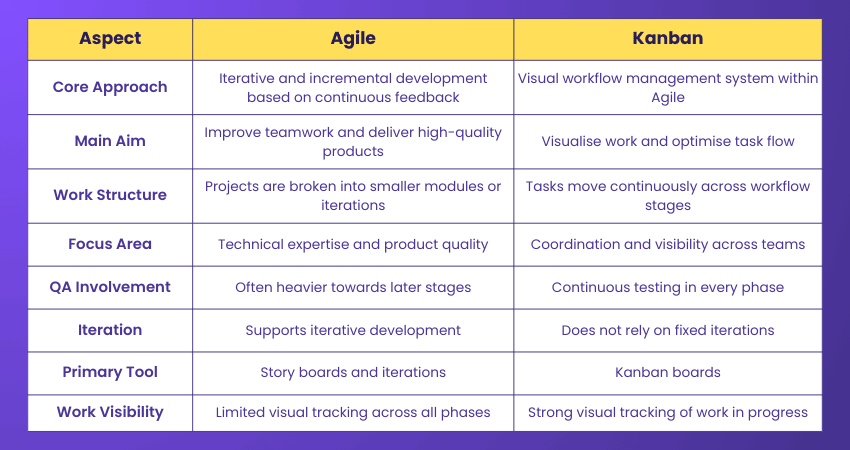
1) Core Approach
Agile delivers work in short, iterative cycles with continuous customer feedback. On the other hand, Kanban manages work through visual workflows, using a pull system to reduce bottlenecks.
2) Main Aim
Agile focuses on teamwork, adaptability, and delivering high-quality products. On the other hand, Kanban aims to optimise task flow by limiting work in progress and improving efficiency.
3) Work Structure
Agile breaks projects into time-boxed iterations that deliver incremental value. On the other hand, Kanban follows a continuous flow where tasks move as capacity becomes available.
4) Focus Area
Agile prioritises product quality and collaboration. On the other hand, Kanban emphasises workflow visibility and coordination across teams.
5) QA Involvement
Agile concentrates testing toward the end of each iteration. On the other hand, Kanban integrates testing continuously throughout the workflow.
6) Iteration
Agile relies on fixed-length sprints for delivery and review. On the other hand, Kanban works without fixed iterations, allowing greater flexibility.
7) Primary Tool
Agile uses storyboards and sprint-based planning tools. On the other hand, Kanban relies on Kanban boards to track task movement visually.
8) Work Visibility
Agile provides visibility mainly within iterations. On the other hand, Kanban offers full, real-time visibility of work in progress.
Advance your Kanban skills and improve workflow efficiency with Certified Kanban Practitioner Training – Register today!
Can Kanban and Agile Work Together?
Yes, Kanban and Agile can work together very well. Agile provides the mindset of flexibility, continuous delivery, and improvement. Kanban, on the other hand, offers practical tools, such as visual boards and work-in-progress limits. Together, they are valuable in helping teams visualise work, identify bottlenecks, and deliver value efficiently.
Improve productivity by streamlining processes with our Agile Training – Join today!
What is the Golden Rule of Agile?
One of the golden rules of Agile is to focus on delivering value to the customer. Agile encourages teams to prioritise working solutions over extensive documentation, respond to change rather than following rigid plans, and deliver in incremental sizes. Gathering feedback and improving regarding real business needs, ensure the product remains useful and relevant.
Conclusion
Choosing between Kanban vs Agile is about understanding how each approach supports different ways of working. Agile provides a flexible mindset based on collaboration, customer feedback, and iterative development. Kanban offers a clear visual system to manage workflow and improve efficiency. Recognising the strengths of both will help teams adopt the approach that best fits their goals and improve work efficiency.
Learn workflow optimisation skills with Kanban Training – Join today!
Frequently Asked Questions
What are the main differences between Kanban and Agile?

Kanban and Agile are both iterative Project Management methods but differ in focus and execution. Kanban improves workflow and processes with no fixed role. Agile delivers work in iterations and defined roles, such as Scrum Master or Product Owner.
How do you choose between Kanban and Agile for your project?
The choice depends on your project’s nature, scope, complexity, uncertainty, change, team skills, and customer feedback. Generally, Kanban suits projects with incremental changes, stable workflows, and low coordination. Agile suits projects with larger-scale changes, dynamic workflows, and high collaboration.
What are the other resources provided by The Knowledge Academy?
The Knowledge Academy takes global learning to new heights, offering over 3,000+ online courses across 490+ locations in 190+ countries. This expansive reach ensures accessibility and convenience for learners worldwide.
Alongside our diverse Online Course Catalogue, encompassing 19 major categories, we go the extra mile by providing a plethora of free educational Online Resources like Blogs, eBooks, Interview Questions and Videos. Tailoring learning experiences further, professionals can unlock greater value through a wide range of special discounts, seasonal deals, and Exclusive Offers.
What is Knowledge Pass, and how does it work?
The Knowledge Academy’s Knowledge Pass, a prepaid voucher, adds another layer of flexibility, allowing course bookings over a 12-month period. Join us on a journey where education knows no bounds.
What are related Business Improvement Courses and blogs provided by The Knowledge Academy?
The Knowledge Academy offers various Kanban Courses, including Certified Kanban Foundation and Practitioner Training, Certified Kanban Practitioner Training, and Agile Project Management Foundation Course. These courses cater to different skill levels, providing comprehensive insights into Kanban Software.
Our Business Improvement Blogs cover a range of topics related to Kanban, offering valuable resources, best practices, and industry insights. Whether you are a beginner or looking to advance your Business Improvement skills, The Knowledge Academy's diverse courses and informative blogs have you covered.

The Knowledge Academy


Global Training Provider
The Knowledge Academy is a world-leading provider of professional training courses, offering globally recognised qualifications across a wide range of subjects. With expert trainers, up-to-date course material, and flexible learning options, we aim to empower professionals and organisations to achieve their goals through continuous learning.

Upcoming Business Improvement Resources Batches & Dates
Date
 Certified Kanban Foundation and Practitioner Training
Certified Kanban Foundation and Practitioner Training
Wed 25th Mar 2026
Certified Kanban Foundation and Practitioner Training
Wed 17th Jun 2026
Certified Kanban Foundation and Practitioner Training
Wed 2nd Sep 2026
Certified Kanban Foundation and Practitioner Training
Wed 9th Dec 2026

 If you wish to make any changes to your course, please


