




We may not have the course you’re looking for. If you enquire or give us a call on + 1-866 272 8822 and speak to our training experts, we may still be able to help with your training requirements.
What is Investment Management: Definition, Strategy and Benefits
ByShristi RoyLast updated on: 22 September 2026
Investment Management oversees assets like stocks, bonds, and real estate, creating strategies and portfolios to balance risk and achieve financial goals. It involves analysing market trends, economic data, and client objectives. Typically, it serves individuals, institutions, and organisations seeking efficient financial outcomes.

You’ve saved some money, but now what? Stocks? Bonds? Or real estate? It will be exciting and a bit intimidating. You’ve taken the first step by building savings, but turning that money into lasting wealth? That will be a whole new game for you.
The truth is that wealth isn’t built by chance. Instead, it is built by choice. Investment Management is the framework that transforms your savings into a strategy. It helps you make deliberate, informed decisions about where your money goes and what it does for you. In this blog, you can explore What is Investment Management, the strategies involved, and how it can help you take control of your financial future. Let’s get started!
What is Investment Management?
Investment Management is the professional process of handling financial assets such as stocks, bonds, real estate, and mutual funds, with the goal of achieving specific financial objectives. It involves creating and maintaining an investment portfolio, assessing risk tolerance, monitoring market trends, and making strategic decisions to optimise returns.
Both individuals and institutions use Investment Management to grow wealth, preserve capital, or generate income. This service can be offered by Financial Advisors, Asset Managers, or investment firms, depending on the client’s needs.

Key Tasks of Investment Management
Investment Management involves a range of tasks that ensure effective management and growth of clients' assets. These tasks encompass strategic planning, Portfolio Management, market analysis, and client communication, all aimed at optimising returns while managing risks.
Here are three Key tasks of Investment Management:
a) Goal Setting and Risk Assessment
The investment journey begins with precise goal setting and identifying financial objectives like retirement, home purchase, or education. Equally crucial is assessing risk tolerance and balancing risk and reward. High-risk tolerance may lead to aggressive strategies, while risk-averse investors prefer conservative approaches, guiding their investment decisions accordingly.
b) Monitor Potential Investments
Investments range from cash deposits and government bonds to shares in emerging companies with uncertain prospects. An Investment Management firm must evaluate the potential and carefully assess the risks and returns of each option, a task handled by the investment analyst.
c) Create Investment Strategies
Every client requires a tailored investment portfolio that aligns with their goals. A diversified portfolio which has been spread across various assets will help minimise risk. The investment firms may manage investment funds for multiple investors, engage in private equity, or handle essential functions like business development, marketing, IT, pricing, and accounting.
History of Investment Management
Let’s take a brief look at the evolution of Investment Management from ancient practices to today’s technology-driven strategies:
1) Early Beginnings
Investment Management can be traced back to ancient civilisations such as Mesopotamia, Greece, and Rome, where people pooled resources for trade and commercial ventures. These early practices often involved profit-sharing and basic Risk Management.

Later, merchants facilitated international trade and provided early forms of financial advice and asset handling. This laid the foundation for more formal investment systems.
2) 17th to 19th Century
The 17th century marked a turning point with the emergence of joint-stock companies such as the Dutch and British East India Company. These entities are allowed to invest capital in return for shares, and models of collective ownership and risk-sharing.
Following that, the financial markets emerged, and banks began offering investment services, paving the way for modern Portfolio Management and institutional investing.
3) 20th Century
The early 20th century saw the rise of professional investment firms, including the establishment of Wellington Management Company in 1928. However, the crash of the stock market of 1929 and the Great Depression highlighted the need for stricter oversight.
This led to the creation of the Securities and Exchange Commission in 1934. The post-war period introduced diversification to optimise returns relative to risk.
4) Late 20th Century to Present
Technological innovation became a defining feature of the late 20th century. The advent of computers, the internet, and algorithmic trading transformed how investments were managed and executed. Online trading platforms made market participation faster and more accessible.
Entering the 21st century, robo-advisors emerged as automated, algorithm-based platforms offering low-cost investment advice which is tailored to individual goals and risk profiles.
Start your journey to smarter investing with our Investment and Portfolio Management Course – Register today!
Investment Management Strategies
Now that you have an idea of What is Investment Management , let’s check the most common strategies for effective Investment Management:

1) Diversification
Diversification is an essential principle of Investment Management. It distributes investments across various asset classes, industries, and regions. This approach reduces the impact of poor performance in any single investment, as gains in some assets can offset losses in others, leading to more stable, long-term returns.
2) Asset Allocation
Asset allocation involves determining the proportion of an investment portfolio to allocate across various Asset Classes, such as stocks, bonds, real estate, and cash. This strategy is guided by risk tolerance, investment goals, and market conditions, ensuring the portfolio aligns with the investor's objectives.
3) Active vs Passive Management
Investors must choose between active and passive management strategies. Active management involves professionals selecting securities to outperform the market, while passive management aims to replicate market index performance using index funds or Exchange-Traded Funds (ETFs). The choice depends on the investor's risk tolerance, time commitment, and belief in achieving market outperformance.
4) Long-term Perspective
A long-term perspective in Investment Management focuses on sustained growth over time rather than short-term market fluctuations. It involves holding investments for years, allowing compounding returns and market recovery to work in the investor's favour, ultimately supporting wealth accumulation and financial stability.
5) Risk Management
Every investment carries some level of risk. Effective Investment Management involves assessing an Investor's risk tolerance and aligning their portfolio accordingly. Strategies to manage risk can include the following:
a) Using protective options strategies
b) Investing in less volatile assets
b) Setting stop-loss orders to limit potential losses
Elevate your business success with our comprehensive Revenue Management Training – Unlock profitable opportunities today!
Advantages and Disadvantages of Investment Management
Here are the advantages and disadvantages of Investment Management:
Advantages of Investment Management
Professional Analysis and Expertise:
Investment Managers bring years of experience, financial knowledge, and analytical skills to lead investment decisions. An understanding of markets, industries, and economic cycles can help optimise performance and avoid common mistakes.
Full-time Diligence:
Managers monitor portfolios continuously, ensuring investments remain aligned with a client’s financial goals and risk tolerance. They also assess value risks and adjust allocations proactively to respond to market conditions.
Market Timing and Outperformance Potential:
With access to in-depth market research, economic data, and company fundamentals, you can aim to outperform benchmarks or time in the market effectively.
Portfolio Protection During Downturns:
A key duty of Investment Management is to act in the best interests of clients. You can use strategies like diversification, rebalancing, and hedging to help protect portfolios during periods of volatility or financial uncertainty.
Access to Broader Investment Opportunities:
Professionals can offer entry into investment vehicles such as private equity, commodities, and international market areas that may be difficult for individual investors to access alone.
Disadvantages of Investment Management
1) High Fees: Management costs can reduce overall returns, especially with smaller portfolios.
2) Market Risk: No guarantee of profits since the performance still depends on market conditions.
3) Passive Competition: Low-cost robo-advisors and index funds challenge traditional firms.
4) Limited Investor Involvement: Heavy reliance on managers may reduce financial awareness and control.
5) Inconsistent Returns: Not all managers consistently outperform market benchmarks.
Take the first step toward a successful finance activity with our Investment Banking Training – Join now!
Types of Investment Management Firms
Investment Management firms come in various types, each catering to different client needs and investment strategies. These firms vary in size, specialisation, and services, ranging from global giants to niche experts.
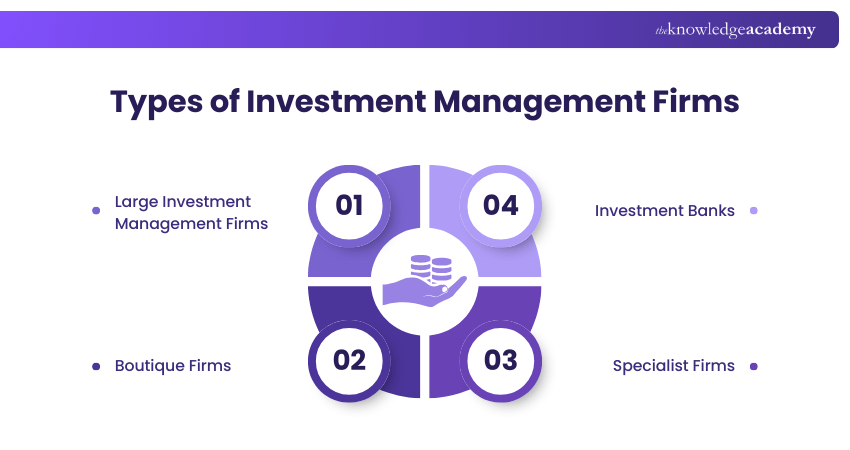
a) Large Investment Management Firms: These firms manage assets worth trillions, offering a wide range of investment options and benefiting from economies of scale.
b) Boutique Firms: Smaller in size, boutique firms emphasise personalised service and quality, often focusing on delivering tailored investment strategies with a personal touch.
c) Specialist Firms: These firms concentrate on specific investment areas, such as private equity, real estate, or art. Larger firms may employ them for their specialised expertise.
d) Investment Banks: Major investment banks like Goldman Sachs have extensive Asset Management divisions, providing comprehensive investment services to institutional and high-net-worth clients.
Unlock the secrets of successful stock trading! Register for our Stock Trading Course today and start building your wealth!
How Do Investment Management Firms Make Money?
Investment Management firms make money primarily by charging fees for managing client’s assets. The most common model is the Assets Under Management (AUM) fee, where firms take a percentage, typically 0.5% to 2% of the total portfolio value annually. Some firms also earn through performance-based fees, receiving a portion of the profits if certain benchmarks are exceeded.
Additionally, they may charge flat advisory fees, commission on trades, or fees for specific services like financial planning. In some cases, firms earn through in-house investment products, where they profit from Fund Management fees. These revenue models allow firms to generate steady income while aligning incentives with client portfolio growth.
What is the Role of an Investment Manager?
An Investment Manager helps people or businesses grow their money by making smart investment decisions. They choose where to invest their money, like in stocks, bonds, or property, based on the client’s goals and how much risk they’re comfortable with.
They continuously check the market, adjust the investments when needed, and make sure everything stays on track. They also give advice and updates to keep clients informed about their financial progress. In short, an Investment Manager’s job is to help clients grow their money safely and wisely over time.

Shristi Roy is a Content Writer with experience in journalism, article writing and web content development. Her experience researching and writing about Business Skills and Accounting and Finance enables her to communicate specialised information through clear, engaging narratives.
View Detail

 If you wish to make any changes to your course, please


